Department of Anesthesiology and Pain Medicine, Presbyterian Medical Center, Jeonju, Korea.
Korean J Anesthesiol. 2021 Feb;74(1):53-58. doi: 10.4097/kja.20152. Epub 2020 Jun 5.
Interscalene brachial plexus block (ISBPB) is commonly used with general anesthesia for postoperative pain management in shoulder surgery. This study investigated the incidence of hypothermia and changes in the body temperature in patients undergoing arthroscopic shoulder surgery under ISBPB with propofol sedation.
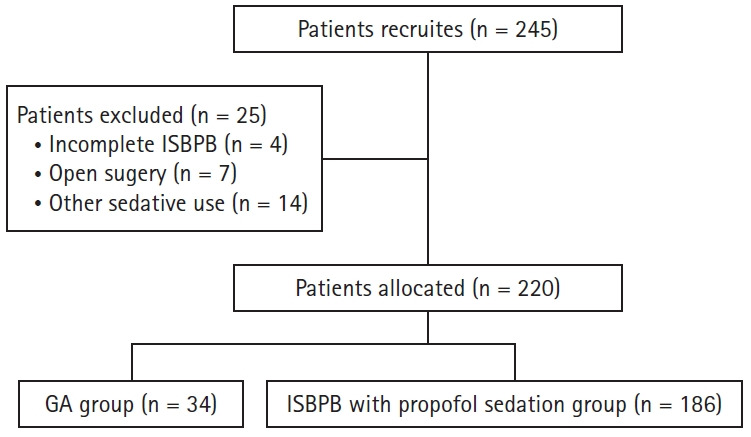
This retrospective study enrolled 220 patients who underwent arthroscopic shoulder surgery. Patients were divided into general anesthesia (n = 34) and ISBPB with propofol sedation (n = 186) groups, and medical records were retrospectively compared. In addition, patients from the ISBPB group were further divided according to age (elderly, [≥ 65 years]; n = 98 vs. young, [< 65 years]; n = 88), and the incidence of hypothermia and changes in the body temperature were compared.
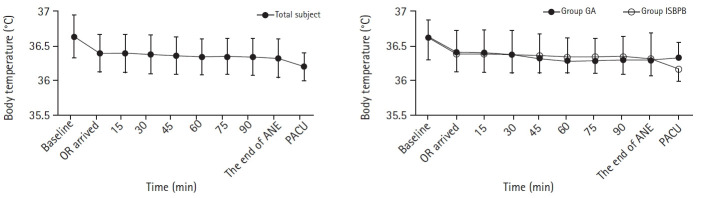
Twenty-seven patients (12.3%) experienced perioperative hypothermia (range; 35.3-35.9℃). The incidence of perioperative hypothermia was 29.4% and 9.1% in the general anesthesia and ISBPB groups, respectively, and there was a significant difference between the two groups (P = 0.002). The incidence of perioperative hypothermia according to age in the ISBPB group was 9.2% and 9.1% in the elderly and young groups, respectively, and there was no significant difference between the two groups (P = 0.983).
The incidence of perioperative hypothermia during arthroscopic shoulder surgery under ISBPB with propofol sedation is lower than that under general anesthesia. Furthermore, when using ISBPB with propofol sedation, the incidence of perioperative hypothermia in elderly patients is similar to that in younger patients.
经锁骨上臂丛阻滞(ISBPB)联合全身麻醉常用于肩部手术后的术后疼痛管理。本研究旨在调查接受异丙酚镇静下 ISBPB 的关节镜肩关节手术患者的低体温发生率和体温变化。
本回顾性研究纳入 220 例行关节镜肩关节手术的患者。患者分为全身麻醉组(n = 34)和 ISBPB 联合异丙酚镇静组(n = 186),并对病历进行回顾性比较。此外,ISBPB 组患者根据年龄(老年组,[≥ 65 岁];n = 98 例与年轻组,[< 65 岁];n = 88 例)进一步分组,并比较低体温的发生率和体温变化。
27 例(12.3%)患者发生围手术期低体温(范围:35.3-35.9℃)。全身麻醉组和 ISBPB 组围手术期低体温发生率分别为 29.4%和 9.1%,两组间差异有统计学意义(P = 0.002)。ISBPB 组中,老年组和年轻组围手术期低体温发生率分别为 9.2%和 9.1%,两组间差异无统计学意义(P = 0.983)。
接受异丙酚镇静下 ISBPB 的关节镜肩关节手术患者的围手术期低体温发生率低于全身麻醉组。此外,在使用 ISBPB 联合异丙酚镇静时,老年患者围手术期低体温的发生率与年轻患者相似。