Department of Anaesthesiology and Pain medicine, Konyang University Hospital, Konyang University College of Medicine, Daejeon, Korea.
Department of Anaesthesiology and Pain medicine, Konyang University Hospital, Myunggok Medical Research Center, Konyang University College of Medicine, Daejeon, Korea.
Int J Med Sci. 2021 Mar 21;18(10):2197-2203. doi: 10.7150/ijms.55023. eCollection 2021.
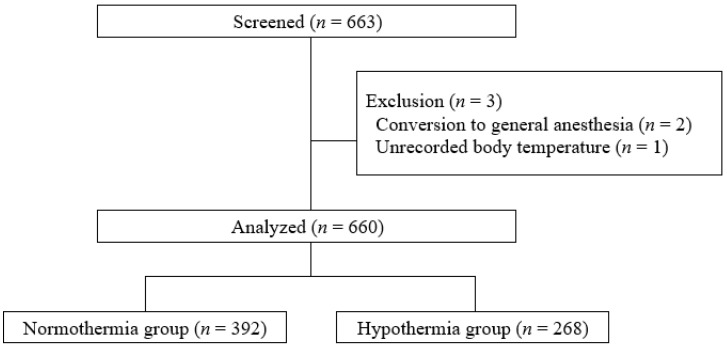
Postoperative hypothermia increases patient mortality and morbidity. However, the incidence of, and risk factors for, postoperative hypothermia in patients undergoing surgery under brachial plexus block (BPB) as the primary method of anesthesia remain unclear. This study aimed to determine the incidence of, and risk factors for, postoperative hypothermia in patients undergoing surgery under BPB. We retrospectively analyzed 660 patients aged ≥ 19 years who underwent orthopedic surgery under BPB in our hospital between October 2014 and October 2019. Postoperative hypothermia was defined as a tympanic membrane temperature < 36 °C when the patient arrived in the post-anesthesia care unit. Multivariate logistic regression analysis was performed to identify the independent risk factors for postoperative hypothermia. Postoperative hypothermia was observed in 40.6% (268/660) of patients. Independent risk factors for postoperative hypothermia were lower baseline core temperature before anesthesia (odds ratio [OR] 0.355; 95% confidence interval [CI] 0.185-0.682), alcohol abuse (OR 2.658; 95% CI 1.105-6.398), arthroscopic shoulder surgery (OR 2.007; 95% CI 1.428-2.820), use of fentanyl (OR 1.486; 95% CI 1.059-2.087), combined use of midazolam and dexmedetomidine (OR 1.816; 95% CI 1.268-2.599), a larger volume of intravenous fluid (OR 1.001; 95% CI 1.000-1.002), and longer duration of surgery (OR 1.010; 95% CI 1.004-1.017). Postoperative hypothermia is common in adult patients undergoing orthopedic surgery under BPB. The risk factors identified in this study should be considered to avoid postoperative hypothermia in these patients.
术后低体温会增加患者的死亡率和发病率。然而,接受臂丛神经阻滞(BPB)作为主要麻醉方法的手术患者术后低体温的发生率和危险因素尚不清楚。本研究旨在确定接受 BPB 麻醉的手术患者术后低体温的发生率和危险因素。我们回顾性分析了 2014 年 10 月至 2019 年 10 月在我院接受 BPB 下骨科手术的 660 例年龄≥19 岁的患者。术后低体温定义为患者到达麻醉后恢复室时鼓膜温度<36°C。采用多变量 logistic 回归分析确定术后低体温的独立危险因素。660 例患者中,40.6%(268/660)发生术后低体温。术后低体温的独立危险因素包括麻醉前基础核心体温较低(比值比[OR]0.355;95%置信区间[CI]0.185-0.682)、酗酒(OR 2.658;95%CI 1.105-6.398)、关节镜肩关节手术(OR 2.007;95%CI 1.428-2.820)、芬太尼的使用(OR 1.486;95%CI 1.059-2.087)、咪达唑仑和右美托咪定联合使用(OR 1.816;95%CI 1.268-2.599)、静脉输液量较大(OR 1.001;95%CI 1.000-1.002)和手术时间较长(OR 1.010;95%CI 1.004-1.017)。接受 BPB 麻醉的骨科手术成年患者术后低体温较为常见。本研究确定的危险因素应考虑避免这些患者术后低体温。