The Leslie Dan Faculty of Pharmacy and the Institute for Health Policy, Management, and Evaluation - Faculty of Medicine, At the University of Toronto, Canada.
The Leslie Dan Faculty of Pharmacy, University of Toronto, Canada.
Res Social Adm Pharm. 2021 Jan;17(1):1867-1875. doi: 10.1016/j.sapharm.2020.05.027. Epub 2020 May 30.
As a result of the COVID-19 pandemic, there has been a significant disruption of the practice of pharmacy. Importantly, in many parts of the world, this disruption occurred literally overnight, requiring pharmacists to demonstrate significant adaptability and resiliency in order to manage continuing and in some cases expanding needs of patients.
The objective of this research was to characterize how community pharmacy in Ontario (Canada) responded to the COVID-19 pandemic of winter/spring 2020, in particular in understanding what factors may influence or predict resiliency of individual practitioners and their workplaces.
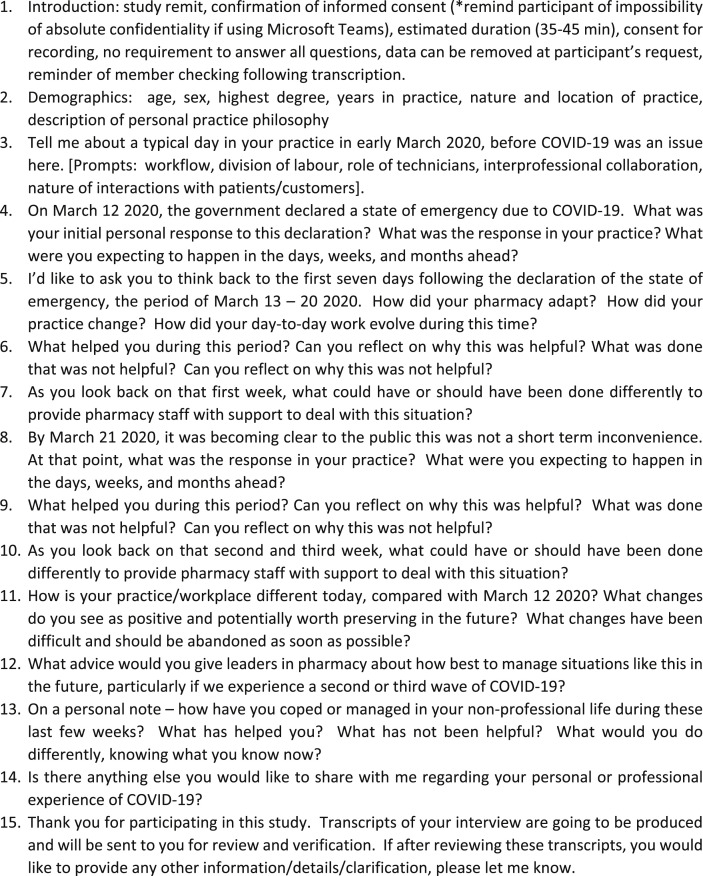
One-on-one interviews mediated through technology (Microsoft Teams) were used, following a semi-structured interview protocol. Verbatim transcripts were produced and analyzed by two independent researchers, using an inductive coding process to identify and characterize themes.
A total of 21 pharmacists participated in this study. Six themes were identified: a) use of and comfort with technology; b) early adoption of corporate and professional guidance; c) workplaces that emphasized task-focus rather than multi-tasking were more resilient; d) scheduling methods and practices in the workplace are important for personal resilience; e) dedicated specialty staff allowed pharmacists to focus on their work; and f) provision of personal protective equipment was essential.
Traditionally, resilience in professional practice has been characterized as a personal, not a workplace, issue. This study suggests that personal resiliency for pharmacists requires substantial workplace support; further work in this area is required to better understand how pharmacists adapt to complex and difficult situations such as pandemics.
由于 COVID-19 大流行,药房的实践受到了重大干扰。重要的是,在世界上许多地方,这种干扰几乎是一夜之间发生的,这要求药剂师表现出很强的适应能力和恢复力,以满足患者持续存在的、在某些情况下不断扩大的需求。
本研究的目的是描述安大略省(加拿大)的社区药房如何应对 2020 年冬季/春季的 COVID-19 大流行,特别是了解哪些因素可能影响或预测个体从业者及其工作场所的恢复力。
采用通过技术(Microsoft Teams)进行的一对一访谈,遵循半结构化访谈方案。对逐字记录进行分析,由两名独立研究人员使用归纳编码过程来识别和描述主题。
共有 21 名药剂师参加了这项研究。确定了六个主题:a)对技术的使用和舒适度;b)对企业和专业指导的早期采用;c)强调任务重点而不是多任务处理的工作场所更具弹性;d)工作场所的日程安排方法和实践对个人弹性很重要;e)专门的专业人员允许药剂师专注于工作;f)提供个人防护设备至关重要。
传统上,专业实践中的恢复力被认为是个人问题,而不是工作场所问题。这项研究表明,药剂师的个人恢复力需要大量的工作场所支持;需要进一步开展这方面的工作,以更好地了解药剂师如何适应复杂和困难的情况,如大流行。