Department of Respiratory & Critical Care Medicine, West China Hospital, Sichuan University, Chengdu, China.
Department of Respiratory & Critical Care Medicine, West China Hospital, Sichuan University, Chengdu, China
BMJ Open. 2020 Jun 3;10(6):e035031. doi: 10.1136/bmjopen-2019-035031.
To explore the relationship between the pretreatment or post-treatment neutrophil to lymphocyte ratio (NLR) and overall survival (OS)/progression-free survival (PFS) in patients with lung cancer receiving immunotherapy.
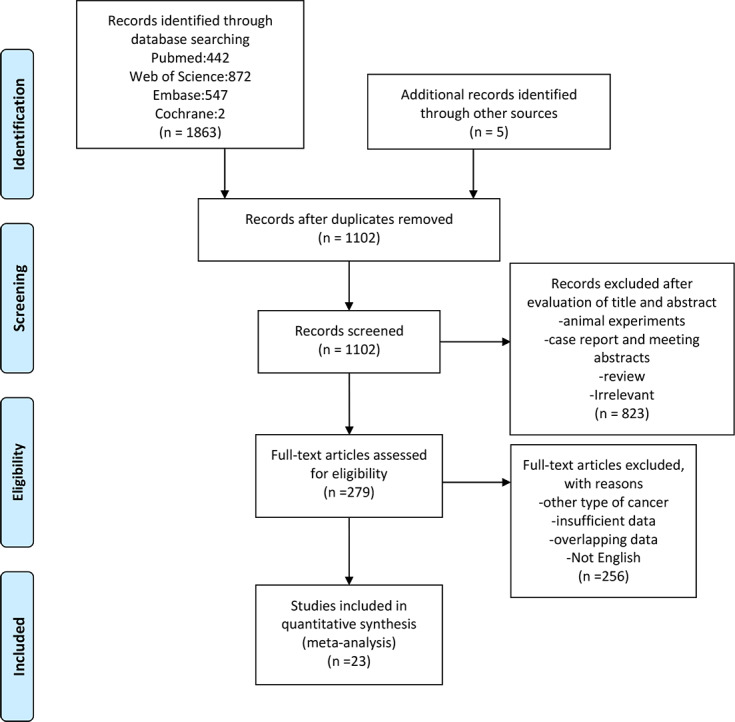
We searched several databases to collect relevant studies conducted until July 2019. We carefully reviewed the full text of the included publications and combined the HRs and 95% CIs to assess the association between the NLR and survival time in patients with lung cancer receiving immunotherapy.
PubMed, the Cochrane Library, Embase and Web of Science ELIGIBILITY CRITERIA: Studies reporting the prognostic value of the NLR in patients with lung cancer receiving immunotherapy were enrolled.
Basic information on the articles and patients (NLR cut-off value, NLR at baseline and HRs with 95% CIs for OS and PFS) was extracted by two authors independently. The pooled HRs of OS and PFS were synthesised using the random effects or fixed effects model.
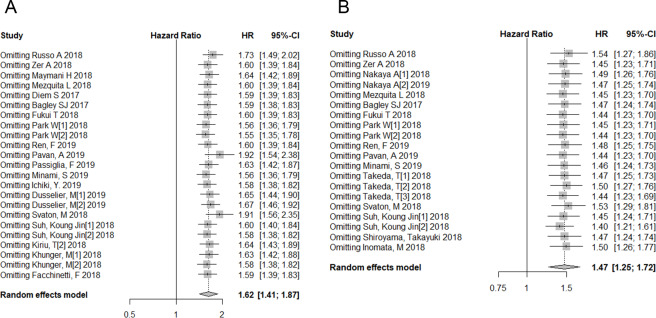
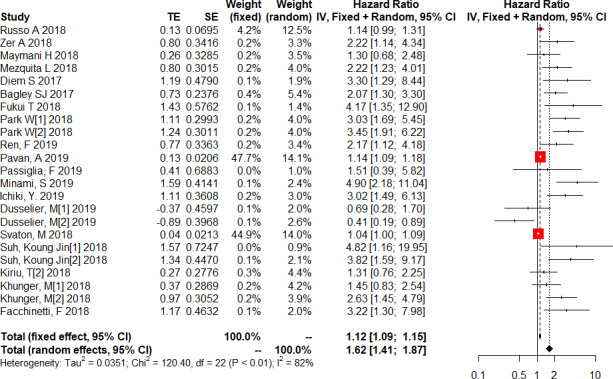
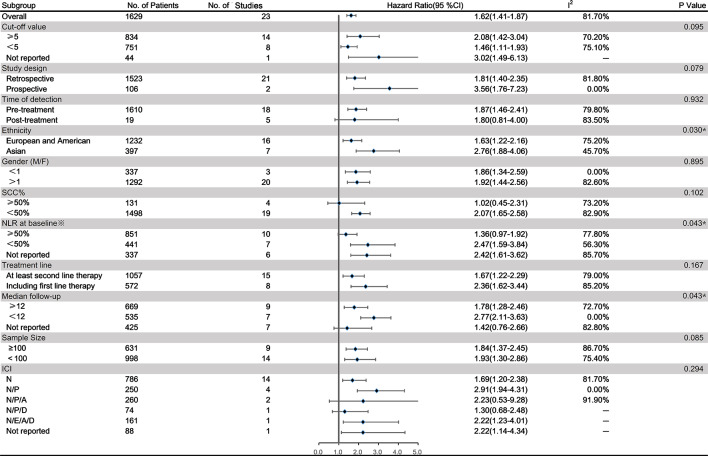
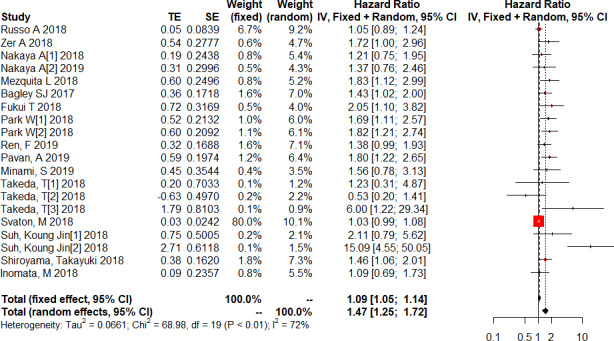
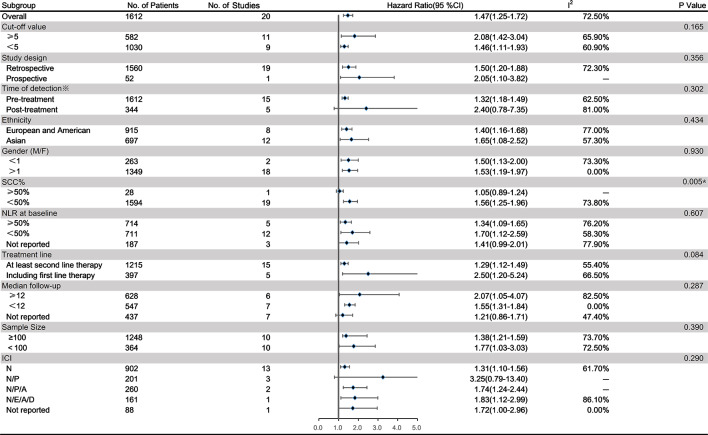
Twenty-three studies with 2068 patients were enrolled. Among all patients, 1305 (64.0%) were men and 643 (31.4%) were diagnosed with squamous cell carcinoma (SCC). In a pooled analysis of OS and PFS from all studies, an elevated NLR predicted poor OS (HR=1.62; 95% CI: 1.41 to 1.87; p<0.001) and PFS (HR=1.47; 95% CI: 1.25 to 1.72; p<0.001). Subgroup analyses stratified showed that the post-treatment NLR was not significantly related to OS and that patients in Asia had significantly higher HRs than those in Europe and America. Furthermore, the proportion of SCC and baseline NLR could affect the prognostic value of the NLR.
Our study found that an elevated NLR was associated with poor OS and PFS in patients with lung cancer receiving immunotherapy and that several clinical factors might have an impact on the predictive value of the NLR in the survival of patients with lung cancer.
探讨肺癌患者接受免疫治疗前后中性粒细胞与淋巴细胞比值(NLR)与总生存期(OS)/无进展生存期(PFS)的关系。
我们检索了几个数据库,以收集截至 2019 年 7 月进行的相关研究。我们仔细审查了纳入文献的全文,并结合 HR 和 95%CI 来评估 NLR 与接受免疫治疗的肺癌患者生存时间之间的相关性。
PubMed、Cochrane 图书馆、Embase 和 Web of Science
纳入报告 NLR 对接受免疫治疗的肺癌患者预后价值的研究。
两名作者独立提取文章和患者的基本信息(NLR 截止值、基线时的 NLR 和 OS 和 PFS 的 HRs 及其 95%CI)。使用随机效应或固定效应模型综合 OS 和 PFS 的合并 HR。
共纳入 23 项研究,共 2068 例患者。所有患者中,1305 例(64.0%)为男性,643 例(31.4%)诊断为鳞状细胞癌(SCC)。在所有研究中对 OS 和 PFS 进行的汇总分析中,升高的 NLR 预示着 OS 不良(HR=1.62;95%CI:1.41 至 1.87;p<0.001)和 PFS 不良(HR=1.47;95%CI:1.25 至 1.72;p<0.001)。亚组分析显示,治疗后 NLR 与 OS 无显著相关性,亚洲患者的 HR 明显高于欧美患者。此外,SCC 的比例和基线 NLR 可能会影响 NLR 的预后价值。
本研究发现,肺癌患者接受免疫治疗后 NLR 升高与 OS 和 PFS 不良相关,一些临床因素可能会影响 NLR 在预测肺癌患者生存中的预测价值。