Passiglia Francesco, Galvano Antonio, Castiglia Marta, Incorvaia Lorena, Calò Valentina, Listì Angela, Mazzarisi Salvatore, Perez Alessandro, Gallina Giuseppe, Rizzo Sergio, Soto Parra Hector, Bazan Viviana, Russo Antonio
Department of Surgical, Oncological and Stomatological Disciplines, University of Palermo, Palermo, Italy.
Medical Oncology Unit, AOU Policlinico Vittorio Emanuele, Catania, Italy.
Ther Adv Med Oncol. 2019 Apr 16;11:1758835919839928. doi: 10.1177/1758835919839928. eCollection 2019.
We investigated whether early dynamic changes of circulating free (cfDNA) levels as well as the neutrophil to lymphocyte ratio (NLR) could predict nivolumab effectiveness in pretreated patients with advanced non-small cell lung cancer (NSCLC).
A total of 45 patients receiving nivolumab 3 mg/kg every 2 weeks were enrolled. Patients underwent a computed tomography scan and responses were evaluated by the response evaluation criteria in solid tumors. Peripheral blood samples were obtained from the patients and the cfDNA level as well as the NLR were assessed. Time to progression (TTP) and overall survival (OS) were determined.
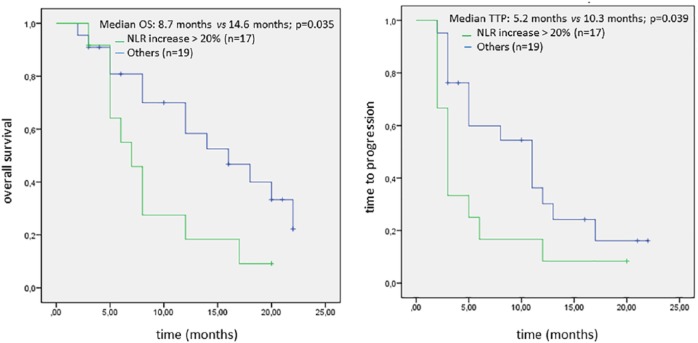
Patients with increased cfDNA >20% at the sixth week reported significantly worse survival outcomes (median OS: 5.7 14.2 months, < 0.001; median TTP: 3.3 10.2 months, < 0.001), as well as patients with increased NLR >20% (median OS: 8.7 14.6 months, = 0.035; median TTP: 5.2 10.3 months, = 0.039). The combined increase of cfDNA and NLR >20% was associated with significantly worse survival outcomes as compared with the remained population (median OS: 5.8 15.5 months, = 0.012; median TTP: 3.2 11.9 months, = 0.028). Multivariable analysis identified three significant factors associated with worse OS: combined cfDNA/NLR increase >20% [hazard ratio (HR): 5.16; 95% confidence interval (CI), 1.09-24.29; = 0.038], liver metastasis (HR: 0.44; 95% CI, 0.20-0.96; = 0.038), and extra-thoracic disease (HR: 0.33; 95% CI, 0.12-0.89; = 0.029).
An early combined increase of both cfDNA and NLR over the course of the first 6 weeks of nivolumab therapy predicted worse survival in pretreated patients with advanced NSCLC, suggesting a potential role in the real-time monitoring of immunotherapy resistance.
我们研究了循环游离(cfDNA)水平的早期动态变化以及中性粒细胞与淋巴细胞比值(NLR)是否能够预测纳武单抗对晚期非小细胞肺癌(NSCLC)预处理患者的疗效。
共纳入45例每2周接受3mg/kg纳武单抗治疗的患者。患者接受计算机断层扫描,并根据实体瘤疗效评价标准评估反应。采集患者外周血样本,评估cfDNA水平和NLR。确定疾病进展时间(TTP)和总生存期(OS)。
第6周时cfDNA升高>20%的患者生存结果显著更差(中位OS:5.7对14.2个月,P<0.001;中位TTP:3.3对10.2个月,P<0.001),NLR升高>20%的患者也是如此(中位OS:8.7对14.6个月,P=0.035;中位TTP:5.2对10.3个月,P=0.039)。与其余人群相比,cfDNA和NLR联合升高>20%与显著更差的生存结果相关(中位OS:5.8对15.5个月,P=0.012;中位TTP:3.2对11.9个月,P=0.028)。多变量分析确定了与较差OS相关的三个显著因素:cfDNA/NLR联合升高>20%[风险比(HR):5.16;95%置信区间(CI),1.09-24.29;P=0.038]、肝转移(HR:0.44;95%CI,0.20-0.96;P=0.038)和胸外疾病(HR:0.33;95%CI,0.12-0.89;P=0.029)。
在纳武单抗治疗的前6周内,cfDNA和NLR早期联合升高预示着晚期NSCLC预处理患者的生存较差,提示其在免疫治疗耐药性实时监测中的潜在作用。