Department of Physics, Department of Chemistry and Biochemistry, Programs of Biophysics, Chemical Physics, and Biochemistry, The Ohio State University, Columbus, OH, 43210, USA.
Center for Ultrafast Science and Technology, School of Chemistry and Chemical Engineering, School of Physics and Astronomy, Shanghai Jiao Tong University, 200240, Shanghai, China.
Nat Commun. 2020 Jun 4;11(1):2822. doi: 10.1038/s41467-020-15535-y.
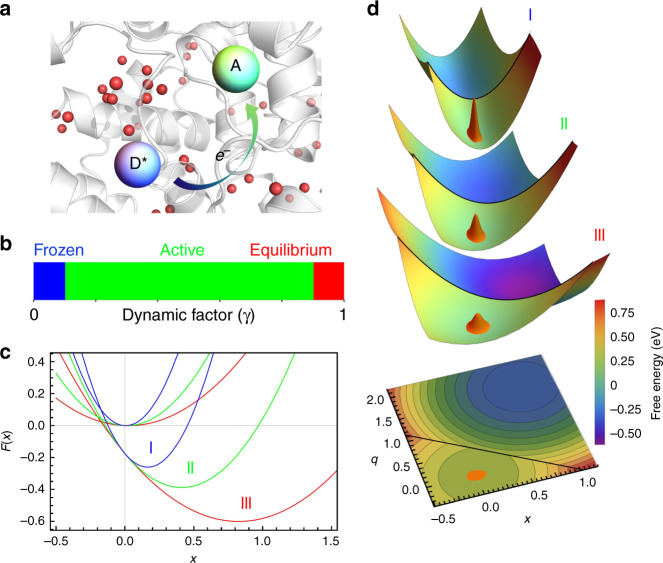
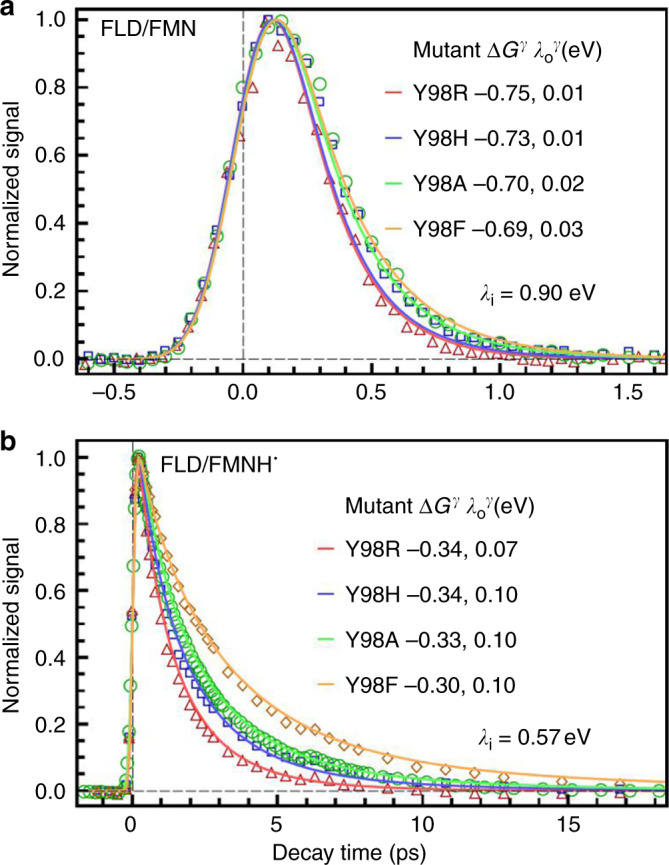
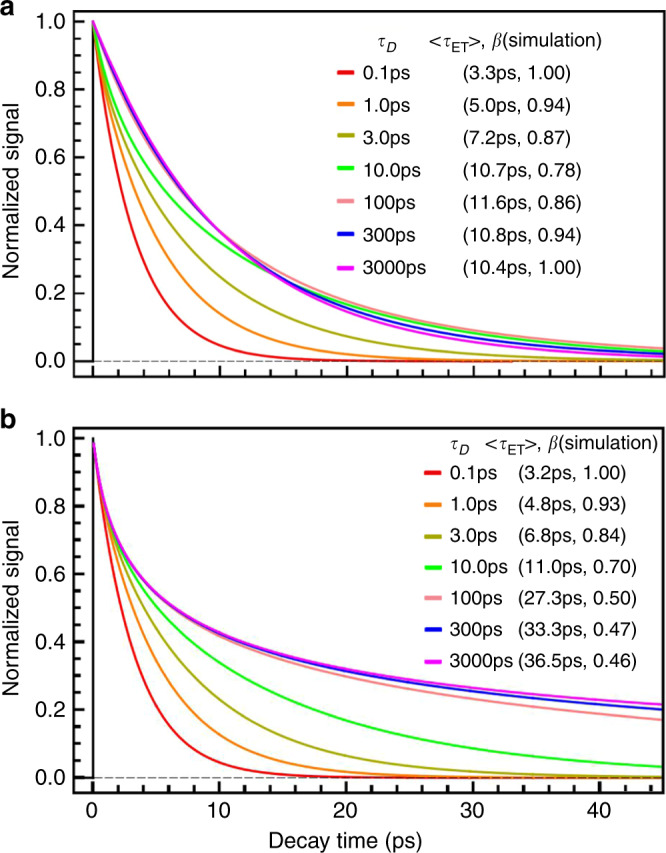
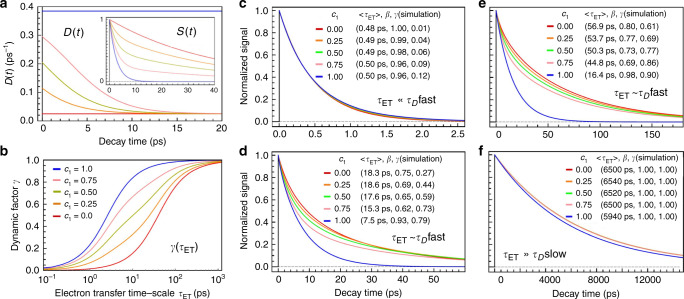
A variety of electron transfer (ET) reactions in biological systems occurs at short distances and is ultrafast. Many of them show behaviors that deviate from the predictions of the classic Marcus theory. Here, we show that these ultrafast ET dynamics highly depend on the coupling between environmental fluctuations and ET reactions. We introduce a dynamic factor, γ (0 ≤ γ ≤ 1), to describe such coupling, with 0 referring to the system without coupling to a "frozen" environment, and 1 referring to the system's complete coupling with the environment. Significantly, this system's coupling with the environment modifies the reaction free energy, ΔG, and the reorganization energy, λ, both of which become smaller. This new model explains the recent ultrafast dynamics in flavodoxin and elucidates the fundamental mechanism of nonequilibrium ET dynamics, which is critical to uncovering the molecular nature of many biological functions.
在生物系统中,各种电子转移(ET)反应发生在短距离内,且速度极快。其中许多反应表现出与经典 Marcus 理论预测不符的行为。在这里,我们表明这些超快 ET 动力学高度依赖于环境波动与 ET 反应之间的耦合。我们引入了一个动态因子 γ(0≤γ≤1)来描述这种耦合,其中 0 表示系统与“冻结”环境没有耦合,1 表示系统与环境完全耦合。重要的是,系统与环境的耦合会改变反应自由能ΔG 和重组能λ,两者都会变小。这个新模型解释了最近在黄素蛋白中的超快动力学,并阐明了非平衡 ET 动力学的基本机制,这对于揭示许多生物功能的分子本质至关重要。