Department of Public Health Solutions, Finnish Institute for Health and Welfare (THL), P.O. Box 30, FI-00271, Helsinki, Finland.
Sci Rep. 2020 Jun 4;10(1):9123. doi: 10.1038/s41598-020-65959-1.
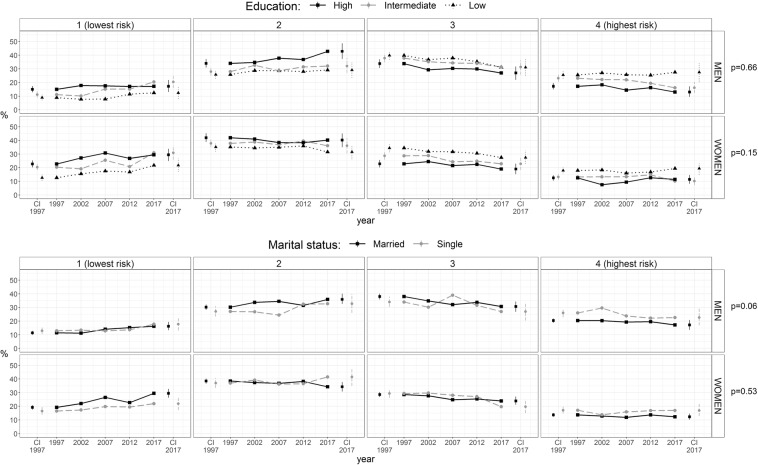
Understanding on sociodemographic variation of the co-occurrence of cardiovascular disease risk factors is crucial for planning future prevention strategies. We aimed at examining (1) the co-occurrence of smoking, obesity, hypertension and elevated serum cholesterol by education and marital status, and (2) its trends in different sociodemographic groups in Finland. We used data from cross-sectional health examination surveys among the general population (25-64 years): for 1997-2012 the National FINRISK Study and for 2017 the FinHealth 2017 Survey (n = 25036). A risk factor accumulation score with categories (1) zero, (2) one, (3) two, and (4) three or four elevated risk factors was the outcome in multinomial logistic regression. The risk factor score was more favourable among women, among high education groups, and slightly among participants living with a spouse. Among men, the lowest risk factor score class became more prevalent especially in the intermediate education group, which approached the highest education group over time. Our results indicate an overall transition towards a more favourable risk factor distribution. However, risk factor accumulation among the least educated remained emphasizing the need to develop and implement more targeted prevention interventions and public health policies to decrease the risk factor burden particularly in this group.
了解心血管疾病危险因素的共同发生在社会人口统计学方面的差异对于规划未来的预防策略至关重要。我们旨在研究:(1)教育和婚姻状况对吸烟、肥胖、高血压和血清胆固醇升高的共同发生的影响;(2)在芬兰不同社会人口学群体中的趋势。我们使用了来自一般人群横断面健康检查调查的数据(25-64 岁):1997-2012 年的国家 FINRISK 研究和 2017 年的 FinHealth 2017 调查(n=25036)。多变量逻辑回归的结果是一个风险因素累积评分,分为(1)零、(2)一、(3)二和(4)三个或四个升高的风险因素。在女性、高教育群体以及与配偶同住的参与者中,风险因素评分更为有利。在男性中,风险因素评分最低的类别变得更为普遍,尤其是在中等教育群体中,随着时间的推移,这一群体逐渐接近最高教育群体。我们的结果表明,总体上向更有利的风险因素分布转变。然而,受教育程度最低的人群中风险因素的积累仍然存在,这强调了需要制定和实施更有针对性的预防干预措施和公共卫生政策,以减少这一群体的风险因素负担。