Shakina Elena, Gasparetto Thadeu, Barajas Angel
National Research University Higher School of Economics, Saint Petersburg, Russia.
Front Psychol. 2020 May 15;11:659. doi: 10.3389/fpsyg.2020.00659. eCollection 2020.
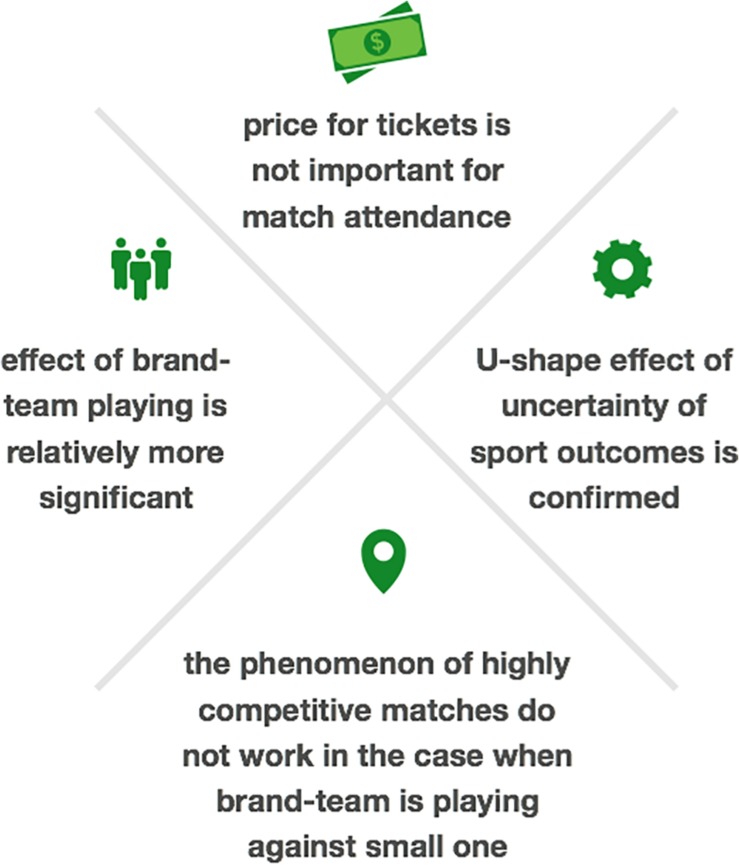
Football is an industry driven by emotions. Fans experience many different emotions related to their teams. This paper aims to inspect how emotions impact attendance at football matches, examining whether football fans prefer to watch highly competitive matches or matches between good teams with star-players. The paper also considers behavioral and emotional differences of match spectators when brand-teams play away or at home. Importantly, we are also looking for the effects that the expectations of these emotions have on the tickets' price mechanism. We use data from three seasons of the Brazilian State championship with information on more than 1,100 matches. The OLS estimator with the moderation marginal effects allows for analysis of a brand-team playing with different levels of uncertainty over the outcomes measured by the relative level of the divisions of rivals. We look for the difference between the marginal contribution of the brand-team and the uncertainty of outcomes that might change under some conditions. The analysis is performed later using two subsamples and, finally, we address the problem of endogeneity in price using an instrumental variable. From our results, the main findings are: first, that the price of tickets does not much affect the demand when a brand-team is playing. In case of competitive matches between non-brand-teams, price behavior correlates to the rationality of the demand curve having a negative impact. The fact that price is not relevant for matches with the brand-team comes to corroborate the idea that fans are driven more by emotions than by economic reasoning; second, the phenomena of highly competitive matches does not work when a brand-team is playing against a small one; and third, the effect of a brand-team playing is relatively more important than the uncertainty of outcome. The last two findings mean that the satisfaction of watching star-players or big-teams is stronger than the emotion brought by a competitive match.
足球是一个由情感驱动的行业。球迷会体验到与他们支持的球队相关的许多不同情感。本文旨在考察情感如何影响足球比赛的上座率,研究足球迷是更喜欢观看竞争激烈的比赛,还是有明星球员的强队之间的比赛。本文还考虑了品牌球队在客场或主场比赛时,比赛观众的行为和情感差异。重要的是,我们还在探寻这些情感预期对门票价格机制产生的影响。我们使用了巴西州锦标赛三个赛季的数据,这些数据包含了1100多场比赛的信息。带有调节边际效应的OLS估计器可以分析品牌球队在比赛结果具有不同程度不确定性的情况下的表现,这种不确定性由对手联赛级别的相对水平来衡量。我们要找出品牌球队的边际贡献与可能在某些条件下发生变化的比赛结果不确定性之间的差异。随后使用两个子样本进行分析,最后,我们使用工具变量来解决价格的内生性问题。从我们的结果来看,主要发现如下:第一,当品牌球队比赛时,门票价格对需求影响不大。在非品牌球队之间的竞争激烈的比赛中,价格行为与需求曲线的合理性相关,会产生负面影响。门票价格与品牌球队比赛无关这一事实,证实了球迷更多是受情感驱动而非经济理性因素影响这一观点;第二,当品牌球队对阵小球队时,竞争激烈的比赛现象不起作用;第三,品牌球队比赛的影响相对比比赛结果的不确定性更为重要。最后两个发现意味着观看明星球员或强队比赛带来的满足感,要比竞争激烈的比赛带来的情感更为强烈。