Liu Li, Yin Ping, Lu Chong, Li Jingxin, Zang Zhaoxia, Liu Yongdan, Liu Shuang, Wei Yafen
Department of Neurology, Heilongjiang Provincial Hospital, Harbin, China.
Department of Neurology, Heilongjiang Provincial Hospital Affiliated to Harbin Institute of Technology, Harbin, China.
Front Neurol. 2020 May 15;11:408. doi: 10.3389/fneur.2020.00408. eCollection 2020.
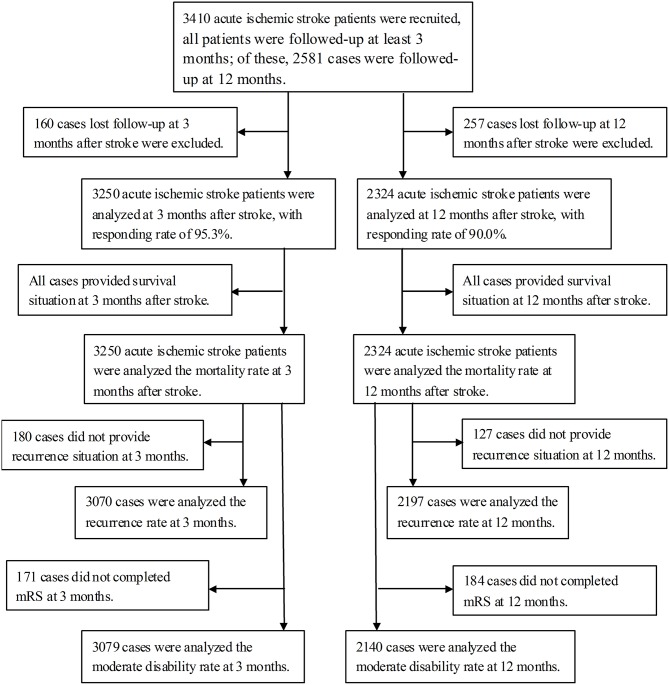
Stroke remains a leading cause of death and disability. The low-density lipoprotein cholesterol to high-density lipoprotein cholesterol (LDL-C/HDL-C ratio) ratio has been confirmed to be a predictor of stroke. However, few studies have assessed the prognostic impact of the LDL-C/HDL-C ratio for stroke patients. We aimed to investigate the relationship between the LDL-C/HDL-C ratio and the prognosis following stroke in Chinese patients. A total of 3,410 patients who had experienced their first ischemic stroke was recruited to this study within 72 h of stroke onset. The patients were followed for at least 12 months. A multivariate regression analysis was used to assess the association between the LDL-C/HDL-C ratio and prognosis following stroke. We considered the LDL-C/HDL-C ratio as a continuous variable and stratified patients according to the LDL-C/HDL-C ratio quartile. A higher LDL-C/HDL-C ratio was associated with lower rates of death, recurrence, and moderate disability (defined as a modified Rankin scale score >2) at 3 months. Using group 1 as the reference group, the relative risk (RRs) at 3 months for death were 0.45 (95% confidence interval [CI]: 0.27, 0.77) for group 2, 0.58 (95% CI: 0.34, 0.98) for group 3, and 0.97 (95% CI: 0.60, 1.56) for group 4; for recurrence, the RRs were 0.75 (95% CI: 0.56, 0.99) for group 2, 0.65 (95% CI: 0.48, 0.89) for group 3, and 0.55 (95% CI: 0.39, 0.78) for group 4; and for moderate disability, the RRs were 0.74 (95% CI: 0.55, 0.99) for group 2, 0.65 (95% CI: 0.47, 0.89) for group 3, and 0.55 (95% CI: 0.39, 0.77) for group 4. At 12 months, patients in group 2 were the most protected against ischemic stroke death (RR: 0.57; 95% CI: 0.34, 0.95). However, there were no associations between the LDL-C/HDL-C ratio and stroke recurrence or moderate disability. A higher LDL-C/HDL-C ratio was found to protect against death, recurrence, and moderate disability at 3 months. However, there was no significant association between the LDL-C/HDL-C ratio and stroke recurrence or moderate disability at 12 months. These results nonetheless suggest that a higher LDL-C/HDL-C ratio was associated with short-term stroke prognosis.
中风仍然是导致死亡和残疾的主要原因。低密度脂蛋白胆固醇与高密度脂蛋白胆固醇之比(LDL-C/HDL-C比值)已被证实是中风的一个预测指标。然而,很少有研究评估LDL-C/HDL-C比值对中风患者预后的影响。我们旨在研究中国患者中LDL-C/HDL-C比值与中风后预后之间的关系。共有3410例首次发生缺血性中风的患者在中风发作后72小时内被纳入本研究。对患者进行了至少12个月的随访。采用多因素回归分析来评估LDL-C/HDL-C比值与中风后预后之间的关联。我们将LDL-C/HDL-C比值视为连续变量,并根据LDL-C/HDL-C比值四分位数对患者进行分层。较高的LDL-C/HDL-C比值与3个月时较低的死亡率、复发率和中度残疾率(定义为改良Rankin量表评分>2)相关。以第1组作为参照组,第2组3个月时死亡的相对风险(RRs)为0.45(95%置信区间[CI]:0.27,0.77),第3组为0.58(95%CI:0.34,0.98),第4组为0.97(95%CI:0.60,1.56);对于复发,第2组的RRs为0.75(95%CI:0.56,0.99),第3组为0.65(95%CI:0.48,0.89),第4组为0.55(95%CI:0.39,0.78);对于中度残疾,第2组的RRs为0.74(95%CI:0.55,0.99),第3组为0.65(95%CI:0.47,0.89),第4组为0.55(95%CI:0.39,0.77)。在12个月时,第2组患者对缺血性中风死亡的保护作用最强(RR:0.57;95%CI:0.34,0.95)。然而,LDL-C/HDL-C比值与中风复发或中度残疾之间没有关联。发现较高的LDL-C/HDL-C比值在3个月时可预防死亡、复发和中度残疾。然而,在12个月时,LDL-C/HDL-C比值与中风复发或中度残疾之间没有显著关联。尽管如此,这些结果表明较高的LDL-C/HDL-C比值与中风短期预后相关。