Environmentally-induced Cardiovascular Degeneration, Institute of Clinical Chemistry and Laboratory Diagnostics, Medical Faculty, Heinrich-Heine University Düsseldorf, Germany; IUF-Leibniz Research Institute for Environmental Medicine, Düsseldorf, Germany.
IUF-Leibniz Research Institute for Environmental Medicine, Düsseldorf, Germany.
Redox Biol. 2020 Jul;34:101543. doi: 10.1016/j.redox.2020.101543. Epub 2020 May 26.
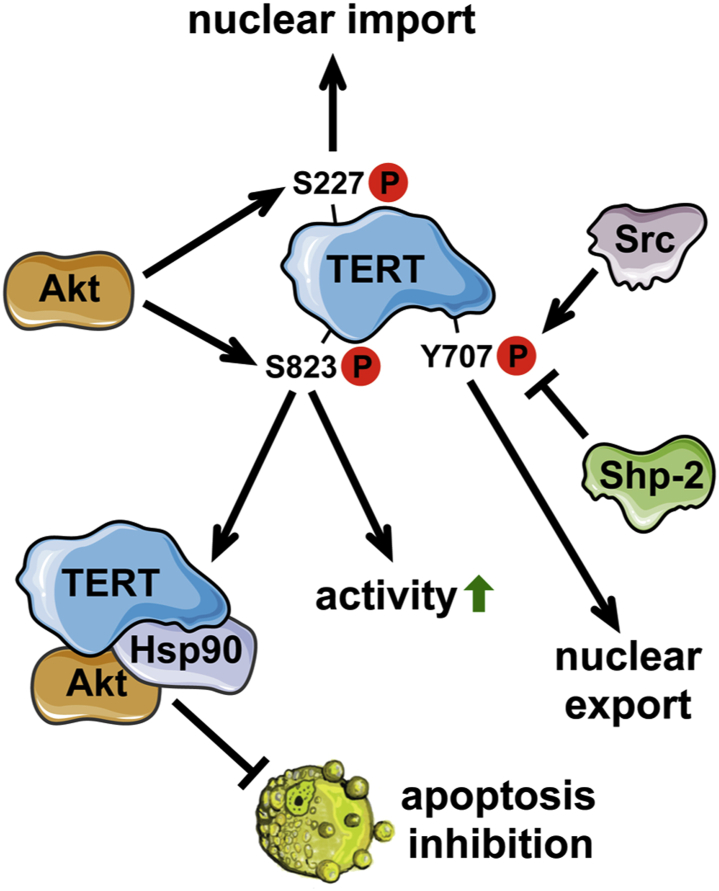
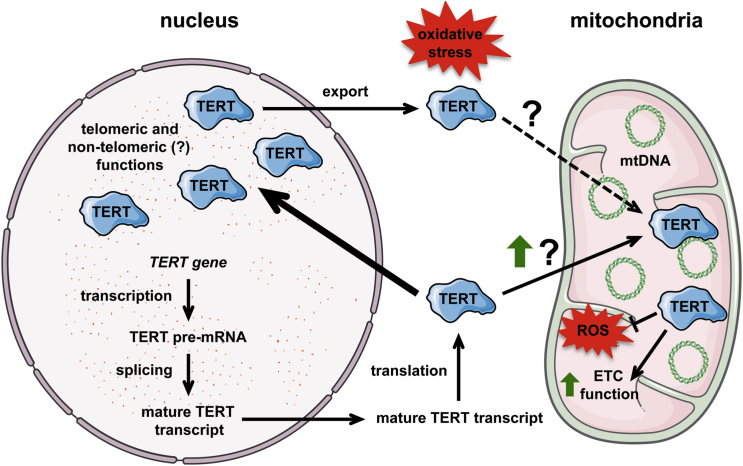
Telomerase consists of the catalytic subunit Telomerase Reverse Transcriptase (TERT) and the Telomerase RNA Component. Its canonical function is the prevention of telomere erosion. Over the last years it became evident that TERT is also present in tissues with low replicative potential. Important non-canonical functions of TERT are protection against apoptosis and maintenance of the cellular redox homeostasis in cancer as well as in somatic tissues. Intriguingly, TERT and reactive oxygen species (ROS) are interdependent on each other, with TERT being regulated by changes in the redox balance and itself controlling ROS levels in the cytosol and in the mitochondria. The latter is achieved because TERT is present in the mitochondria, where it protects mitochondrial DNA and maintains levels of anti-oxidative enzymes. Since numerous diseases are associated with oxidative stress, increasing the mitochondrial TERT level could be of therapeutic value.
端粒酶由催化亚基端粒酶逆转录酶(TERT)和端粒酶 RNA 成分组成。其典型功能是防止端粒磨损。在过去的几年中,人们已经意识到 TERT 也存在于复制能力低的组织中。TERT 的重要非典型功能是保护细胞免受凋亡,并在癌症以及体细胞组织中维持细胞的氧化还原稳态。有趣的是,TERT 和活性氧(ROS)相互依存,TERT 受氧化还原平衡变化的调节,而 TERT 自身控制细胞质和线粒体中的 ROS 水平。后者是因为 TERT 存在于线粒体中,它保护线粒体 DNA 并维持抗氧化酶的水平。由于许多疾病与氧化应激有关,增加线粒体 TERT 水平可能具有治疗价值。