Program in Neuroscience, University of Mississippi Medical Center, Jackson, MS 39216, USA.
Department of Psychiatry and Human Behavior, University of Mississippi Medical Center, Jackson, MS 39216, USA.
Int J Mol Sci. 2020 Jun 3;21(11):3999. doi: 10.3390/ijms21113999.
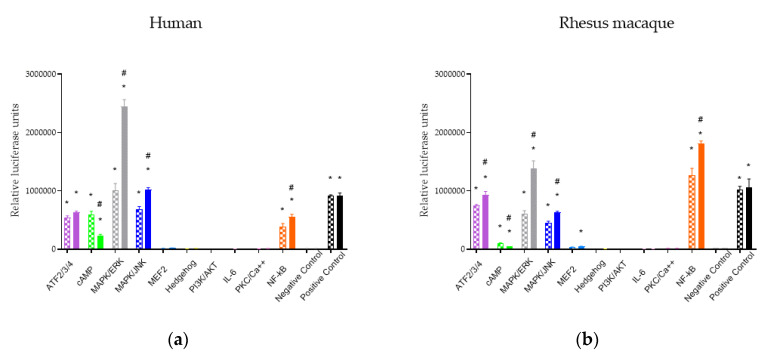
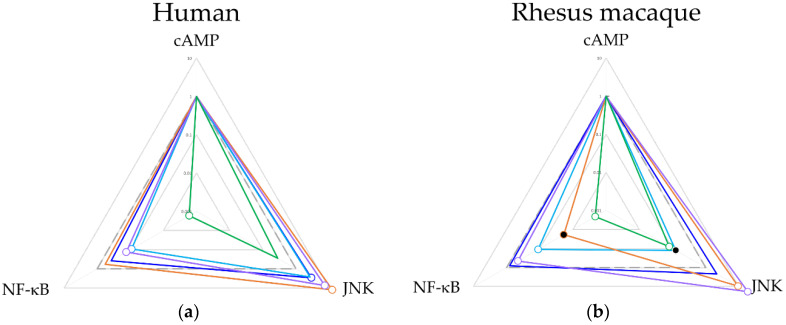
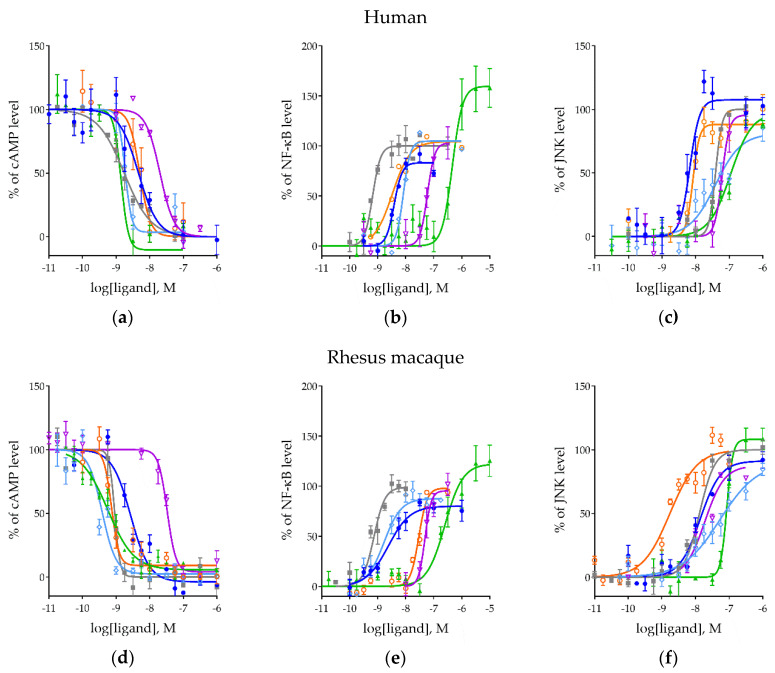
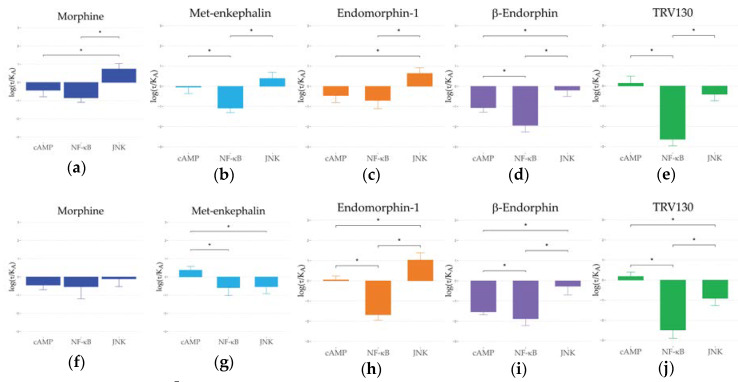
Interest has emerged in biased agonists at the mu opioid receptor (MOR) as a possible means for maintaining potent analgesis with reduced side effect profiles. While approaches measuring in vitro biased agonism are used in the development of these compounds, their therapeutic utility will ultimately be determined by in vivo functional effects. Nonhuman primates (NHPs) are the most translational model for evaluating the behavioral effects of candidate medications, but biased signaling of these drugs at NHP MOR receptors has been unstudied. The goal of the current work was to characterize MOR ligand bias in rhesus macaques, focusing on agonists that have previously been reported to show different patterns of biased agonism in rodents and humans. Downstream signaling pathways that responded to MOR activation were identified using a luciferase reporter array. Concentration-response curves for specific pathways (cAMP, NF-ĸB, MAPK/JNK) were generated using six agonists previously reported to differ in terms of signaling bias at rodent and human MORs. Using DAMGO as a reference ligand, relative cAMP, NF-ĸB and MAPK/JNK signaling by morphine, endomorphin-1, and TRV130 were found to be comparable between species. Further, the bias patterns of across ligands for NF-ĸB and MAPK/JNK were largely similar between species. There was a high degree of concordance between rhesus macaque and human MOR receptor signaling bias for all agonists tested, further demonstrating their utility for future translational behavioral studies.
人们对 μ 阿片受体 (MOR) 的偏态激动剂产生了兴趣,认为这可能是一种保持强效镇痛同时减少副作用的方法。虽然在这些化合物的开发中使用了测量体外偏态激动作用的方法,但它们的治疗效果最终将取决于体内的功能效应。非人类灵长类动物 (NHP) 是评估候选药物行为效应的最具转化性的模型,但这些药物在 NHP MOR 受体上的偏态信号传递尚未得到研究。目前这项工作的目的是表征恒河猴 MOR 配体的偏态性,重点研究先前在啮齿动物和人类中报道具有不同偏态激动作用模式的激动剂。使用荧光素酶报告基因阵列鉴定对 MOR 激活有反应的下游信号通路。使用先前报道在啮齿动物和人类 MOR 上具有不同信号偏态的六种激动剂生成特定途径(cAMP、NF-ĸB、MAPK/JNK)的浓度-反应曲线。使用 DAMGO 作为参考配体,吗啡、内吗啡肽-1 和 TRV130 在物种间的 cAMP、NF-ĸB 和 MAPK/JNK 信号传递方面被发现是可比的。此外,NF-ĸB 和 MAPK/JNK 跨配体的偏态模式在物种间也基本相似。所有测试的激动剂在恒河猴和人类 MOR 受体信号偏态方面具有高度一致性,进一步证明了它们在未来转化行为研究中的效用。