KiTZ Clinical Trial Unit, Hopp Children's Cancer Center Heidelberg (KiTZ), German Cancer Research Center (DKFZ) and Heidelberg University Hospital, Im Neuenheimer Feld 430, 69120, Heidelberg, Germany.
Clinical Cooperation Unit Pediatric Oncology, German Cancer Research Center (DKFZ) and German Cancer Consortium (DKTK), Heidelberg, Germany.
BMC Cancer. 2020 Jun 5;20(1):523. doi: 10.1186/s12885-020-07008-8.
Pediatric patients with relapsed or refractory disease represent a population with a desperate medical need. The aim of the INFORM (INdividualized Therapy FOr Relapsed Malignancies in Childhood) program is to translate next generation molecular diagnostics into a biomarker driven treatment strategy. The program consists of two major foundations: the INFORM registry providing a molecular screening platform and the INFORM2 series of biomarker driven phase I/II trials. The INFORM2 NivEnt trial aims to determine the recommended phase 2 dose (RP2D) of the combination treatment of nivolumab and entinostat (phase I) and to evaluate activity and safety (phase II).
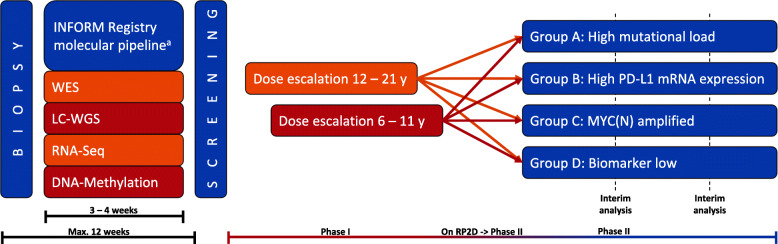
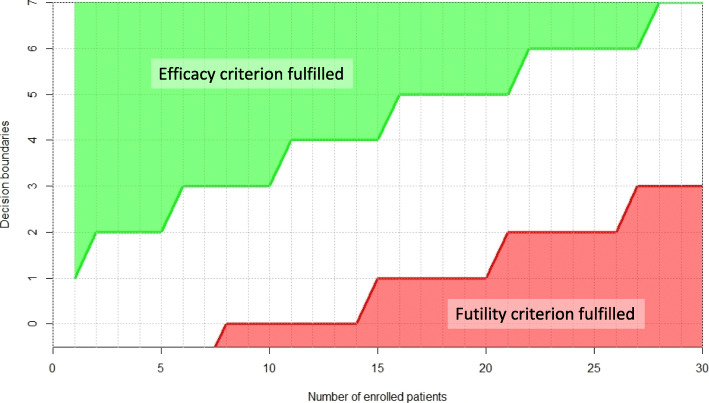
This is an exploratory non-randomized, open-label, multinational and multicenter seamless phase I/II trial in children and adolescents with relapsed / refractory or progressive high-risk solid tumors and CNS tumors. The phase I is divided in 2 age cohorts: 12-21 years and 6-11 years and follows a 3 + 3 design with two dose levels for entinostat (2 mg/m and 4 mg/m once per week) and fixed dose nivolumab (3 mg/kg every 2 weeks). Patients entering the trial on RP2D can seamlessly enter phase II which consists of a biomarker defined four group basket trial: high mutational load (group A), high PD-L1 mRNA expression (group B), focal MYC(N) amplification (group C), low mutational load and low PD-L1 mRNA expression and no MYC(N) amplification (group D). A Bayesian adaptive design will be used to early stop cohorts that fail to show evidence of activity. The maximum number of patients is 128.
This trial intends to exploit the immune enhancing effects of entinostat on nivolumab using an innovative biomarker driven approach in order to maximize the chance of detecting signs of activity. It prevents exposure to unnecessary risks by applying the Bayesian adaptive design for early stopping for futility. The adaptive biomarker driven design provides an innovative approach accelerating drug development and reducing exposure to investigational treatments in these vulnerable children at the same time.
ClinicalTrials.gov, NCT03838042. Registered on 12 February 2019.
患有复发或难治性疾病的儿科患者代表着一群有迫切医疗需求的人群。INFORM(儿童复发恶性肿瘤的个体化治疗)计划的目的是将下一代分子诊断转化为基于生物标志物的治疗策略。该计划由两个主要基础组成:INFORM 登记处提供分子筛选平台和 INFORM2 系列基于生物标志物的 I/II 期试验。INFORM2 NivEnt 试验旨在确定纳武单抗和恩替诺特联合治疗的推荐 II 期剂量(RP2D)(I 期),并评估活性和安全性(II 期)。
这是一项在儿童和青少年中具有复发/难治性或进展性高危实体瘤和中枢神经系统肿瘤的探索性、非随机、开放标签、多国家和多中心无缝 I/II 期试验。I 期分为两个年龄组:12-21 岁和 6-11 岁,采用 3+3 设计,恩替诺特(每周一次,2mg/m 和 4mg/m)和固定剂量纳武单抗(每两周一次,3mg/kg)各有两个剂量水平。在 RP2D 进入试验的患者可以无缝进入 II 期,II 期由一个基于生物标志物的四组篮子试验组成:高突变负荷(A 组)、高 PD-L1 mRNA 表达(B 组)、局灶性 MYC(N)扩增(C 组)、低突变负荷和低 PD-L1 mRNA 表达且无 MYC(N)扩增(D 组)。将使用贝叶斯自适应设计来早期停止没有证据显示活性的队列。最大患者人数为 128 人。
该试验旨在利用恩替诺特对纳武单抗的免疫增强作用,采用创新的基于生物标志物的方法,最大限度地提高检测活性迹象的机会。通过应用贝叶斯自适应设计进行早期无效性停止,避免了不必要的风险。基于生物标志物的自适应设计为加速药物开发提供了一种创新方法,同时减少了这些脆弱儿童接受试验性治疗的风险。
ClinicalTrials.gov,NCT03838042。于 2019 年 2 月 12 日注册。