Dipartimento Malattie Infettive, Istituto Superiore di Sanità, Viale Regina Elena 299, 00161, Rome, Italy.
Ministero della Salute, Direzione Generale della Prevenzione Sanitari, Ufficio 5 - Prevenzione delle Malattie Trasmissibili e Profilassi Internazionale, Rome, Italy.
BMC Public Health. 2020 Jun 5;20(1):857. doi: 10.1186/s12889-020-08748-9.
The European region achieved interruption of malaria transmission during the 1970s. Since then, malaria control programs were replaced by surveillance systems in order to prevent possible re-emergence of this disease. Sporadic cases of non-imported malaria were recorded in several European countries in the past decade and locally transmitted outbreaks of Plasmodium vivax, most probably supported by Anopheles sacharovi, have been repeatedly reported from Greece since 2009. The possibility of locally-transmitted malaria has been extensively studied in Italy where the former malaria vector An. labranchiae survived the control campaign which led to malaria elimination. In this study, we present paradigmatic cases that occurred during a 2017 unusual cluster, which caused strong concern in public opinion and were carefully investigated after the implementation of the updated malaria surveillance system.
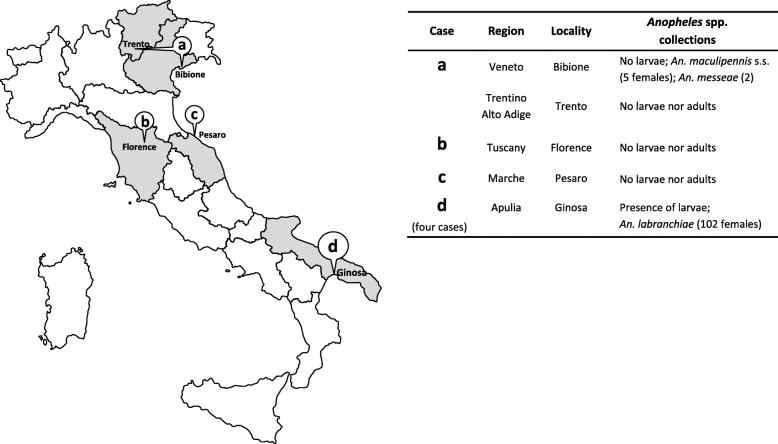
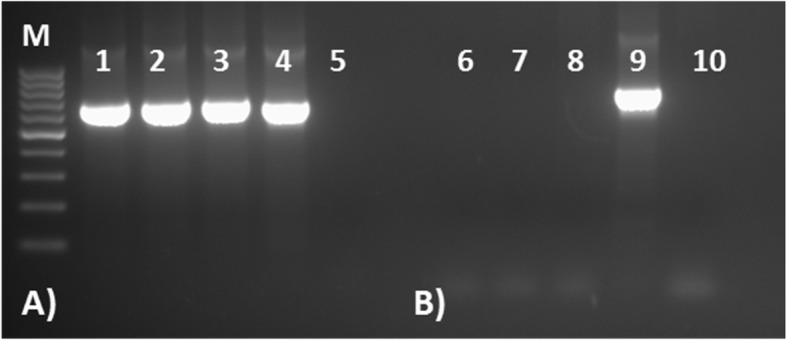
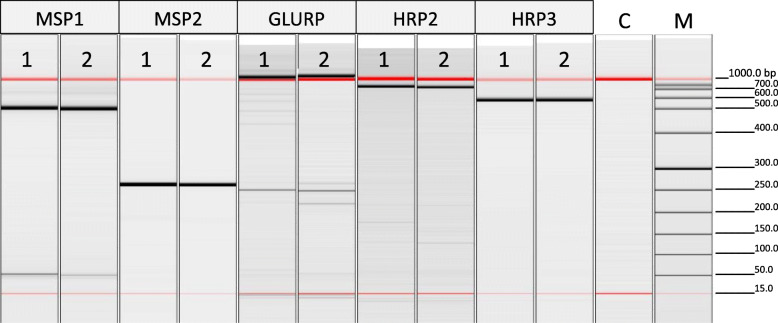
For suspected locally-transmitted malaria cases, alerts to Ministry of Health (MoH) and the National Institute of Health (ISS) were mandated by the Local Health Services (LHS). Epidemiological investigations on the transmission modes and the identification of possible infection's source were carried out by LHS, MoH and ISS. Entomological investigations were implemented locally for all suspected locally-transmitted cases that occurred in periods suitable to anopheline activity. Molecular diagnosis by nested-PCR for the five human Plasmodium species was performed to support microscopic diagnosis. In addition, genotyping of P. falciparum isolate was carried out to investigate putative sources of infection and transmission modalities.
In 2017, a cluster of seven non-imported cases was recorded from August through October. Among them, P. ovale curtisi was responsible of one case whereas six cases were caused by P. falciparum. Two cases were proved to be nosocomial while the other five were recorded as cryptic at the end of epidemiological investigations.
The epidemiological evidence shows that the locally acquired events are sporadic, often remain unresolved and classified as cryptic ones despite investigative efforts. The "cluster" of seven non-imported cases that occurred in 2017 in different regions of Italy therefore represents a conscious alert that should lead us to maintain a constant level of surveillance in a former malaria endemic country.
欧洲地区在 20 世纪 70 年代实现了疟疾传播的中断。此后,为了防止这种疾病的再次出现,疟疾控制项目被监测系统所取代。在过去十年中,几个欧洲国家记录了散发的非输入性疟疾病例,自 2009 年以来,希腊一再报告由可能由萨氏按蚊(Anopheles sacharovi)支持的本地传播的间日疟原虫暴发。在意大利,曾经的疟疾传播媒介按蚊(An. labranchiae)在导致疟疾消除的控制运动中幸存下来,因此广泛研究了本地传播疟疾的可能性。在本研究中,我们介绍了 2017 年不寻常聚集期间发生的典型病例,这些病例引起了公众的强烈关注,并在更新的疟疾监测系统实施后进行了仔细调查。
对于疑似本地传播的疟疾病例,地方卫生服务部门(LHS)向卫生部(MoH)和国家卫生研究所(ISS)发出警报。LHS、MoH 和 ISS 对传播方式和可能感染源进行了流行病学调查。对所有发生在适合按蚊活动期的疑似本地传播病例进行了局部昆虫学调查。对 5 种人类疟原虫进行巢式-PCR 分子诊断以支持显微镜诊断。此外,对疟原虫分离株进行基因分型,以调查感染源和传播方式。
2017 年 8 月至 10 月期间,记录了 7 例非输入性病例。其中,卵形疟原虫(P. ovale curtisi)导致 1 例,恶性疟原虫(P. falciparum)导致 6 例。2 例被证实为医院感染,而其他 5 例在流行病学调查结束时被归类为隐匿性感染。
流行病学证据表明,本地获得性事件是零星发生的,尽管进行了调查,但往往仍未得到解决并被归类为隐匿性感染。因此,2017 年意大利不同地区发生的 7 例非输入性病例“聚集”是一个有意识的警报,应促使我们在曾经的疟疾流行国家保持持续的监测水平。