Balzli Daniela, Gültekin Nejla, Stanga Zeno, Ülgür Ismail, Hedrich Nadja, Fehr Jan, Schlagenhauf Patricia
University of Zurich, Department of Public and Global Health, Institute for Epidemiology, Biostatistics and Prevention, Hirschengraben 84, 8001, Zurich, Switzerland.
Centre of Competence for Military and Disaster Medicine, Swiss Armed Forces, Bern, Switzerland.
New Microbes New Infect. 2025 Aug 24;67:101627. doi: 10.1016/j.nmni.2025.101627. eCollection 2025 Oct.
In the context of this paper, airport/seaport malaria denotes the accidental relocation by air or sea of a malaria infected mosquito to Europe, a non-endemic area, the survival of the transported mosquito and subsequent blood meal and infection of a local person. Autochthonous malaria refers to locally transmitted cases of malaria in Europe.
The systematic review followed PRISMA guidelines and was registered on PROSPERO (CRD42023444243). PubMed and Ovid MEDLINE electronic databases as well as EMBASE, Scopus and CINAHL were searched for eligible papers. The selection process followed strict inclusion and exclusion criteria.
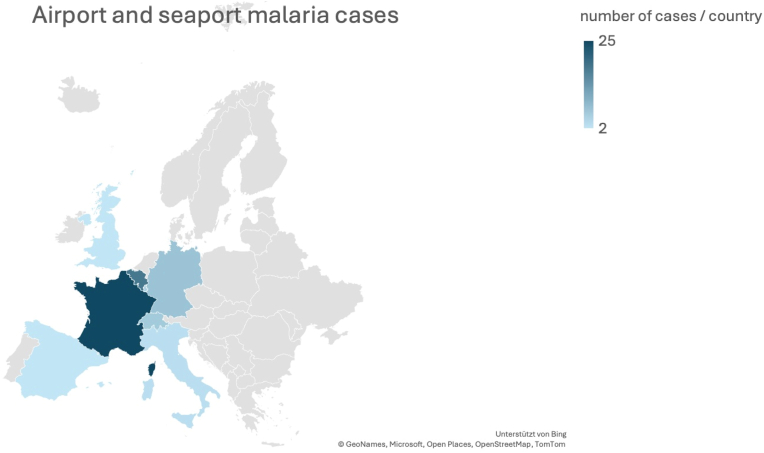
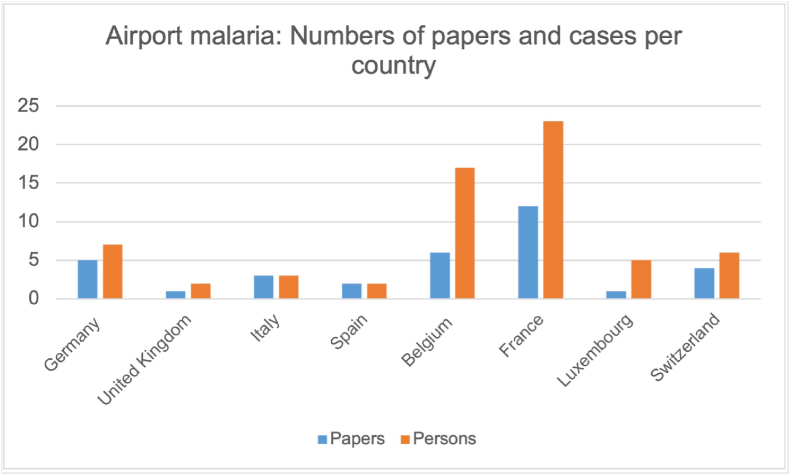
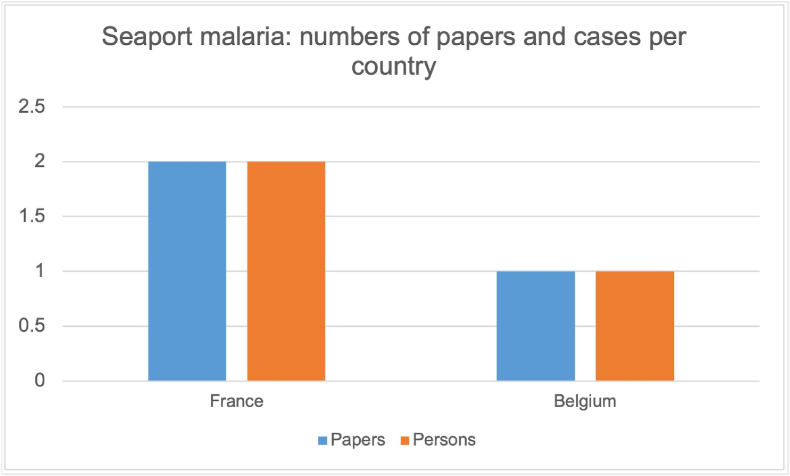
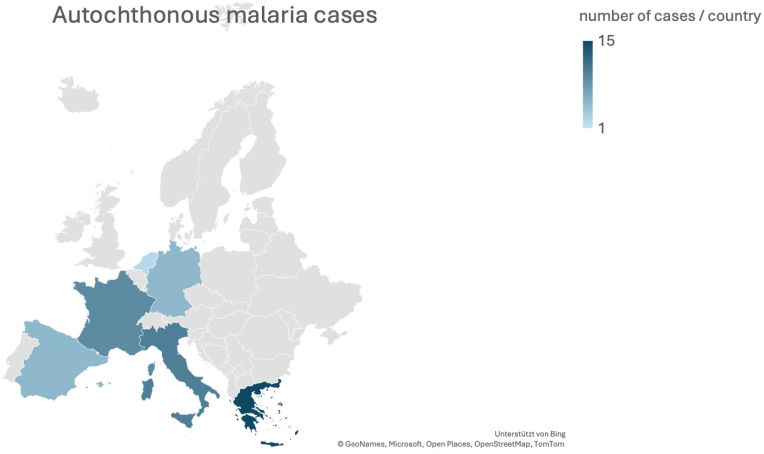
We included 68 papers describing 115 cases of airport, seaport or autochthonous malaria in Europe, with a total of 68 airport/seaport malaria cases and 47 autochthonous malaria cases. France, Germany, Italy and Spain reported both types of malaria cases. Cases of airport/seaport malaria only were reported from Belgium, Luxembourg, Switzerland and the United Kingdom. Cases of autochthonous malaria only were reported from Greece, Malta and the Netherlands. The case fatality rates for airport/seaport malaria were 13.24 % and for autochthonous malaria 2.13 % respectively.
The importance of airport/seaport and autochthonous malaria is related to the frequently delayed or missed diagnosis, leading to high case fatality rates. Rising temperature may facilitate the importation and proliferation of competent vectors. Increased human migration and travel with malaria parasite carriage may contribute to the reemergence of autochthonous malaria in Europe.
在本文中,机场/海港疟疾是指受疟疾感染的蚊子通过航空或海运意外转移到非疟疾流行区欧洲,被运输的蚊子存活下来,随后叮咬当地居民并导致感染。本土疟疾是指欧洲本地传播的疟疾病例。
系统评价遵循PRISMA指南,并在PROSPERO(CRD42023444243)上进行了注册。检索了PubMed和Ovid MEDLINE电子数据库以及EMBASE、Scopus和CINAHL,以查找符合条件的论文。选择过程遵循严格的纳入和排除标准。
我们纳入了68篇描述欧洲115例机场、海港或本土疟疾病例的论文,其中共有68例机场/海港疟疾病例和47例本土疟疾病例。法国、德国、意大利和西班牙报告了这两种疟疾病例。仅报告了比利时、卢森堡、瑞士和英国的机场/海港疟疾病例。仅报告了希腊、马耳他和荷兰的本土疟疾病例。机场/海港疟疾的病死率分别为13.24%,本土疟疾的病死率为2.13%。
机场/海港疟疾和本土疟疾的重要性与经常延迟或漏诊有关,导致病死率很高。气温上升可能有助于传播媒介的输入和繁殖。人类迁移增加以及携带疟原虫的旅行可能导致欧洲本土疟疾再次出现。