School of Epidemiology and Public Health, University of Ottawa, 600 Peter Morand Crescent, Ottawa, Ontario, K1G 5Z3, Canada.
Healthy Active Living and Obesity Research Group, Children's Hospital of Eastern Ontario Research Institute, Ottawa, Ontario, Canada.
Int J Behav Nutr Phys Act. 2020 Jun 5;17(1):72. doi: 10.1186/s12966-020-00976-x.
For optimal health benefits, the Canadian 24-Hour Movement Guidelines for Children and Youth (aged 5-17 years) recommend an achievement of high levels of physical activity (≥60 min of moderate-to-vigorous physical activity), low levels of sedentary behaviour (≤2 h of recreational screen time), and sufficient sleep (9-11 h for children or 8-10 h for adolescents) each day. The objective of this systematic review was to examine how combinations of physical activity, sedentary time, and sleep duration relate to depressive symptoms and other mental health indicators among children and adolescents.
Literature was obtained through searching Medline, EMBASE, PsycINFO, and SportDiscus up to September 30, 2019. Peer-reviewed studies published in English or French were included if they met the following criteria: population (apparently healthy children and adolescents with a mean age of 5-17 years), intervention/exposure (combinations of physical activity, sedentary time, and sleep duration), and outcomes (depressive symptoms and other mental health indicators). A risk of bias assessment was completed for all included studies using the methods described in the Cochrane Handbook. The Grading of Recommendations Assessment, Development and Evaluation (GRADE) framework was used to assess the quality of evidence for each health indicator. Narrative syntheses were employed to describe the results due to high levels of heterogeneity across studies.
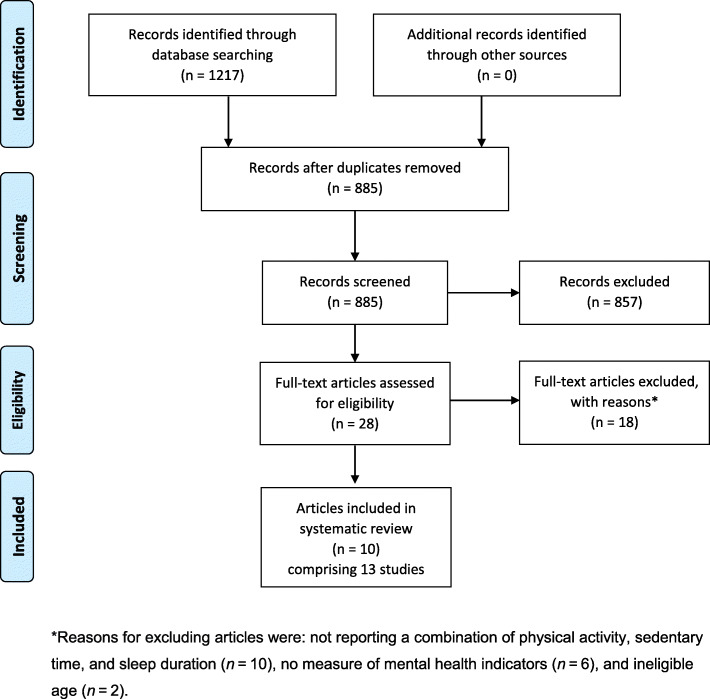
A total of 13 cross-sectional studies comprised in 10 papers met inclusion criteria. Data across studies involved 115,540 children and adolescents from 12 countries. Overall, the findings indicated favourable associations between meeting all 3 recommendations and better mental health indicators among children and adolescents when compared with meeting none of the recommendations. There was evidence of a dose-response gradient between an increasing number of recommendations met and better mental health indicators. Meeting the screen time and sleep duration recommendations appeared to be associated with more mental health benefits than meeting the physical activity recommendation. The quality of evidence reviewed was "very low" according to GRADE.
The findings indicate favourable associations between meeting all 3 movement behaviour recommendations in the 24-h guidelines and better mental health indicators among children and adolescents. There is a clear need for high-quality studies that use robust measures of all movement behaviours and validated measures of mental health to increase our understanding in this topic area.
为了获得最佳的健康益处,加拿大儿童和青少年 24 小时运动指南(5-17 岁)建议实现高水平的身体活动(≥60 分钟的中等到剧烈身体活动)、低水平的久坐行为(≤2 小时的娱乐屏幕时间)和充足的睡眠(儿童 9-11 小时,青少年 8-10 小时)。本系统评价的目的是研究身体活动、久坐时间和睡眠时间的组合与儿童和青少年抑郁症状和其他心理健康指标的关系。
通过搜索 Medline、EMBASE、PsycINFO 和 SportDiscus,获取截至 2019 年 9 月 30 日的文献。如果研究符合以下标准,则纳入同行评审的英文或法文发表的研究:人群(年龄在 5-17 岁的明显健康儿童和青少年)、干预/暴露(身体活动、久坐时间和睡眠时间的组合)和结果(抑郁症状和其他心理健康指标)。使用 Cochrane 手册中描述的方法对所有纳入的研究进行了偏倚风险评估。使用推荐评估、制定和评估(GRADE)框架对每个健康指标的证据质量进行了评估。由于研究之间存在高度异质性,因此采用叙述性综合方法描述结果。
共有 13 项横断面研究纳入了 10 篇论文。来自 12 个国家的 115540 名儿童和青少年的数据参与了研究。总体而言,与不遵守任何建议相比,符合所有 3 项建议与儿童和青少年更好的心理健康指标相关。随着遵守建议数量的增加,与更好的心理健康指标之间存在剂量反应关系。遵守屏幕时间和睡眠时间的建议似乎比遵守身体活动建议更有益于心理健康。根据 GRADE,审查的证据质量为“非常低”。
研究结果表明,符合 24 小时指南中所有 3 项运动行为建议与儿童和青少年更好的心理健康指标之间存在有利关联。非常需要高质量的研究,这些研究应使用所有运动行为的可靠措施和经过验证的心理健康措施,以增加我们在这一主题领域的认识。