Department of Psychology, Henry Wellcome Building, Institute of Psychiatry, Psychology, and Neuroscience, King's College London, De Crespigny Park, London, SE5 8AF, UK.
Psychometrics and Measurement Lab, Department of Biostatistics and Health Informatics, Institute of Psychiatry, Psychology, and Neuroscience, King's College London, London, UK.
Arch Sex Behav. 2020 Oct;49(7):2353-2373. doi: 10.1007/s10508-020-01755-2. Epub 2020 Jun 5.
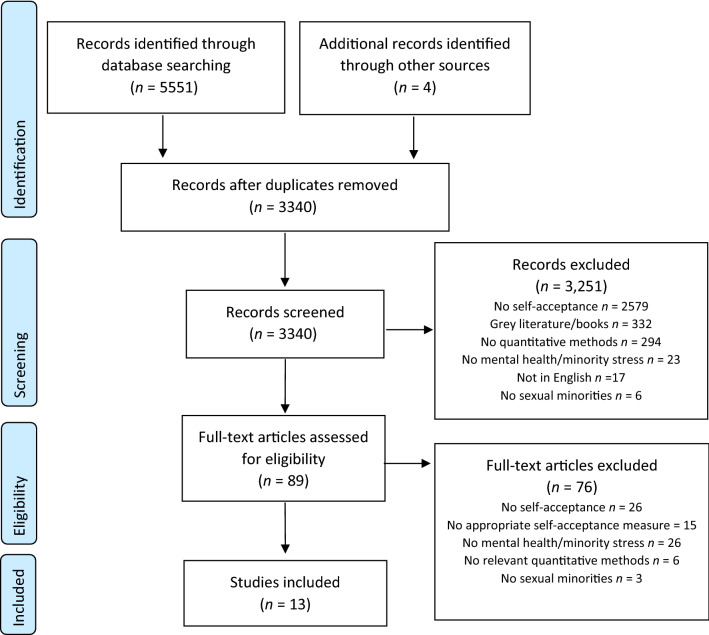
Many individuals who identify as lesbian, gay, bisexual, queer, and with other non-heterosexual orientations (LGBQ+) experience stigma, prejudice, and/or discrimination because of their sexuality. According to minority stress and identity development theories, these experiences can contribute to difficulties with self-acceptance of sexuality. Lower self-acceptance is considered a risk factor for adverse mental health outcomes. The current review aims to investigate whether self-acceptance of sexuality is associated with minority stressors or difficulties with mental health in LGBQ+ individuals, as well as whether there are differences in self-acceptance between different sexual orientations. Five bibliographic databases were searched. Thirteen studies were identified which used quantitative methodology to investigate associations between self-acceptance, minority stressors, and/or mental health within LGBQ+ samples, or differences in self-acceptance between different sexual orientations. The results from these cross-sectional studies suggested that lower self-acceptance of sexuality was associated with higher levels of self-reported minority stressors, including a lack of acceptance from friends and family, a lack of disclosure to others, and internalized heterosexism. Lower self-acceptance of sexuality was associated with poorer mental health outcomes, including greater global distress, depression symptoms, and lower psychological well-being. There was no significant relationship with suicidality. Studies also found that LGBQ+ individuals had lower general self-acceptance compared to heterosexual participants, bisexual individuals had lower sexuality self-acceptance compared to lesbian/gay individuals, and lesbian women had lower sexuality self-acceptance compared to gay men. Given the potential importance of self-acceptance for LGBQ+ populations, further research is required with more robust methodology. Self-acceptance could be a potential target in clinical interventions for LGBQ+ individuals.
许多自认为是女同性恋、男同性恋、双性恋、酷儿和其他非异性恋取向的人(LGBQ+)由于性取向而经历污名化、偏见和/或歧视。根据少数群体应激和身份发展理论,这些经历可能导致他们难以接受自己的性取向。较低的自我接纳被认为是不良心理健康结果的一个风险因素。本综述旨在调查性取向的自我接纳是否与 LGBQ+个体的少数群体应激源或心理健康问题有关,以及不同性取向之间的自我接纳是否存在差异。检索了五个文献数据库。确定了 13 项研究,这些研究采用定量方法调查了 LGBQ+样本中自我接纳、少数群体应激源和/或心理健康之间的关联,或不同性取向之间的自我接纳差异。这些横断面研究的结果表明,较低的性取向自我接纳与较高水平的自我报告少数群体应激源相关,包括来自朋友和家人的不接受、对他人的不披露以及内化的异性恋偏见。较低的性取向自我接纳与较差的心理健康结果相关,包括更大的总体困扰、抑郁症状和较低的心理幸福感。与自杀意念没有显著关系。研究还发现,与异性恋参与者相比,LGBQ+个体的一般自我接纳较低,与男同性恋者相比,双性恋个体的性取向自我接纳较低,与男同性恋者相比,女同性恋者的性取向自我接纳较低。鉴于自我接纳对 LGBQ+群体的潜在重要性,需要采用更稳健的方法进行进一步研究。自我接纳可能是 LGBQ+个体临床干预的一个潜在目标。