Department of Veterinary Clinical Sciences, Faculty of Health and Medical Sciences, University of Copenhagen, Copenhagen, Denmark.
Department of Biomedical Sciences, Faculty of Health and Medical Sciences, University of Copenhagen, Copenhagen, Denmark.
Equine Vet J. 2021 Mar;53(2):397-403. doi: 10.1111/evj.13301. Epub 2020 Jun 28.
Cardiac arrhythmias in horses are diagnosed by auscultation or electrocardiogram (ECG), which results in a low sensitivity for detecting arrhythmias that occur sporadically. Implantable loop recorders (ILRs) are small ECG devices placed subcutaneously, to automatically detect arrhythmias in human patients.
To test ILRs ability to detect atrial fibrillation (AF) in horses. Furthermore, we hypothesised that anatomical location of the implant site might influence signal quality. Signal quality was evaluated both during exercise and over time.
Experimental study.
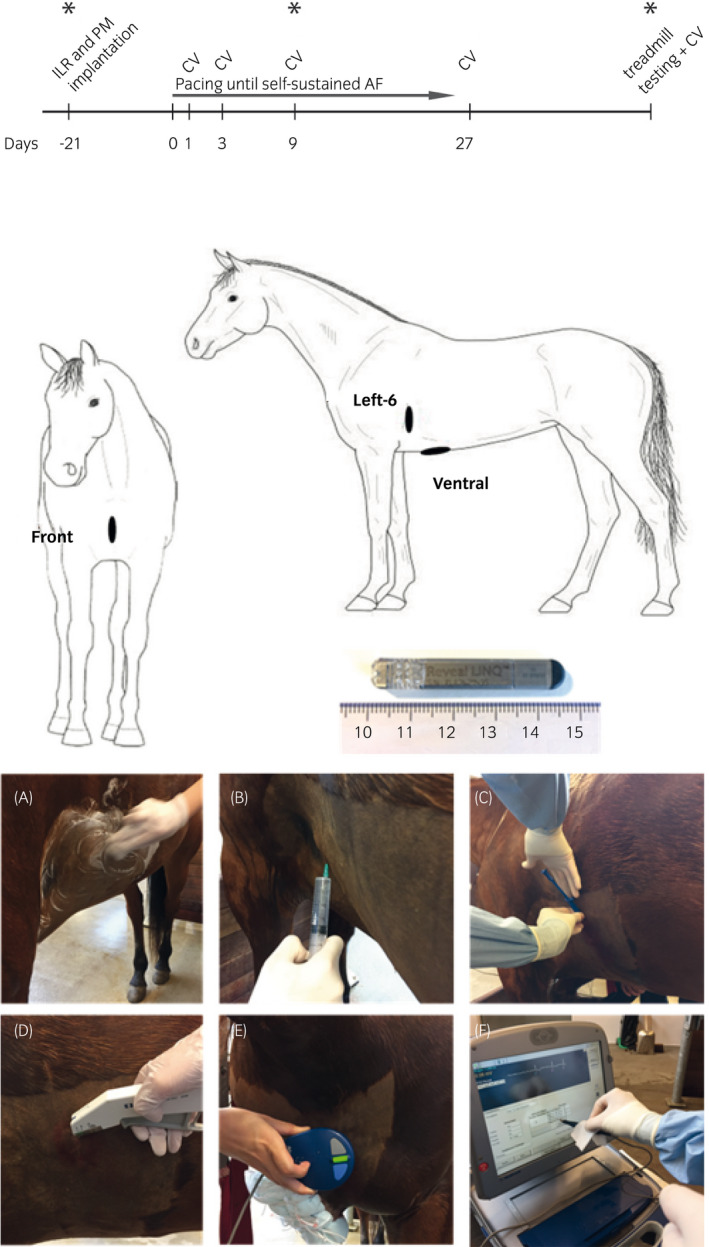
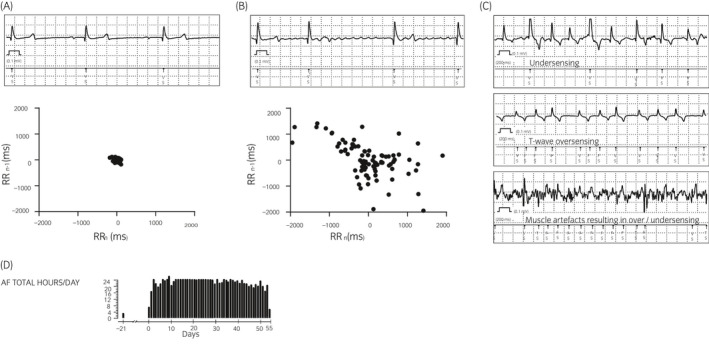
In five Standardbred mares, eleven ILRs were implanted subcutaneously in up to three different positions (Front: pectoral region, Left-6: sixth left intercostal space and Ventral: xiphoid region) and AF induced. The R- and T-wave amplitudes were measured in all positions over time during AF. AF burden automatically registered by the ILRs over a 2-month period was compared with selected Holter ECG recordings.
All three positions had stable R- and T-wave amplitudes during the study period and were of sufficient quality to allow AF detection at rest. The position Left-6 showed significantly higher R- and T-wave amplitudes compared with the other positions. During submaximal exercise only the Left-6 position was able to record ECG signals of diagnostic quality. No position yielded diagnostic signals at maximum exercise due to artefacts.
Few horses and ILRs included and no spontaneous AF episodes were studied.
This preliminary study indicates that ILRs can be used for AF detection in horses, but the anatomical location is important for optimal ECG quality. Despite insufficient quality during exercise, ILRs were suitable for AF detection at rest. Therefore, the ILR may be a valuable diagnostic tool for detecting paroxysmal AF in horses.
通过听诊或心电图(ECG)诊断马的心律失常,这导致对偶尔发生的心律失常的检测灵敏度较低。植入式环路记录器(ILR)是一种小型 ECG 设备,可皮下放置,以自动检测人类患者的心律失常。
测试 ILR 检测马心房颤动(AF)的能力。此外,我们假设植入部位的解剖位置可能会影响信号质量。评估了在运动期间和随时间推移的信号质量。
实验研究。
在五匹标准种母马中,将十一个 ILR 皮下植入多达三个不同位置(前:胸区、左 6:第六左肋间空间和腹:剑状突区)并诱导 AF。在 AF 期间,在所有位置随时间测量 R 波和 T 波幅度。ILR 自动记录的 AF 负担在 2 个月的时间内与选定的 Holter ECG 记录进行了比较。
所有三个位置在研究期间都具有稳定的 R 波和 T 波幅度,并且质量足以在休息时检测到 AF。位置左 6 与其他位置相比,R 波和 T 波幅度明显更高。在亚最大运动期间,只有左 6 位置能够记录出具有诊断质量的 ECG 信号。由于伪影,在最大运动时没有位置产生诊断信号。
包括的马和 ILR 数量较少,并且没有研究自发性 AF 发作。
这项初步研究表明,ILR 可用于马的 AF 检测,但解剖位置对于最佳 ECG 质量很重要。尽管在运动期间质量不足,但 ILR 仍适用于休息时的 AF 检测。因此,ILR 可能是检测马阵发性 AF 的有价值的诊断工具。