King's College London British Heart Foundation Centre London United Kingdom.
Department of Pediatric Nephrology Evelina London Children's Hospital London United Kingdom.
J Am Heart Assoc. 2020 Jun 16;9(12):e015097. doi: 10.1161/JAHA.119.015097. Epub 2020 Jun 6.
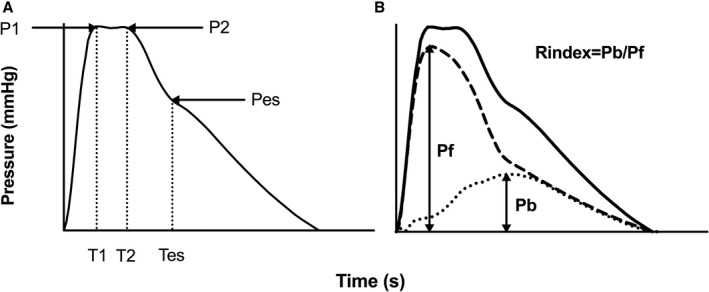
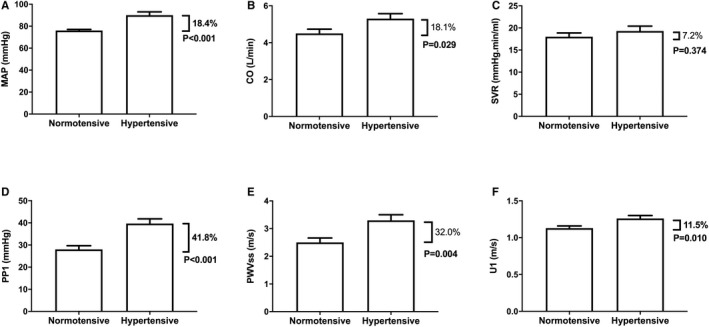
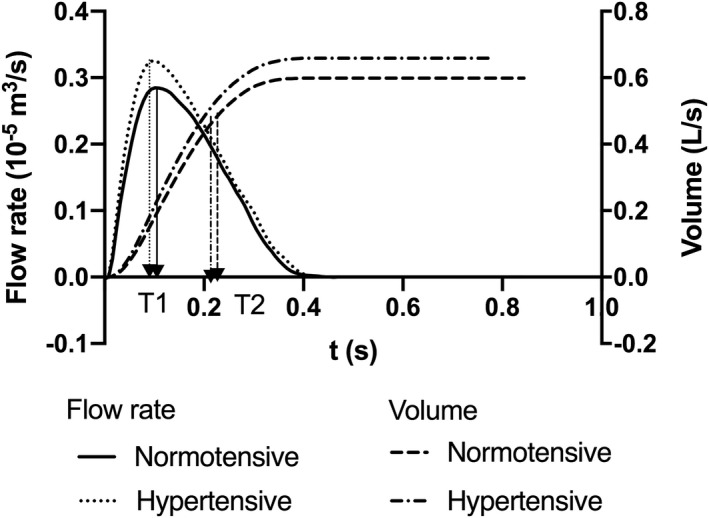
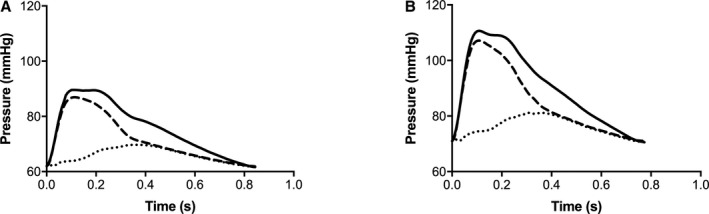
Background Primary hypertension in children is often characterized by high pulse pressure that could be attributable to increased ventricular ejection velocities and volumes and/or increased arterial stiffness. The objective of this study was to examine the contributions of cardiac (ventricular ejection) and vascular (systemic vascular resistance, arterial stiffness, and pressure wave reflection) properties to primary hypertension in children and adolescents. Methods and Results Children aged 8 to 18 years referred to a tertiary center for evaluation of hypertension and found to have primary hypertension (n=31) were compared with normotensive controls of similar age (n=50). Peripheral (brachial) and central (carotid) blood pressure waveforms and carotid-femoral pulse wave velocity were measured by tonometry. Left ventricular outflow tract velocities and ejection volumes were measured by echocardiography. Wave separation and wave intensity analysis were used to assess pressure wave propagation. Increased mean arterial pressure in hypertensive children (90±15 versus 76±10 mmHg in hypertensive versus normotensive children; means±SD; <0.001) was explained by increased heart rate and cardiac output (5.3±2.0 versus 4.5±1.2 L/min adjusted for age and sex; <0.05) rather than increased systemic vascular resistance (18.0±4.6 versus 19.3±7.3 mmHg/min/mL; =0.374). A more-marked increase in pulsatility (peripheral pulse pressure 66±21 versus 46±12 mmHg; <0.001) was explained by increased proximal aortic stiffness (pulse wave velocity, 3.3±1.4 versus 2.5±0.8 m/s; <0.005) and increased left ventricular ejection velocity (1.33±0.24 versus 1.21±0.18 m/s; <0.05). Conclusions Cardiac overactivity characterized by increased heart rate and left ventricular ejection velocities and increased proximal pulse wave velocity may be the main cause of primary hypertension in children.
儿童原发性高血压常表现为脉压升高,这可能归因于心室射血速度和容积的增加和/或动脉僵硬度的增加。本研究旨在探讨心脏(心室射血)和血管(全身血管阻力、动脉僵硬度和压力波反射)特性对儿童和青少年原发性高血压的影响。
研究人员比较了 31 名因高血压就诊于三级医疗中心的 8 至 18 岁儿童原发性高血压患者和 50 名年龄匹配的血压正常的对照组。通过张力测量法测量外周(肱动脉)和中央(颈动脉)血压波形和颈动脉-股动脉脉搏波速度。通过超声心动图测量左心室流出道速度和射血容积。应用波分离和波强分析评估压力波传播。与血压正常的儿童相比,高血压儿童的平均动脉压升高(90±15 与 76±10mmHg;均值±标准差;<0.001),这是由心率和心输出量增加(5.3±2.0 与 4.5±1.2L/min,按年龄和性别调整;<0.05)引起的,而不是全身血管阻力增加(18.0±4.6 与 19.3±7.3mmHg/min/mL;=0.374)。外周脉搏压升高(66±21 与 46±12mmHg;<0.001)更明显,这是由近端主动脉僵硬度增加(脉搏波速度,3.3±1.4 与 2.5±0.8m/s;<0.005)和左心室射血速度增加(1.33±0.24 与 1.21±0.18m/s;<0.05)引起的。
以心率和左心室射血速度增加以及近端脉搏波速度增加为特征的心脏过度活动可能是儿童原发性高血压的主要原因。