Wallings Rebecca L, Herrick Mary K, Tansey Malú Gámez
Department of Neuroscience and Center for Translational Research in Neurodegenerative Disease, University of Florida College of Medicine, Gainesville, FL, United States.
Laney Graduate School, Emory University, Atlanta, GA, United States.
Front Neurosci. 2020 May 21;14:443. doi: 10.3389/fnins.2020.00443. eCollection 2020.
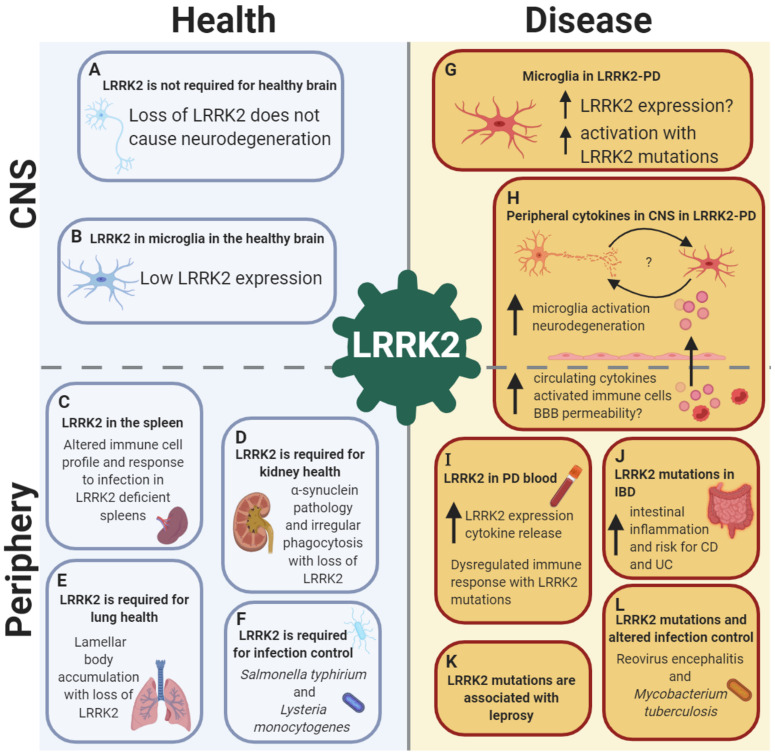
It is becoming increasingly accepted that there is an interplay between the peripheral immune response and neuroinflammation in the pathophysiology of Parkinson's disease (PD). Mutations in the () gene are associated with familial and sporadic cases of PD but are also found in immune-related disorders, such as inflammatory bowel disease (IBD) and leprosy. Furthermore, LRRK2 has been associated with bacterial infections such as and . Recent evidence suggests a role of LRRK2 in the regulation of the immune system and modulation of inflammatory responses, at a systemic level, with LRRK2 functionally implicated in both the immune system of the central nervous system (CNS) and the periphery. It has therefore been suggested that peripheral immune signaling may play an important role in the regulation of neurodegeneration in LRRK2 as well as non-LRRK2-associated PD. This review will discuss the current evidence for this hypothesis and will provide compelling rationale for placing LRRK2 at the interface between peripheral immune responses and neuroinflammation.
越来越多的人认为,在帕金森病(PD)的病理生理学中,外周免疫反应与神经炎症之间存在相互作用。()基因的突变与家族性和散发性PD病例相关,但也见于免疫相关疾病,如炎症性肠病(IBD)和麻风病。此外,LRRK2与诸如和等细菌感染有关。最近的证据表明,LRRK2在全身水平上参与免疫系统的调节和炎症反应的调节,在功能上与中枢神经系统(CNS)和外周的免疫系统都有关联。因此,有人提出外周免疫信号可能在LRRK2以及非LRRK2相关PD的神经退行性变调节中发挥重要作用。本综述将讨论这一假说的当前证据,并为将LRRK2置于外周免疫反应与神经炎症之间的界面提供令人信服的理由。