Wang Jinhui, Wang Jieqi, Ma Chao, Zhou Ziqi, Yang Decheng, Zheng Junzan, Wang Qi, Li Huiwen, Zhou Hongyang, Sun Zhijun, Liu Hanxi, Li Jianyi, Chen Lin, Kang Qinglin, Qi Zhaoming, Jiang Hongwei, Zhu Rongsheng, Wu Xiaoxia, Liu Chunyan, Chen Qingshan, Xin Dawei
Key Laboratory of Soybean Biology of Chinese Ministry of Education, Key Laboratory of Soybean Biology and Breeding/Genetics of Chinese Agriculture Ministry, College of Agriculture, Northeast Agricultural University, Harbin, China.
Jilin Academy of Agricultural Sciences, Changchun, China.
Front Plant Sci. 2020 May 19;11:453. doi: 10.3389/fpls.2020.00453. eCollection 2020.
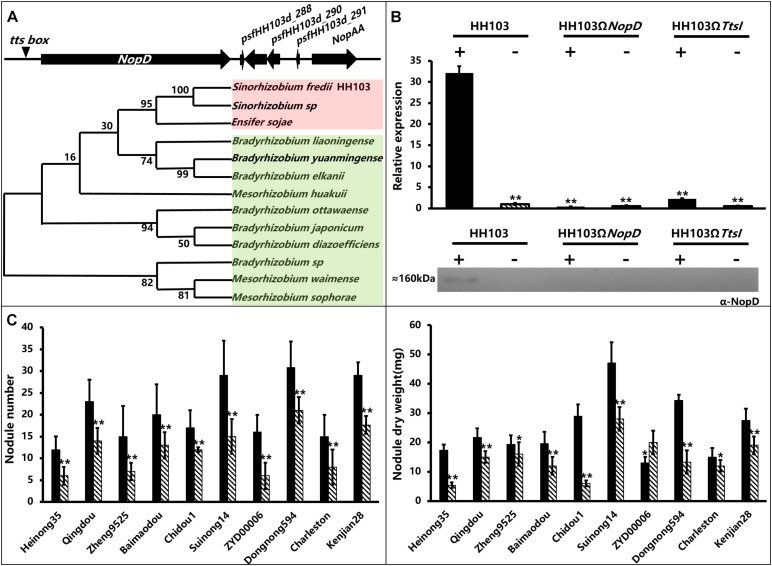
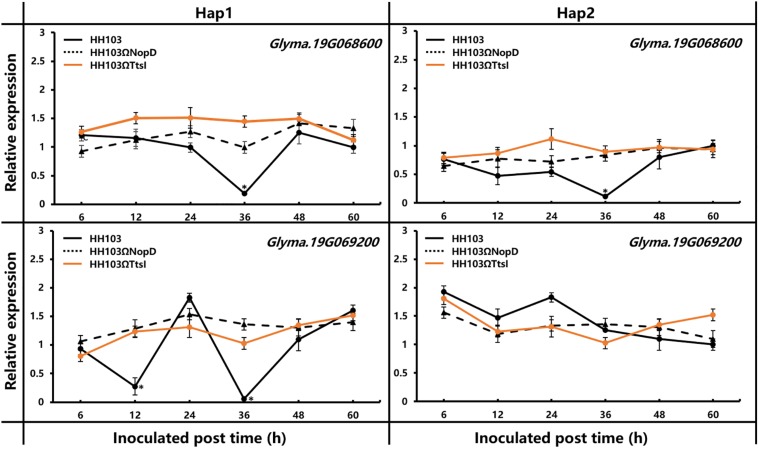
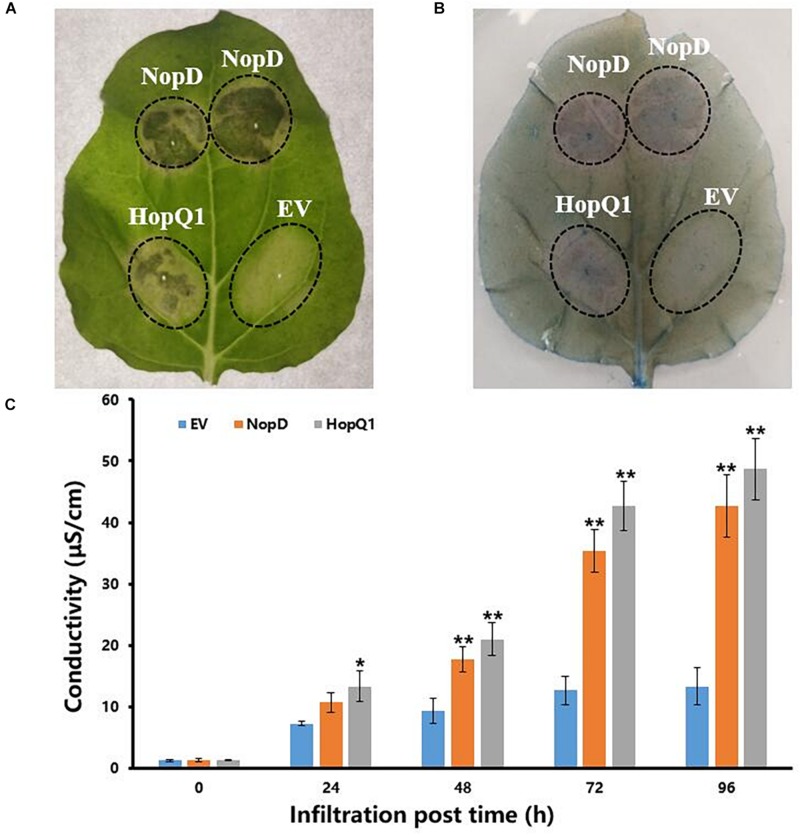
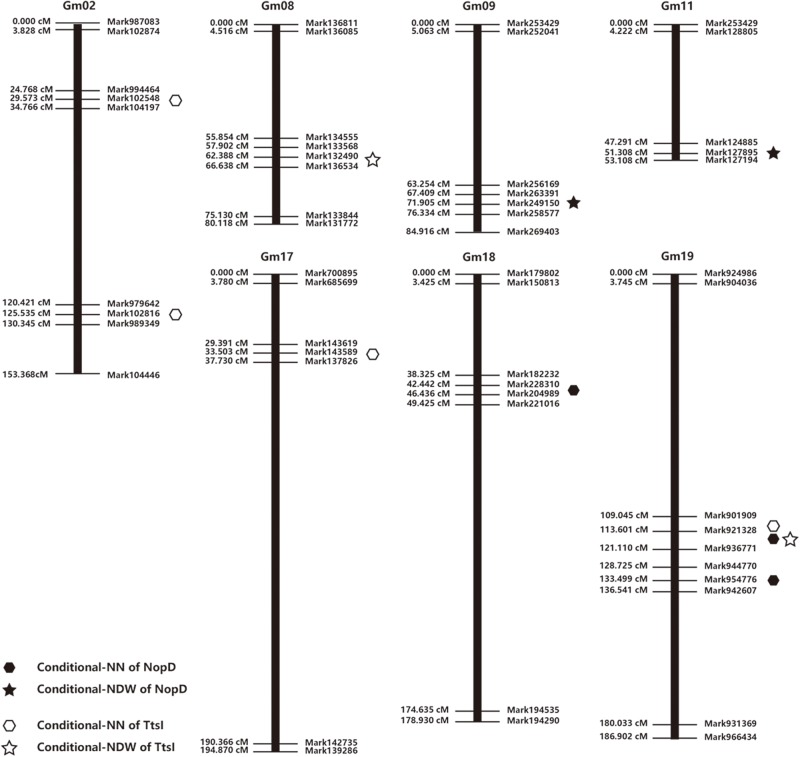
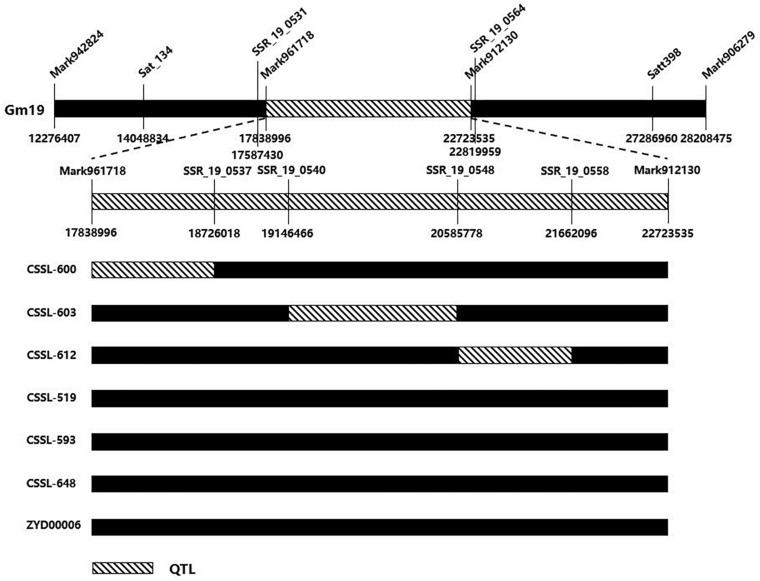
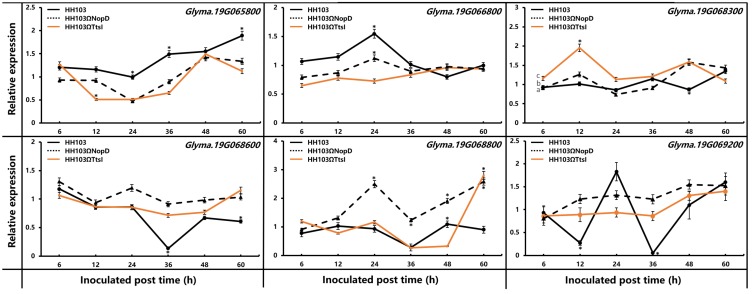
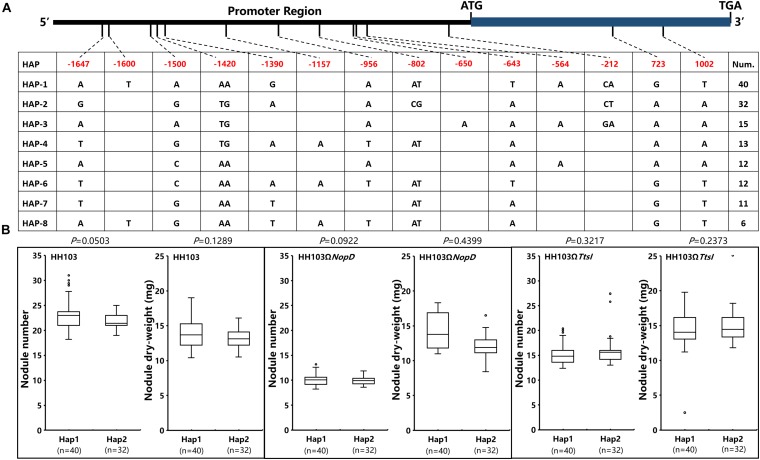
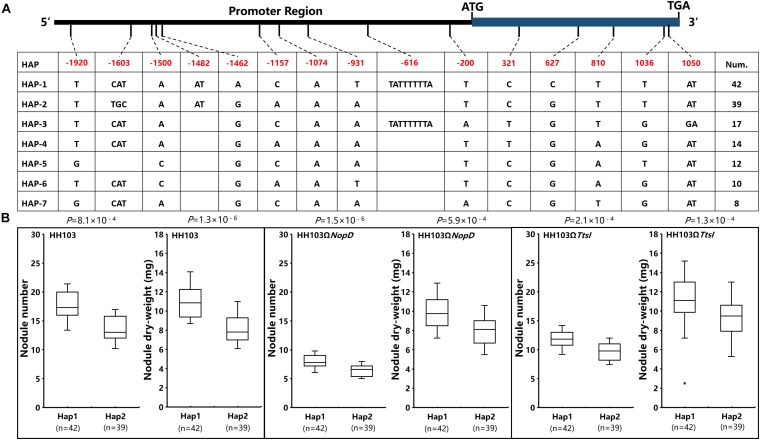
In some legume-rhizobium symbioses, host specificity is influenced by rhizobial type III effectors-nodulation outer proteins (Nops). However, the genes encoding host proteins that interact with Nops remain unknown. In this study, we aimed to identify candidate soybean genes associated with NopD, one of the type III effectors of HH103. The results showed that the expression pattern of NopD was analyzed in rhizobia induced by genistein. We also found NopD can be induced by TtsI, and NopD as a toxic effector can induce tobacco leaf death. In 10 soybean germplasms, NopD played a positively effect on nodule number (NN) and nodule dry weight (NDW) in nine germplasms, but not in Kenjian28. Significant phenotype of NN and NDW were identified between Dongnong594 and Charleston, Suinong14 and ZYD00006, respectively. To map the quantitative trait locus (QTL) associated with NopD, a recombinant inbred line (RIL) population derived from the cross between Dongnong594 and Charleston, and chromosome segment substitution lines (CSSLs) derived from Suinong14 and ZYD00006 were used. Two overlapping conditional QTL associated with NopD on chromosome 19 were identified. Two candidate genes were identified in the confident region of QTL, we found that NopD could influence the expression of (FBD/LRR) and expression of (PP2C) after HH103 infection. Haplotype analysis showed that different types of haplotypes could cause significant nodule phenotypic differences, but (FBD/LRR) was not. These results suggest that NopD promotes HH103 infection directly or indirectly regulating and expression during the establishment of symbiosis between rhizobia and soybean plants.
在一些豆科植物 - 根瘤菌共生关系中,宿主特异性受根瘤菌III型效应子——结瘤外蛋白(Nops)影响。然而,编码与Nops相互作用的宿主蛋白的基因仍不清楚。在本研究中,我们旨在鉴定与HH103的III型效应子之一NopD相关的候选大豆基因。结果表明,在染料木黄酮诱导的根瘤菌中分析了NopD的表达模式。我们还发现NopD可被TtsI诱导,并且NopD作为一种毒性效应子可诱导烟草叶片死亡。在10份大豆种质中,NopD对9份种质的根瘤数(NN)和根瘤干重(NDW)有正向影响,但对垦鉴28没有影响。分别在东农594和Charleston、绥农14和ZYD00006之间鉴定出了显著的NN和NDW表型。为了定位与NopD相关的数量性状位点(QTL),使用了以东农594和Charleston杂交产生的重组自交系(RIL)群体,以及以绥农14和ZYD00006为亲本构建的染色体片段代换系(CSSL)。在第19号染色体上鉴定出了两个与NopD相关的重叠条件QTL。在QTL的置信区间内鉴定出两个候选基因,我们发现HH103感染后NopD可影响(FBD/LRR)和(PP2C)的表达。单倍型分析表明,不同类型的单倍型可导致显著的根瘤表型差异,但(FBD/LRR)则不然。这些结果表明,NopD在根瘤菌与大豆植物共生关系建立过程中通过直接或间接调节和的表达来促进HH103感染。