Wang Jinhui, Ma Chao, Ma Shengnan, Zheng Haiyang, Feng Haojie, Wang Yue, Wang Jiangxu, Liu Chunyan, Xin Dawei, Chen Qingshan, Yang Mingliang
College of Agriculture, Key Laboratory of Soybean Biology in Chinese Ministry of Education, Northeast Agricultural University, Harbin, China.
Heilongjiang Academy of Agricultural Sciences, Harbin, China.
Front Genet. 2022 May 27;13:889795. doi: 10.3389/fgene.2022.889795. eCollection 2022.
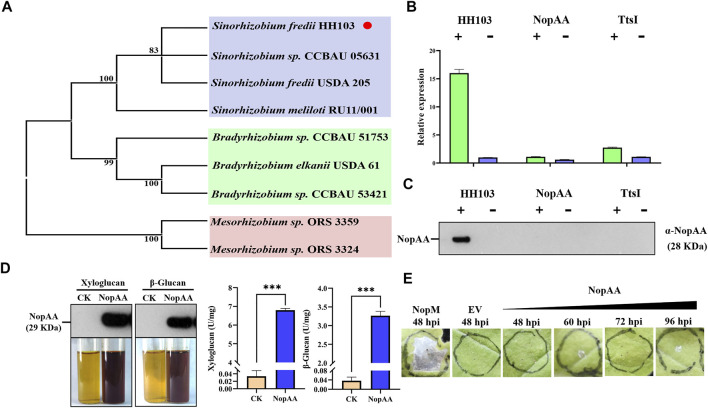
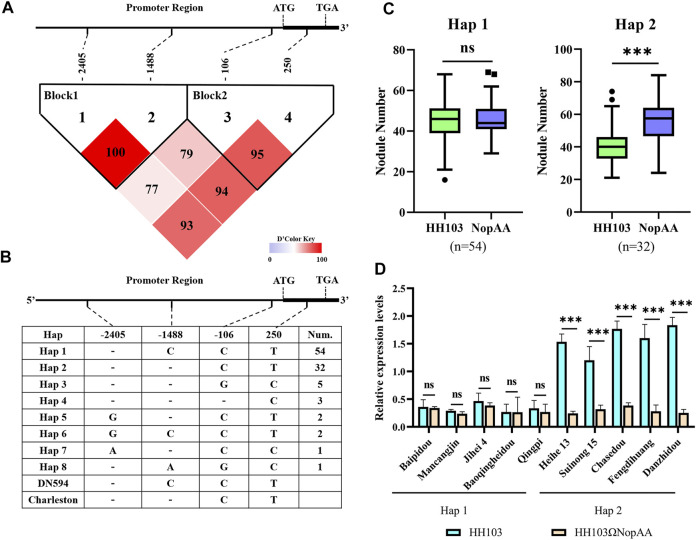
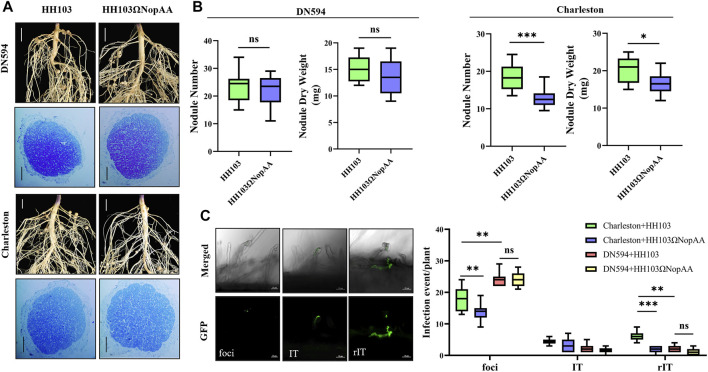
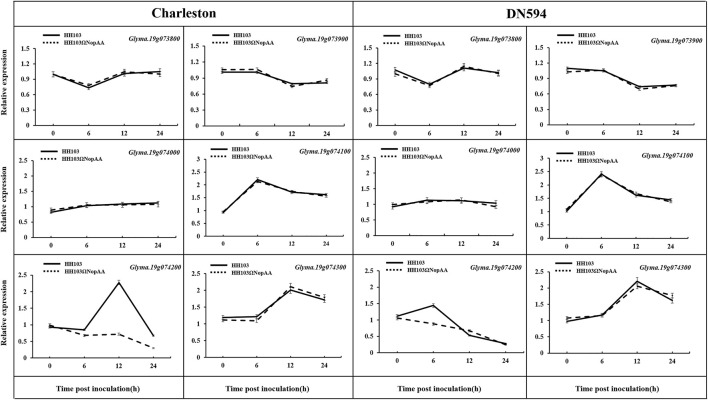
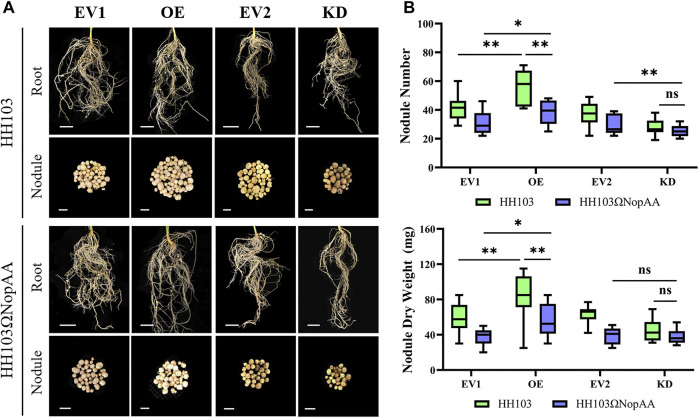
Type III effectors secreted by rhizobia regulate nodulation in the host plant and are important modulators of symbiosis between rhizobia and soybean (), although the underlying mechanisms are poorly understood. Here, we studied the type III effector NopAA in HH103, confirming its secretion into the extracellular environment under the action of genistein. The enzyme activity of NopAA was investigated , using xyloglucan and β-glucan as substrates. NopAA functions were investigated by the generation of a NopAA mutant and the effects of NopAA deficiency on symbiosis were analyzed. Soybean genes associated with NopAA were identified in a recombinant inbred line (RIL) population and their functions were verified. NopAA was confirmed to be a type III effector with glycosyl hydrolase activity, and its mutant did not promote nodulation. Quantitative trait locus (QTL) analysis identified 10 QTLs with one, (), found to be associated with NopAA and to positively regulate the establishment of symbiosis All these results support the hypothesis that type III effectors interact with host proteins to regulate the establishment of symbiosis and suggest the possibility of manipulating the symbiotic soybean-rhizobia interaction to promote efficient nitrogen fixation.
根瘤菌分泌的III型效应蛋白调节宿主植物的结瘤过程,是根瘤菌与大豆共生关系的重要调节因子(),但其潜在机制尚不清楚。在此,我们研究了HH103中的III型效应蛋白NopAA,证实其在染料木黄酮的作用下分泌到细胞外环境中。以木葡聚糖和β-葡聚糖为底物,研究了NopAA的酶活性。通过构建NopAA突变体研究其功能,并分析NopAA缺失对共生的影响。在重组自交系(RIL)群体中鉴定了与NopAA相关的大豆基因,并验证了其功能。证实NopAA是一种具有糖基水解酶活性的III型效应蛋白,其突变体不能促进结瘤。数量性状位点(QTL)分析确定了10个QTL,其中一个()与NopAA相关,并正向调节共生关系的建立。所有这些结果支持III型效应蛋白与宿主蛋白相互作用以调节共生关系建立的假说,并提示操纵大豆-根瘤菌共生相互作用以促进高效固氮的可能性。