Martin Eric, Beckham George
Kinesiology Department, California State University Monterey Bay, 100 Campus Center, Seaside, California 93933 USA.
BMC Sports Sci Med Rehabil. 2020 May 25;12:33. doi: 10.1186/s13102-020-00174-z. eCollection 2020.
Since World Rugby changed the laws regarding scrums in the 2013-2014 season, the sustained push phase of the scrum has increased in tactical importance. Therefore, the purpose of this systematic literature review was to examine the biomechanical demands during the sustained push phase of individual, unit, and full pack scrummaging.
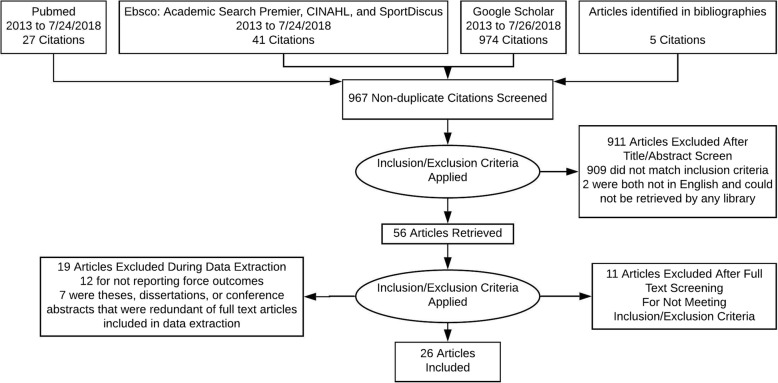
Pubmed, EBSCO (specifically and simultaneously searching Academic Search Premier, CINAHL, and SPORTDiscus), and Google Scholar were searched for any research that presented force production in a live or simulated rugby scrum. Study quality was appraised using the National Institute of Health's Quality Assessment Tool for Observational Cohort and Cross-Sectional Studies. Recorded scrum forces, positioning of players including joint angles, and testing procedures were extracted and narratively synthesized.
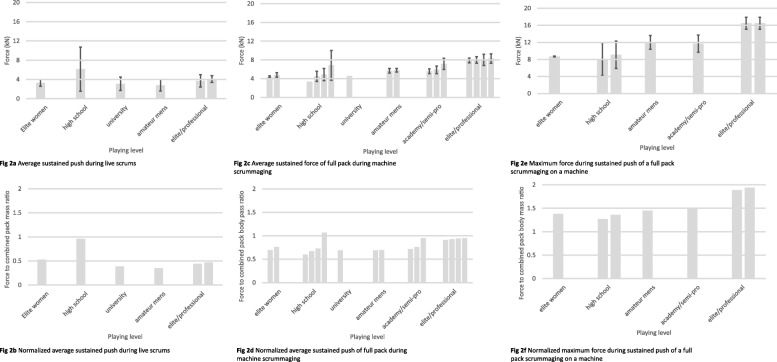
Twenty six studies were included in the review. 50% of included studies were rated good, 31% fair, and 19% poor. Major limitations included not reporting any effect size, statistical power, or reliability. Reported group mean values for average sustained forces against a machine generally ranged from 1000 to 2000 N in individual scrums and 4000-8000 N for full packs of male rugby players older than high school age. Individuals seem to optimize their force generation when their shoulders are set against scrum machine pads at approximately 40% of body height, with feet parallel, and with knee and hip angles around 120°. A 10% difference in pack force seems to be necessary for one pack to drive another back in the scrum, but little data exist to quantify differences in force production between winning and losing packs during live scrums. Data collection within studies was not standardized, making comparisons difficult. There is a lack of data in live scrums, and the current research indicates that machine scrums may not replicate many of the demands of live scrums. There is a lack of data for female rugby players.
This review indicates an optimal individual body position for players to strive to achieve during scrummaging, consisting of a low body height (40% of stature) and large extended hip and knee angles (120° each).
自世界橄榄球联合会在2013 - 2014赛季更改了关于争球的规则以来,争球的持续推挤阶段在战术重要性方面有所增加。因此,本系统文献综述的目的是研究个人、单元和整组争球持续推挤阶段的生物力学需求。
在PubMed、EBSCO(具体同时搜索学术搜索高级版、护理学与健康领域数据库和体育科学数据库)以及谷歌学术上搜索任何展示在现场或模拟橄榄球争球中力量产生情况的研究。使用美国国立卫生研究院的观察性队列研究和横断面研究质量评估工具对研究质量进行评估。提取记录的争球力量、包括关节角度在内的球员位置以及测试程序,并进行叙述性综合分析。
该综述纳入了26项研究。纳入研究中50%被评为良好,31%为中等,19%为较差。主要局限性包括未报告任何效应量、统计功效或可靠性。报告的针对机器的平均持续力量的组均值在个人争球中通常为1000至2000牛,对于高中年龄以上的成年男性橄榄球运动员整组争球而言为4000 - 8000牛。当个体将肩部靠在争球机器垫上,高度约为身高的40%,双脚平行,膝盖和髋部角度约为120°时,似乎能优化力量产生。在争球中,一组要将另一组向后推,两组力量似乎需要有10%的差异,但关于现场争球中获胜组和失败组力量产生差异的数据很少。研究中的数据收集未标准化,难以进行比较。现场争球方面缺乏数据,当前研究表明机器争球可能无法复制现场争球的许多需求。女性橄榄球运动员的数据也很缺乏。
本综述指出了球员在争球过程中应努力达到的最佳个人身体姿势,即低身高(身高的40%)以及较大的髋部和膝盖伸展角度(各120°)。