Mello Bruno Freitas, de Carvalho Formiga Márcio, de Souza da Silva Luiz Fernando, Dos Santos Coura Gustavo, Shibli Jamil Awad
Department of Periodontology and Oral Implantology, Dental Research Division, University of Guarulhos, Sao Paulo, Brazil.
Department of Implantology, Unisociesc, Florianópolis, Brazil.
Case Rep Dent. 2020 May 14;2020:6723936. doi: 10.1155/2020/6723936. eCollection 2020.
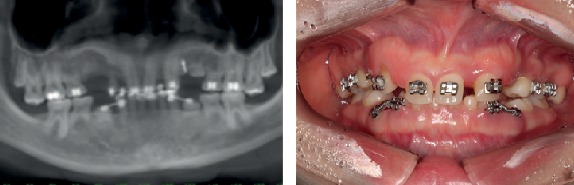
The guided bone regeneration (GBR) technique has been used to achieve optimal bone volume augmentation and allow dental implant placement in atrophic maxilla and mandible, with predictable results and high survival rates. The use of bone substitutes has reduced the necessity of autogenous bone grafts, reducing the morbidity at the donor areas and thus improving the patients' satisfaction and comfort. This clinical case report shows a clinical and histological evaluation of the bone tissue behavior, in a case that required the horizontal augmentation of the alveolar ridge, with the use of xenograft biomaterial and further dental implant placement. After six months of healing time, six implants were placed, and a bone biopsy was done. The histological analysis depicted some fragments of the xenograft bone graft, integrated with the new-formed bone tissue.
引导骨再生(GBR)技术已被用于实现最佳的骨量增加,并允许在萎缩的上颌骨和下颌骨中植入牙种植体,其结果可预测且生存率高。骨替代物的使用减少了自体骨移植的必要性,降低了供区的发病率,从而提高了患者的满意度和舒适度。本临床病例报告展示了在一例需要水平增高牙槽嵴并使用异种移植生物材料及后续植入牙种植体的病例中,对骨组织行为的临床和组织学评估。经过六个月的愈合期后,植入了六颗种植体,并进行了骨活检。组织学分析显示了一些异种移植骨移植物的碎片,与新形成的骨组织整合在一起。