Radisavljević Snežana, Petrović Biljana
Department of Chemistry, Faculty of Science, University of Kragujevac, Kragujevac, Serbia.
Front Chem. 2020 May 20;8:379. doi: 10.3389/fchem.2020.00379. eCollection 2020.
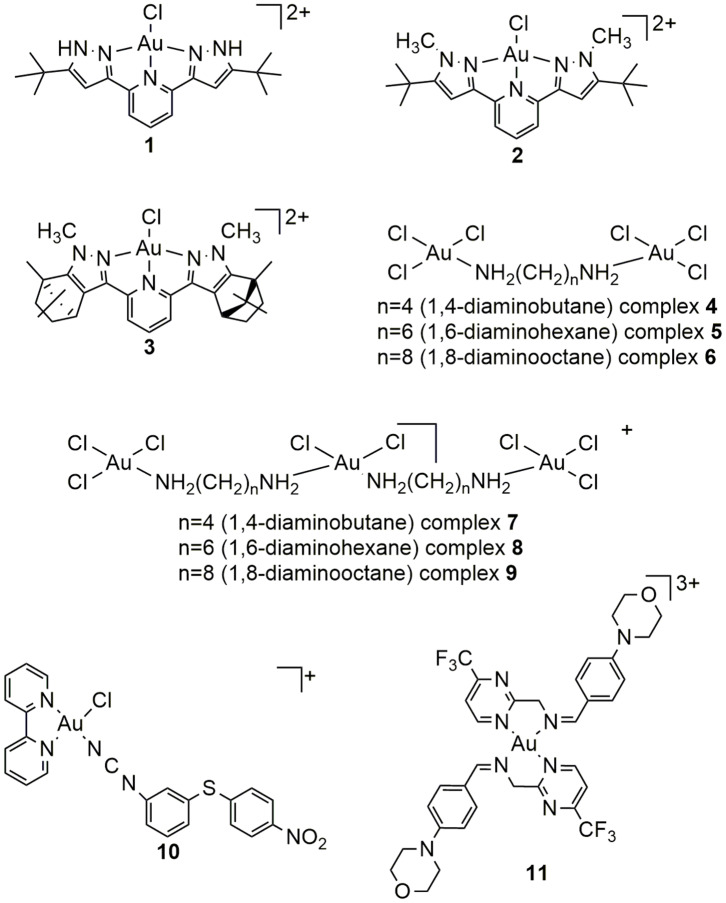
In the last few years, metallodrugs play a key role in the development of medicinal chemistry. The choice of metal ion, its oxidation state and stability, and the choice of inert and labile ligands are just some of the very important facts which must be considered before starting the synthesis of complexes with utilization in medicinal purpose. As a result, a lot of compounds of different transition metal ions found application for diagnostic and therapeutic purpose. Beside all, gold compounds have attracted particular attention. It is well-known that gold compounds could be used for the treatment of cancer, HIV, rheumatoid arthritis (chrysotherapy), and other diseases. This metal ion has unoccupied d-sublevels and possibility to form compounds with different oxidation states, from -1 to +5. However, gold(I) and gold(III) complexes are dominant in chemistry and medicine. Especially, gold(III) complexes are of great interest due to their structural similarity with cisplatin. Accordingly, this review summarizes the chemistry of some mononuclear and polynuclear gold(III) complexes. Special attention is given to gold(III) complexes with nitrogen-donor inert ligands (aliphatic or aromatic that have a possibility to stabilize complex) and their kinetic behavior toward different biologically relevant nucleophiles, mechanism of interaction with DNA/bovine serum albumin (BSA), cytotoxic activity, as well as computational calculations.
在过去几年中,金属药物在药物化学发展中发挥着关键作用。金属离子的选择、其氧化态和稳定性,以及惰性和活性配体的选择,只是在开始合成用于医学目的的配合物之前必须考虑的一些非常重要的因素。因此,许多不同过渡金属离子的化合物被用于诊断和治疗目的。除此之外,金化合物尤其受到关注。众所周知,金化合物可用于治疗癌症、艾滋病、类风湿性关节炎(金疗法)和其他疾病。这种金属离子具有未占据的d亚层,并且有可能形成具有从-1到+5不同氧化态的化合物。然而,金(I)和金(III)配合物在化学和医学中占主导地位。特别是,金(III)配合物因其与顺铂的结构相似性而备受关注。因此,本综述总结了一些单核和多核金(III)配合物的化学性质。特别关注了具有氮供体惰性配体(有可能稳定配合物的脂肪族或芳香族配体)的金(III)配合物及其对不同生物相关亲核试剂的动力学行为、与DNA/牛血清白蛋白(BSA)的相互作用机制、细胞毒性活性以及计算计算。