Department of Emergency Medicine, Shandong First Medical University, No. 366, Taishan Street, Taian, Shandong 271000, China.
South China Normal University, No. 55, Zhongshan Avenue, Guangzhou, Guangdong 510631, China.
Biomed Res Int. 2020 May 15;2020:6210201. doi: 10.1155/2020/6210201. eCollection 2020.
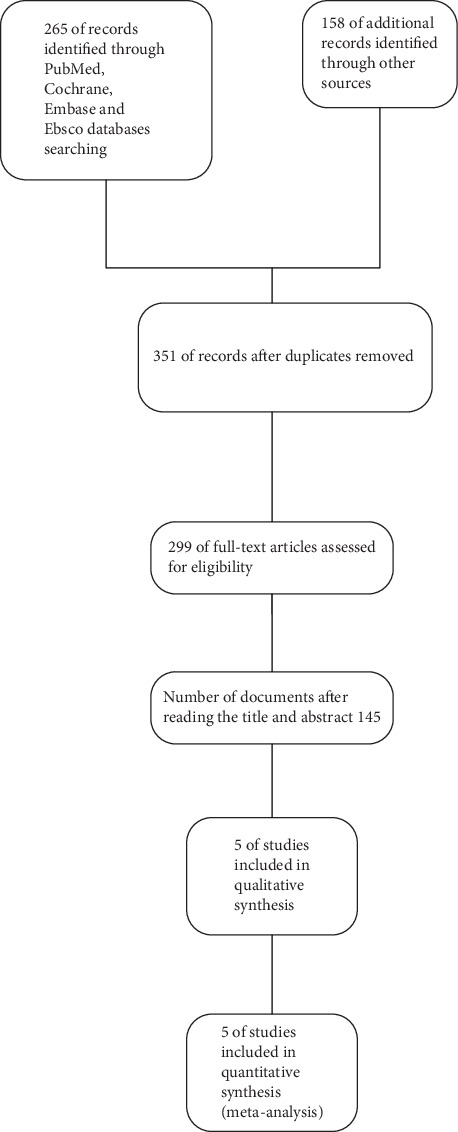
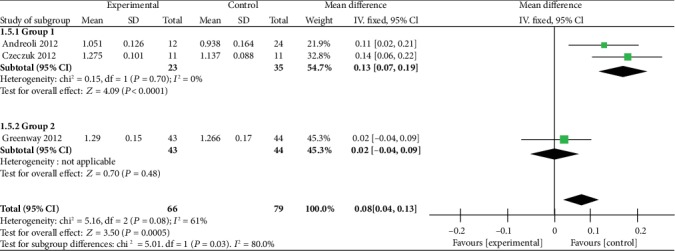
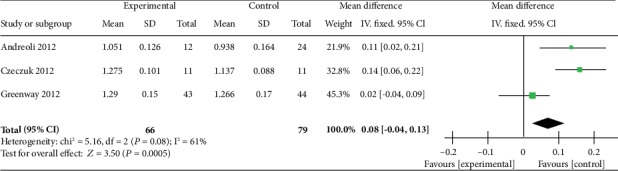
Osteoporosis is a chronic disease that seriously affects human health and quality of life. This study is aimed at determining whether swimming had an effect on the bone mineral density (BMD) of the spine and femoral neck in postmenopausal and premenopausal osteoporosis patients. We retrieved relevant literature and analyzed data from randomized controlled trials to assess the effect of swimming on BMD in postmenopausal and premenopausal women. Relevant studies, with no language restrictions, from inception to September 2019, were retrieved from the PubMed, Cochrane, EMBASE, and EBSCO databases independently by two investigators. The keywords used for the literature search were "osteoporosis" and "swimming." The main results included BMD and -score. We searched 256 relevant articles and finally screened five articles, including 263 participants. Lumbar spine density was mentioned in three articles. Although the heterogeneity of lumbar vertebral density is moderate, the analysis of swimmers to nonswimmers shows that the lumbar vertebral density in swimmers is improved [heterogeneity: chi = 5.16, df = 2 ( = 0.08); = 61%]. We analyzed the following heterogeneous subgroups: subgroup 1 (3-6 hours) and subgroup 2 (<3 hours). The BMD in subgroup 1 was significantly higher than that in the placebo, while no effect on BMD was found in subgroup 2 [heterogeneity: chi = 0.15, df = 3 ( = 0.70); = 0%]. According to the current evidence, swimming may improve the BMD of postmenopausal women participants, if the swimming time is between 3 and 6 hours, especially in long-term swimmers. However, the effectiveness of swimming does require further investigation.
骨质疏松症是一种严重影响人类健康和生活质量的慢性疾病。本研究旨在确定游泳是否对绝经后和绝经前骨质疏松症患者的脊柱和股骨颈骨矿物质密度(BMD)有影响。我们检索了相关文献,并对来自随机对照试验的数据进行了分析,以评估游泳对绝经后和绝经前妇女 BMD 的影响。相关研究,无语言限制,从开始到 2019 年 9 月,由两名研究者分别从 PubMed、Cochrane、EMBASE 和 EBSCO 数据库独立检索。文献检索的关键词为“骨质疏松症”和“游泳”。主要结果包括 BMD 和 -评分。我们检索了 256 篇相关文章,最终筛选了 5 篇文章,共 263 名参与者。有 3 篇文章提到了腰椎密度。虽然腰椎密度的异质性为中度,但游泳者与非游泳者的分析表明,游泳者的腰椎密度有所提高[异质性:chi = 5.16,df = 2 ( = 0.08); = 61%]。我们分析了以下异质亚组:亚组 1(3-6 小时)和亚组 2(<3 小时)。亚组 1 的 BMD 明显高于安慰剂,而亚组 2 对 BMD 无影响[异质性:chi = 0.15,df = 3 ( = 0.70); = 0%]。根据目前的证据,游泳可能会提高绝经后女性参与者的 BMD,如果游泳时间在 3 到 6 小时之间,特别是在长期游泳者中。然而,游泳的效果确实需要进一步研究。