Malin Steven K, Navaneethan Sankar D, Fealy Ciaran E, Scelsi Amanda, Huang Hazel, Rocco Michael, Kirwan John P
Department of Kinesiology University of Virginia Charlottesville VA USA.
Division of Endocrinology and Metabolism University of Virginia Charlottesville VA USA.
Obes Sci Pract. 2020 Feb 11;6(3):307-312. doi: 10.1002/osp4.408. eCollection 2020 Jun.
The incidence of chronic kidney disease (CKD) has increased in recent years. CKD is associated with obesity, type 2 diabetes, and cardiovascular disease, although the mechanism remains unclear. Elevated soluble form of the receptor for advanced glycation end products ( RAGE) is related to proinflammatory signaling pathways that may promote diabetic nephropathy and vascular dysfunction. Because lifestyle modification reduces systematic inflammation in adults with obesity and hyperglycaemia, the hypothesis that exercise plus caloric restriction would lower soluble RAGE in adults with CKD was tested in this study.
Eight adults (n = 6 females; age: 56.3 ± 2.8 y; BMI: 43.7 ± 2.2 kg/m; 2-h OGTT glucose: 215 ± 9.8 mg/dL; eGFR: 49.6 ± 3.3 mL/min/1.73 m) were enrolled in a 12-week pilot lifestyle intervention (supervised aerobic exercise [5 d/wk, up to 60 min/d at approximately 65%-85% HR] plus low-fat dietary counseling). Body composition (DXA), aerobic fitness (VOmax), insulin sensitivity (120 min 75 g OGTT; Matsuda Index), plasma levels of soluble RAGE and fetuin-A were measured before and after the intervention.
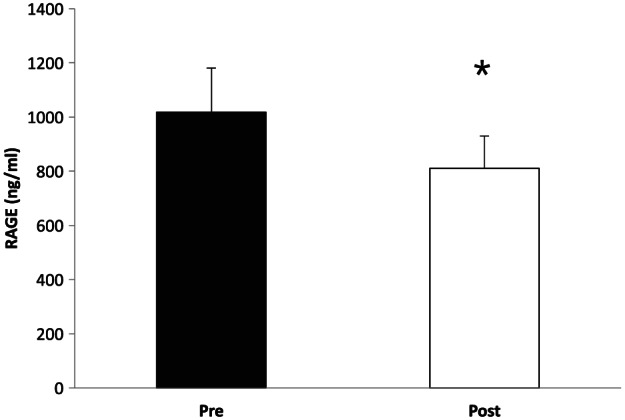
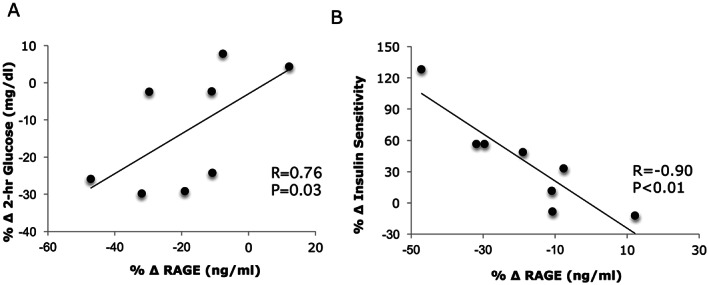
Exercise reduced body weight, fasting glucose, and fetuin-A as well as increased VOmax, glucose tolerance, and insulin sensitivity (all < .05). Lifestyle intervention decreased plasma soluble RAGE (pre: 1018.1 ± 163 vs post: 810.6 ± 119.6 ng/mL; = .02), and the decrease was associated with a lower 2-hour blood glucose ( = 0.76, = .03) and with increased insulin sensitivity ( = -0.90, < .01).
Exercise and caloric restriction are effective at lowering soluble RAGE in relation to glucose regulation in patients with CKD.
近年来,慢性肾脏病(CKD)的发病率有所上升。CKD与肥胖、2型糖尿病和心血管疾病相关,但其机制尚不清楚。晚期糖基化终产物受体(RAGE)的可溶性形式升高与促炎信号通路有关,可能会促进糖尿病肾病和血管功能障碍。由于生活方式的改变可减轻肥胖和高血糖成年人的全身炎症,因此本研究检验了运动加热量限制能否降低CKD成年人可溶性RAGE的假设。
八名成年人(n = 6名女性;年龄:56.3±2.8岁;体重指数:43.7±2.2kg/m;口服葡萄糖耐量试验2小时血糖:215±9.8mg/dL;估算肾小球滤过率:49.6±3.3mL/min/1.73m²)参加了为期12周的生活方式干预试点(有监督的有氧运动[每周5天,每天最多60分钟,心率约为65%-85%]加低脂饮食咨询)。在干预前后测量身体成分(双能X线吸收法)、有氧适能(最大摄氧量)、胰岛素敏感性(75g口服葡萄糖耐量试验120分钟;松田指数)、可溶性RAGE和胎球蛋白-A的血浆水平。
运动减轻了体重、空腹血糖和胎球蛋白-A,同时增加了最大摄氧量、糖耐量和胰岛素敏感性(均P<0.05)。生活方式干预降低了血浆可溶性RAGE(干预前:1018.1±163 vs干预后:810.6±119.6ng/mL;P = 0.02),且这种降低与较低的2小时血糖(r = 0.76,P = 0.03)和增加的胰岛素敏感性(r = -0.90,P<0.01)相关。
运动和热量限制对于降低CKD患者与血糖调节相关的可溶性RAGE有效。