The Second Clinical College, Guangzhou University of Chinese Medicine, Guangzhou, China.
Department of Nephrology, The Second Affiliated Hospital of Guangzhou University of Chinese Medicine, Guangdong Provincial Hospital of Chinese Medicine, Guangzhou, China.
Front Endocrinol (Lausanne). 2023 Mar 22;14:1096093. doi: 10.3389/fendo.2023.1096093. eCollection 2023.
Time-restricted feeding (TRF) has become a popular weight loss method in recent years. It is widely used in the nutritional treatment of normal obese people and obese people with chronic diseases such as diabetes mellitus and hypertension, and has shown many benefits. However, most TRF studies have excluded chronic kidney disease (CKD) patients, resulting in a lack of sufficient evidence-based practice for the efficacy and safety of TRF therapy for CKD. Therefore, we explore the efficacy and safety of TRF in overweight and obese patients with moderate-to-severe stage CKD through this pilot study, and observe patient compliance to assess the feasibility of the therapy.
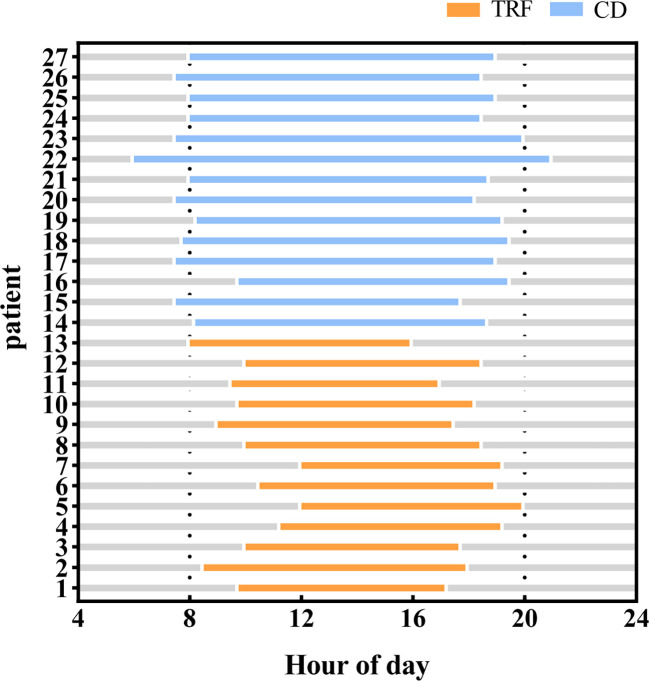
This is a prospective, non-randomized controlled short-term clinical trial. We recruited overweight and obese patients with CKD stages 3-4 from an outpatient clinic and assigned them to either a TRF group or a control diet (CD) group according to their preferences. Changes in renal function, other biochemical data, anthropometric parameters, gut microbiota, and adverse events were measured before the intervention and after 12 weeks.
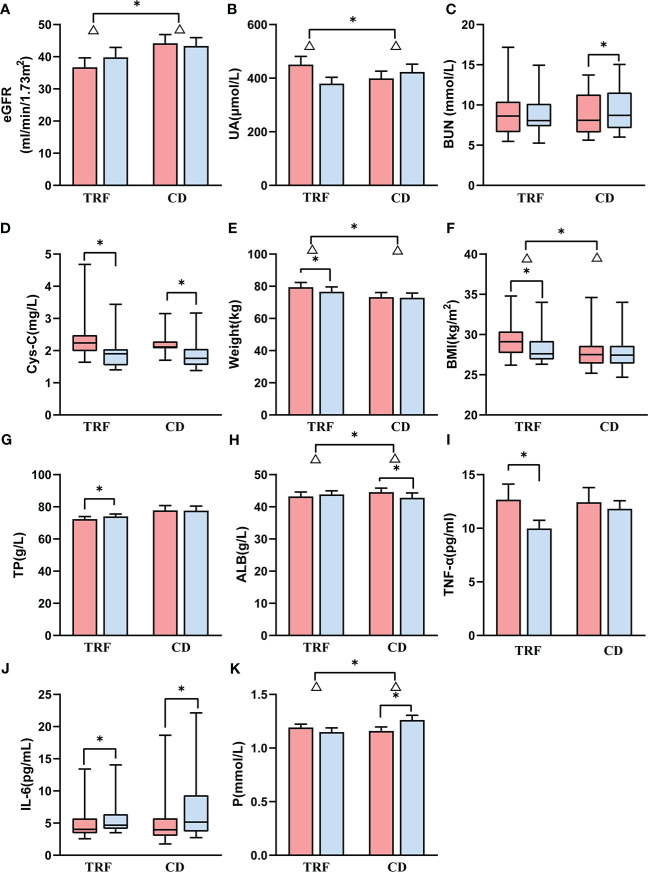
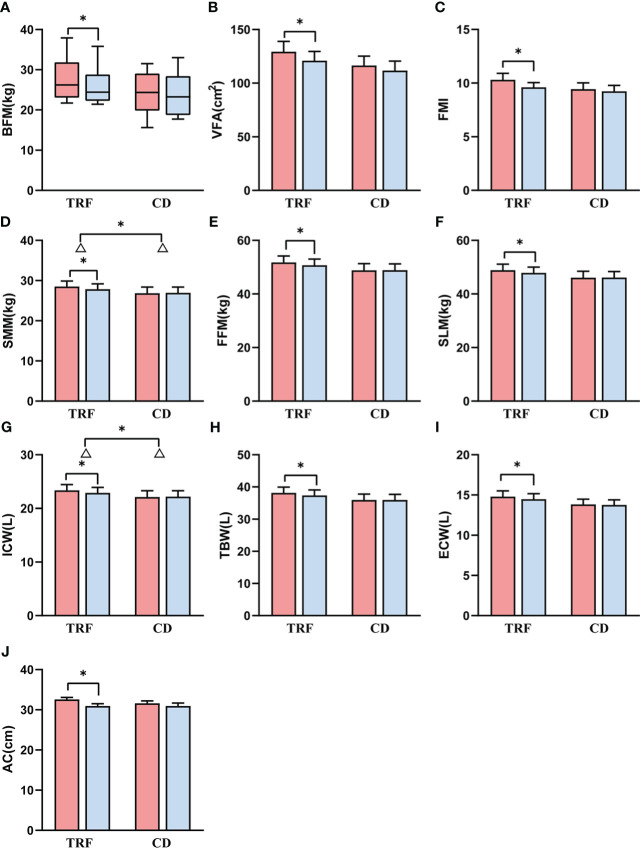
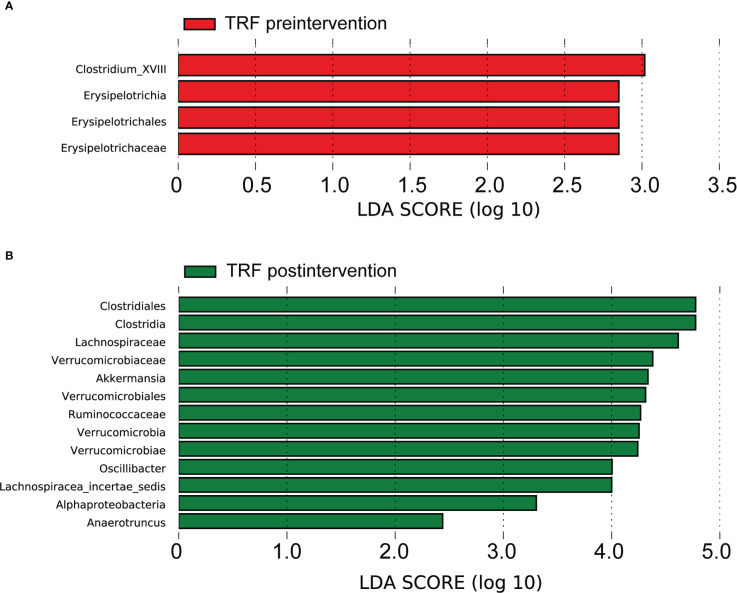
The change in estimated glomerular filtration rate (eGFR) before and after intervention in the TRF group (Δ = 3.1 ± 5.3 ml/min/1.73m) showed significant improvement compared with the CD group (Δ = -0.8 ± 4.4 ml/min/1.73m). Furthermore, the TRF group had a significant decrease in uric acid (Δ = -70.8 ± 124.2 μmol/L), but an increase in total protein (Δ = 1.7 ± 2.5 g/L), while the changes were inconsistent for inflammatory factors. In addition, the TRF group showed a significant decrease in body weight (Δ = -2.8 ± 2.9 kg) compared to the CD group, and body composition indicated the same decrease in body fat mass, fat free mass and body water. Additionally, TRF shifted the gut microbiota in a positive direction.
Preliminary studies suggest that overweight and obese patients with moderate-to-severe CKD with weight loss needs, and who were under strict medical supervision by healthcare professionals, performed TRF with good compliance. They did so without apparent adverse events, and showed efficacy in protecting renal function. These results may be due to changes in body composition and alterations in gut microbiota.
限时进食(TRF)近年来已成为一种流行的减肥方法。它广泛应用于正常肥胖人群和糖尿病、高血压等慢性病肥胖人群的营养治疗,并显示出许多益处。然而,大多数 TRF 研究都排除了慢性肾脏病(CKD)患者,因此缺乏 TRF 治疗 CKD 的疗效和安全性的充分循证实践。因此,我们通过这项初步研究探讨了超重和肥胖的中重度 CKD 患者 TRF 的疗效和安全性,并观察患者的依从性以评估该疗法的可行性。
这是一项前瞻性、非随机对照的短期临床试验。我们从门诊招募了中重度 CKD 阶段 3-4 的超重和肥胖患者,并根据他们的喜好将他们分配到限时进食组或对照饮食(CD)组。在干预前和 12 周后测量肾功能、其他生化数据、人体测量参数、肠道微生物群和不良事件的变化。
TRF 组干预前后估算肾小球滤过率(eGFR)的变化(Δ=3.1±5.3 ml/min/1.73m)明显优于 CD 组(Δ=-0.8±4.4 ml/min/1.73m)。此外,TRF 组尿酸显著下降(Δ=-70.8±124.2 μmol/L),但总蛋白增加(Δ=1.7±2.5 g/L),而炎症因子的变化则不一致。此外,与 CD 组相比,TRF 组体重明显下降(Δ=-2.8±2.9 kg),身体成分显示体脂量、去脂体重和体水量均下降。此外,TRF 使肠道微生物群向积极方向转变。
初步研究表明,在严格的医疗监督下,有减肥需求且体重过重的中重度 CKD 患者,依从性良好,可进行 TRF。他们没有明显的不良反应,且在保护肾功能方面显示出疗效。这些结果可能归因于身体成分的变化和肠道微生物群的改变。