Department of Biotechnological and Applied Clinical Sciences, University of L'Aquila, 67100 L'Aquila, Italy.
Int J Mol Sci. 2020 Jun 9;21(11):4124. doi: 10.3390/ijms21114124.
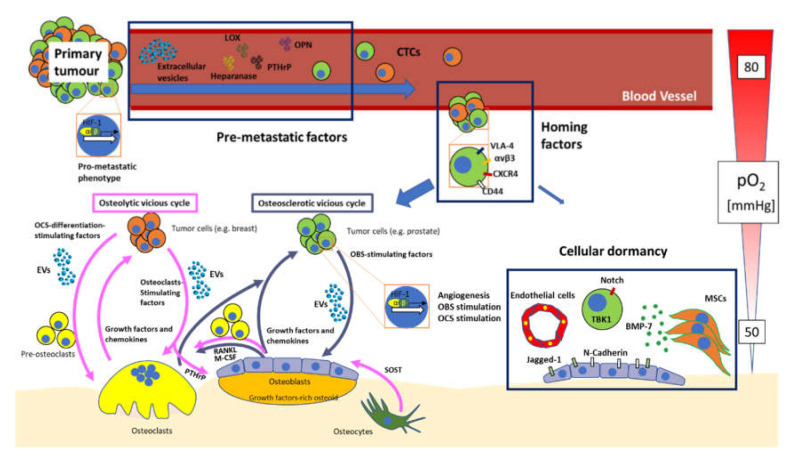
Bone metastases (BM) are a very common complication of the most prevalent human cancers. BM are extremely painful and may be life-threatening when associated with hypercalcaemia. BM can lead to kidney failure and cardiac arrhythmias and arrest, but why and how do cancer cells decide to "switch homes" and move to bone? In this review, we will present what answers science has provided so far, with focus on the molecular mechanisms and cellular aspects of well-established findings, such as the concept of "vicious cycle" and "osteolytic" vs. "osteosclerotic" bone metastases; as well as on novel concepts, such as cellular dormancy and extracellular vesicles. At the molecular level, we will focus on hypoxia-associated factors and angiogenesis, the Wnt pathway, parathyroid hormone-related peptide (PTHrP) and chemokines. At the supramolecular/cellular level, we will discuss tumour dormancy, id est the mechanisms through which a small contingent of tumour cells coming from the primary site may be kept dormant in the endosteal niche for many years. Finally, we will present a potential role for the multimolecular mediators known as extracellular vesicles in determining bone-tropism and establishing a premetastatic niche by influencing the bone microenvironment.
骨转移(BM)是最常见人类癌症的一种非常常见的并发症。BM 非常疼痛,当伴有高钙血症时可能危及生命。BM 可导致肾衰竭和心律失常和骤停,但癌细胞为什么以及如何决定“换家”并转移到骨骼?在这篇综述中,我们将介绍科学迄今为止提供的答案,重点介绍已确立发现的分子机制和细胞方面,例如“恶性循环”和“溶骨性”与“成骨性”骨转移的概念;以及新的概念,如细胞休眠和细胞外囊泡。在分子水平上,我们将重点关注缺氧相关因子和血管生成、Wnt 通路、甲状旁腺激素相关肽(PTHrP)和趋化因子。在超分子/细胞水平上,我们将讨论肿瘤休眠,即从原发性部位而来的一小部分肿瘤细胞通过何种机制在骨内膜龛中长期保持休眠状态。最后,我们将介绍称为细胞外囊泡的多分子介体在通过影响骨微环境来决定骨骼趋向性和建立前转移龛中可能发挥的作用。