Caffò Alessandro Oronzo, Tinella Luigi, Lopez Antonella, Spano Giuseppina, Massaro Ylenia, Lisi Andrea, Stasolla Fabrizio, Catanesi Roberto, Nardulli Francesco, Grattagliano Ignazio, Bosco Andrea
Dipartimento di Scienze della Formazione, Psicologia, Comunicazione, Università degli Studi di Bari Aldo Moro, Bari, Italy.
Department of Agricultural and Environmental Science, Faculty of Agricultural Science, University of Bari Aldo Moro, Bari, Italy.
Front Psychol. 2020 May 27;11:917. doi: 10.3389/fpsyg.2020.00917. eCollection 2020.
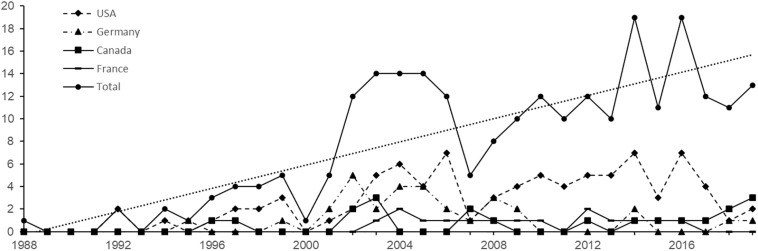
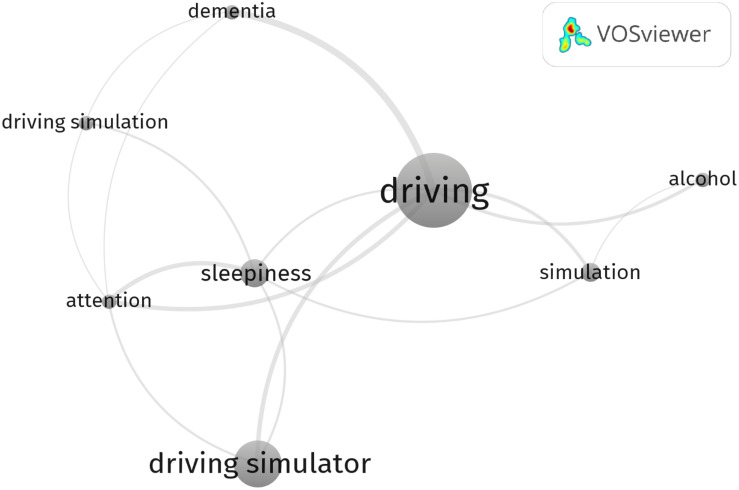
Driving behaviors and fitness to drive have been assessed over time using different tools: standardized neuropsychological, on-road and driving simulation testing. Nowadays, the great variability of topics related to driving simulation has elicited a high number of reviews. The present work aims to perform a scientometric analysis on driving simulation reviews and to propose a selective review of reviews focusing on relevant aspects related to validity and fidelity. A scientometric analysis of driving simulation reviews published from 1988 to 2019 was conducted. Bibliographic data from 298 reviews were extracted from Scopus and WoS. Performance analysis was conducted to investigate most prolific Countries, Journals, Institutes and Authors. A cluster analysis on authors' keywords was performed to identify relevant associations between different research topics. Based on the reviews extracted from cluster analysis, a selective review of reviews was conducted to answer questions regarding validity, fidelity and critical issues. United States and Germany are the first two Countries for number of driving simulation reviews. United States is the leading Country with 5 Institutes in the top-ten. Top Authors wrote from 3 to 7 reviews each and belong to Institutes located in North America and Europe. Cluster analysis identified three clusters and eight keywords. The selective review of reviews showed a substantial agreement for supporting validity of driving simulation with respect to neuropsychological and on-road testing, while for fidelity with respect to real-world driving experience a blurred representation emerged. The most relevant critical issues were the a) lack of a common set of standards, b) phenomenon of simulation sickness, c) need for psychometric properties, lack of studies investigating d) predictive validity with respect to collision rates and e) ecological validity. Driving simulation represents a cross-cutting topic in scientific literature on driving, and there are several evidences for considering it as a valid alternative to neuropsychological and on-road testing. Further research efforts could be aimed at establishing a consensus statement for protocols assessing fitness to drive, in order to (a) use standardized systems, (b) compare systematically driving simulators with regard to their validity and fidelity, and (c) employ shared criteria for conducting studies in a given sub-topic.
随着时间的推移,人们使用不同的工具对驾驶行为和驾驶适宜性进行了评估:标准化神经心理学测试、道路测试和驾驶模拟测试。如今,与驾驶模拟相关的主题差异很大,引发了大量的综述。本研究旨在对驾驶模拟综述进行科学计量分析,并针对与有效性和逼真度相关的重要方面提出选择性综述。对1988年至2019年发表的驾驶模拟综述进行了科学计量分析。从Scopus和WoS中提取了298篇综述的文献数据。进行了绩效分析,以调查最多产的国家、期刊、机构和作者。对作者关键词进行了聚类分析,以确定不同研究主题之间的相关关联。基于聚类分析中提取的综述,进行了选择性综述,以回答有关有效性、逼真度和关键问题的疑问。美国和德国是驾驶模拟综述数量排名前两位的国家。美国是领先国家,前十中有5个机构。顶级作者每人撰写了3至7篇综述,他们隶属于位于北美和欧洲的机构。聚类分析确定了三个聚类和八个关键词。选择性综述表明,在支持驾驶模拟相对于神经心理学测试和道路测试的有效性方面存在实质性共识,而在与现实世界驾驶体验相关的逼真度方面则呈现出模糊的表述。最相关的关键问题是:a)缺乏一套通用标准;b)模拟晕动病现象;c)对心理测量特性的需求,缺乏研究调查d)相对于碰撞率的预测有效性和e)生态有效性。驾驶模拟是驾驶科学文献中的一个交叉主题,有若干证据表明可将其视为神经心理学测试和道路测试的有效替代方法。进一步的研究工作可旨在为评估驾驶适宜性的方案制定一份共识声明,以便(a)使用标准化系统;(b)就其有效性和逼真度系统地比较驾驶模拟器;(c)采用共享标准在给定子主题中开展研究。