WHO Collaborating Center, Institute for Maternal and Child Health-IRCCS Burlo Garofolo, Trieste, Italy
WHO Collaborating Center, Institute for Maternal and Child Health-IRCCS Burlo Garofolo, Trieste, Italy.
BMJ Open. 2020 Jun 11;10(6):e034738. doi: 10.1136/bmjopen-2019-034738.
5.0 million annual deaths in low-income and middle-income countries are due to poor quality of care (QOC). We evaluated the QOC provided to malnourished children in West Nile Region in Uganda.
Cross-sectional study.
West Nile Region, an area hosting over one million refugees.
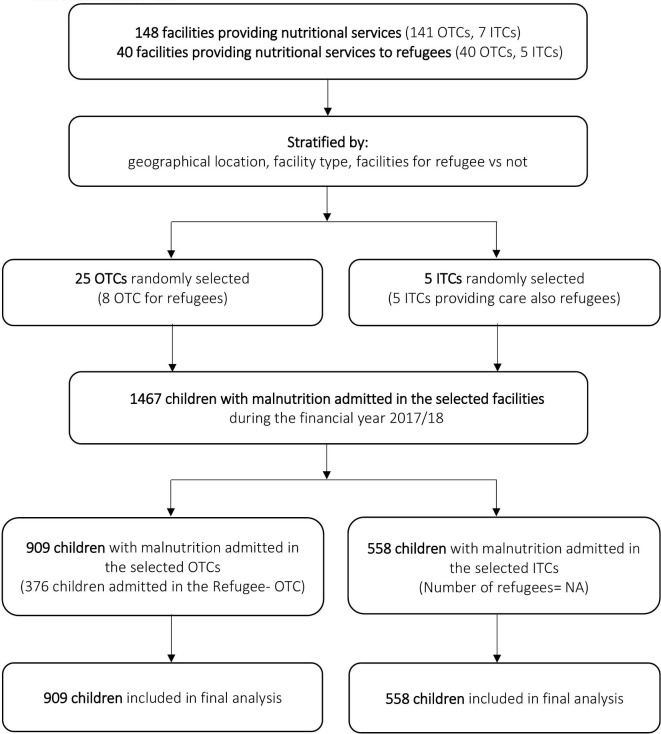
Among 148 facilities providing nutritional services, 30 randomly selected facilities (20%) and the records of 1467 children with severe acute malnutrition (100% of those attending the 30 facilities during last year) were assessed.
The national Nutrition Service Delivery Assessment (NSDA) tool was used to assess capacity areas related to QOC. Case management, data quality and health outcomes were assessed from official health records. Multivariate analysis was performed to explore factors significantly associated with better cure rates.
Of 305 NSDA scores allocated to 30 participating centres, 201 (65.9%) were 'good' or 'excellent'. However, 20 (66.7%) facilities had 'poor' 'quality improvement mechanisms' and 13 (43.3%) had 'poor' 'human resources'. Overall data quality in official records was poor, while recorded quality of case management was overall fair. Average cure rate was significantly lower than international Sphere standards (50.4% vs 75% p<0.001) with a higher default rate (23.2% vs 15% p<0.001). Large heterogeneity among facilities was detected for all indicators. Refugee-hosting and non-refugee-hosting facilities had a similar cure rate (47.1% vs 52.1%) though transfer rates were higher for those hosting refugees (21.5% vs 1.9%, p<0.001) despite better 'equipment and supplies'. 'Good/excellent' 'equipment' and 'store management' were significantly associated with better cure rates in outpatient therapeutic centres (+55.9, p<0.001; +65.4, p=0.041, respectively) in multivariate analysis.
Though most NSDA capacity areas were rated good or excellent, health outcomes of malnourished children in West Nile Region, both in refugee-hosting and non-refugee-hosting facilities, are significantly below international standards. Effective and sustainable approaches to improve malnourished child health outcomes are needed.
低收入和中等收入国家每年有 500 万人死于医疗质量差。我们评估了乌干达西尼罗地区营养不良儿童的医疗质量。
横断面研究。
西尼罗地区,一个容纳超过 100 万难民的地区。
在提供营养服务的 148 个设施中,随机选择了 30 个设施(20%),并评估了 1467 名患有严重急性营养不良的儿童的记录(去年参加这 30 个设施的儿童 100%)。
使用国家营养服务提供评估(NSDA)工具评估与医疗质量相关的能力领域。从官方卫生记录中评估病例管理、数据质量和健康结果。进行多变量分析以探讨与更高治愈率显著相关的因素。
在分配给 30 个参与中心的 305 个 NSDA 评分中,201 个(65.9%)为“良好”或“优秀”。然而,20 个(66.7%)设施的“质量改进机制”较差,13 个(43.3%)设施的“人力资源”较差。官方记录中的整体数据质量较差,而记录的病例管理质量总体良好。平均治愈率明显低于国际 Sphere 标准(50.4%对 75%,p<0.001),违约率更高(23.2%对 15%,p<0.001)。所有指标在各设施之间均存在较大差异。难民收容所和非难民收容所的收容所的治愈率相似(47.1%对 52.1%),尽管收容难民的设施的转移率更高(21.5%对 1.9%,p<0.001),但“设备和用品”更好。多变量分析显示,门诊治疗中心的“良好/优秀”“设备”和“储存管理”与更好的治愈率显著相关(+55.9,p<0.001;+65.4,p=0.041)。
尽管大多数 NSDA 能力领域的评分均为良好或优秀,但西尼罗地区营养不良儿童的健康结果,无论是在难民收容所还是非难民收容所,均明显低于国际标准。需要采取有效和可持续的方法来改善营养不良儿童的健康结果。