International Breast Cancer Study Group Statistical Center, Department of Data Sciences, Division of Biostatistics, Dana-Farber Cancer Institute, 450 Brookline Ave, Boston, MA, 02215, USA.
Institute of Oncology of Southern Switzerland, Geneva University Hospitals, Swiss Group for Clinical Cancer Research (SAKK), Lugano Viganello, Switzerland.
Breast. 2020 Oct;53:1-7. doi: 10.1016/j.breast.2020.05.012. Epub 2020 Jun 2.
Although randomized controlled clinical trials are optimal to evaluate the effect of an experimental therapy, single-arm trials are required whenever randomization is unethical or not feasible, such as de-escalation studies. We propose using prospectively identified historical controls to place results of single-arm, de-escalation trials into context.
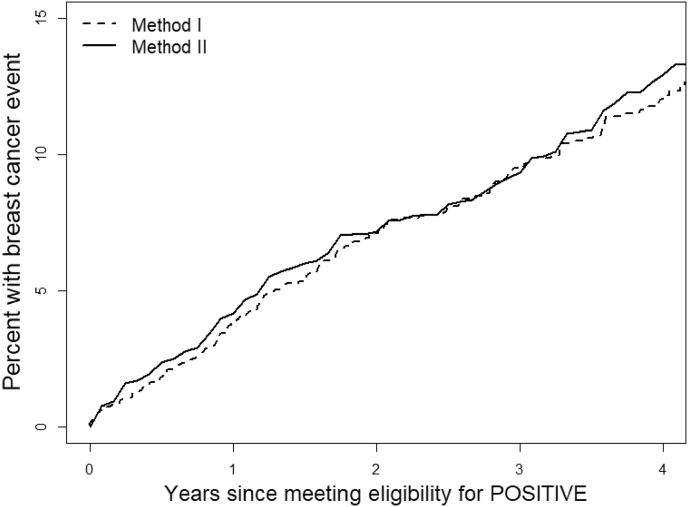
POSITIVE is a prospective, single-arm study in young women with hormone-receptor-positive early breast cancer to determine if temporarily interrupting adjuvant endocrine therapy in order to become pregnant increases the risk of a breast cancer event. After 272 women enrolled in POSITIVE, we identified a cohort of 1499 SOFT/TEXT patients potentially eligible to enroll in POSITIVE who did not interrupt endocrine therapy. Method I used the SOFT/TEXT cohort to calculate annualized hazard rates by a piecewise exponential model. Method II used the SOFT/TEXT cohort to group-match SOFT/TEXT patients to POSITIVE patients; sample sets of SOFT/TEXT patients were randomly drawn 5000 times to obtain sets having patient, disease, and treatment characteristics more balanced with POSITIVE participants.
Compared with SOFT/TEXT, POSITIVE participants were younger, less likely to be overweight/obese, had fewer positive nodes, and fewer received aromatase inhibitor or chemotherapy. The estimated 3-year breast cancer free interval event rates were 9.5% (95% CI: 7.9%,11.1%) for Method I and 9.4% (95% CI: 7.8%,10.9%) for Method II, compared with 5.8% initially assumed when POSITIVE was designed.
External control datasets should be identified before launching single-arm, de-escalation trials and methods applied during their conduct to provide context for interim monitoring and interpretation of the final analysis.
虽然随机对照临床试验是评估实验性治疗效果的最佳方法,但在随机化不道德或不可行的情况下,如降级研究,需要进行单臂试验。我们建议使用前瞻性确定的历史对照来将单臂、降级试验的结果置于上下文中。
POSITIVE 是一项针对年轻激素受体阳性早期乳腺癌女性的前瞻性单臂研究,旨在确定暂时中断辅助内分泌治疗以怀孕是否会增加乳腺癌事件的风险。在 POSITIVE 入组 272 名女性后,我们确定了一个潜在符合入组条件的 1499 名 SOFT/TEXT 患者队列,他们没有中断内分泌治疗。方法 I 使用 SOFT/TEXT 队列通过分段指数模型计算年化风险率。方法 II 使用 SOFT/TEXT 队列对 SOFT/TEXT 患者进行分组匹配;SOFT/TEXT 患者的样本集随机抽取 5000 次,以获得与 POSITIVE 参与者更平衡的患者、疾病和治疗特征的样本集。
与 SOFT/TEXT 相比,POSITIVE 参与者更年轻,超重/肥胖的可能性更小,阳性淋巴结更少,接受芳香化酶抑制剂或化疗的患者更少。方法 I 估计的 3 年无乳腺癌间期事件率为 9.5%(95%CI:7.9%,11.1%),方法 II 为 9.4%(95%CI:7.8%,10.9%),而 POSITIVE 设计时最初假设为 5.8%。
在开展单臂、降级试验之前应确定外部对照数据集,并在其进行过程中应用方法,为中期监测和最终分析解释提供背景。