Qin Bo, Yu Jia, Nowsheen Somaira, Zhao Fei, Wang Liewei, Lou Zhenkun
Division of Oncology, Mayo Clinic, Rochester, MN 55905, USA.
Division of Clinical Pharmacology, Department of Molecular Pharmacology and Experimental Therapeutics, Mayo Clinic, Rochester, MN 55905, USA.
Sci Adv. 2020 Jun 3;6(23):eaax8214. doi: 10.1126/sciadv.aax8214. eCollection 2020 Jun.
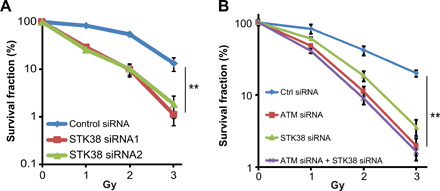
The ATM (ataxia-telangiectasia mutated) kinase is rapidly activated following DNA damage and phosphorylates its downstream targets to launch DDR signaling. Recently, we and others showed that UFM1 signaling promotes ATM activation. We further discovered that monoufmylation of histone H4 at Lys by UFM1-specific ligase 1 (UFL1) is an important step in the amplification of ATM activation. However, how monoufmylated H4 enhances ATM activation is still unknown. Here, we report STK38, a kinase in the Hippo pathway, serves as a reader for histone H4 ufmylation to promote ATM activation in a kinase-independent manner. STK38 contains a potential UFM1 binding motif which recognizes ufmylated H4 and recruits the SUV39H1 to the double-strand breaks, resulting in H3K9 trimethylation and Tip60 activation to promote ATM activation. Together, STK38 is a previously unknown player in DNA damage signaling and functions as a reader of monoufmylated H4 at Lys to promote ATM activation.
共济失调毛细血管扩张症突变(ATM)激酶在DNA损伤后迅速被激活,并使其下游靶点磷酸化以启动DNA损伤反应(DDR)信号传导。最近,我们和其他研究人员表明,UFM1信号传导促进ATM激活。我们进一步发现,UFM1特异性连接酶1(UFL1)在赖氨酸处对组蛋白H4进行单泛素化修饰是ATM激活放大过程中的重要一步。然而,单泛素化的H4如何增强ATM激活仍不清楚。在此,我们报告,Hippo通路中的激酶STK38作为组蛋白H4泛素化修饰的识别蛋白,以非激酶依赖的方式促进ATM激活。STK38含有一个潜在的UFM1结合基序,该基序识别泛素化的H4并将SUV39H1招募到双链断裂处,导致H3K9三甲基化和Tip60激活,从而促进ATM激活。总之,STK38是DNA损伤信号传导中一个先前未知的参与者,作为赖氨酸处单泛素化H4的识别蛋白促进ATM激活。