Donders Institute for Brain, Cognition and Behaviour, Radboud University Medical Center, Nijmegen, the Netherlands.
Department of Psychiatry, Radboud University Medical Center, Nijmegen, the Netherlands.
Psychol Med. 2022 Jan;52(2):303-313. doi: 10.1017/S0033291720001956. Epub 2020 Jun 15.
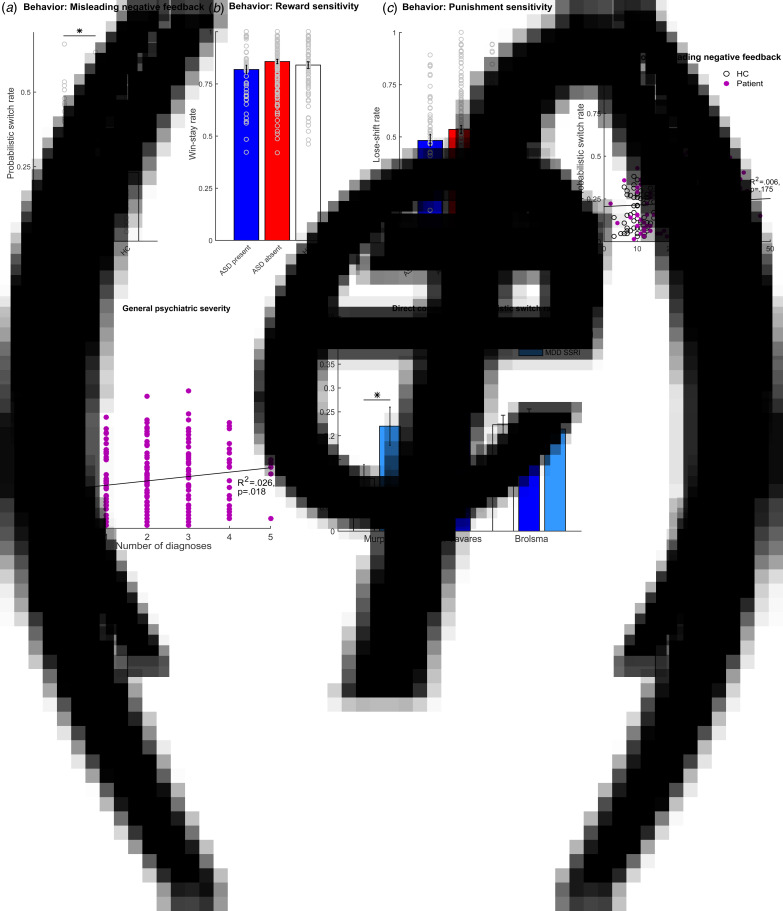
Classic theories posit that depression is driven by a negative learning bias. Most studies supporting this proposition used small and selected samples, excluding patients with comorbidities. However, comorbidity between psychiatric disorders occurs in up to 70% of the population. Therefore, the generalizability of the negative bias hypothesis to a naturalistic psychiatric sample as well as the specificity of the bias to depression, remain unclear. In the present study, we tested the negative learning bias hypothesis in a large naturalistic sample of psychiatric patients, including depression, anxiety, addiction, attention-deficit/hyperactivity disorder, and/or autism. First, we assessed whether the negative bias hypothesis of depression generalized to a heterogeneous (and hence more naturalistic) depression sample compared with controls. Second, we assessed whether negative bias extends to other psychiatric disorders. Third, we adopted a dimensional approach, by using symptom severity as a way to assess associations across the sample.
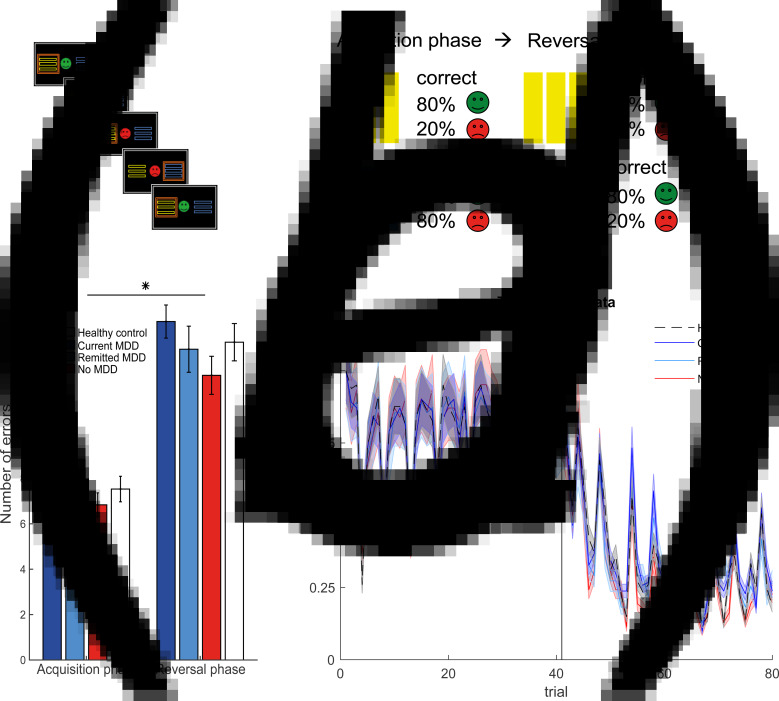
We administered a probabilistic reversal learning task to 217 patients and 81 healthy controls. According to the negative bias hypothesis, participants with depression should exhibit enhanced learning and flexibility based on punishment v. reward. We combined analyses of traditional measures with more sensitive computational modeling.
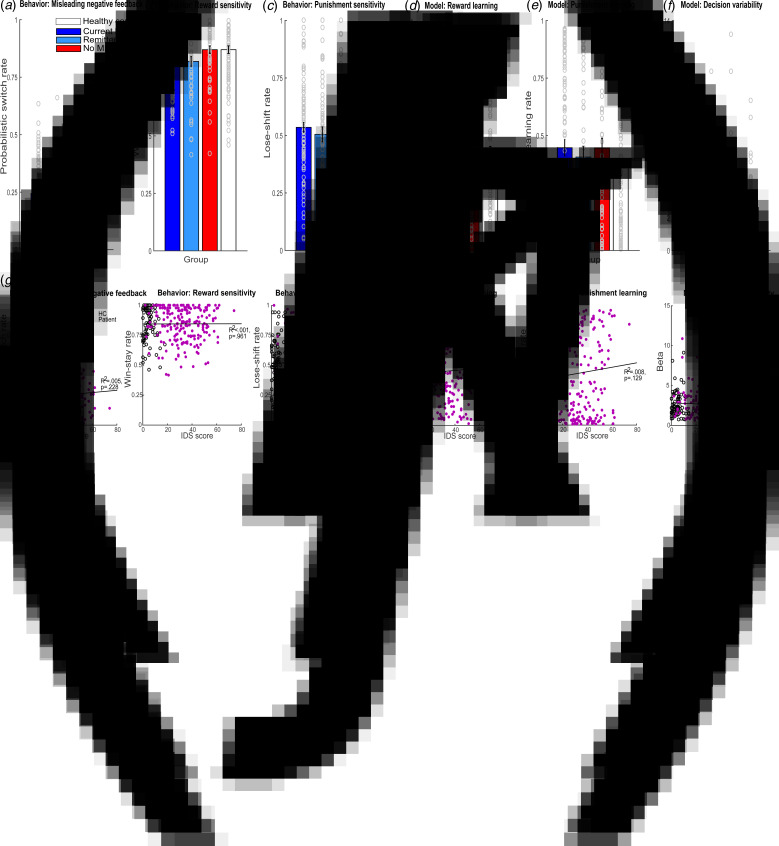
In contrast to previous findings, this sample of depressed patients with psychiatric comorbidities did not show a negative learning bias.
These results speak against the generalizability of the negative learning bias hypothesis to depressed patients with comorbidities. This study highlights the importance of investigating unselected samples of psychiatric patients, which represent the vast majority of the psychiatric population.
经典理论假设抑郁症是由负性学习偏差驱动的。支持这一观点的大多数研究都使用了小样本和选择性样本,排除了合并症患者。然而,精神障碍之间的合并症在高达 70%的人群中发生。因此,负性偏差假设对自然主义精神科样本的普遍性以及偏差对抑郁症的特异性仍不清楚。在本研究中,我们在包括抑郁症、焦虑症、成瘾、注意力缺陷/多动障碍和/或自闭症在内的大型自然主义精神科患者样本中测试了负性学习偏差假设。首先,我们评估了与对照组相比,抑郁症的负性偏差假设是否适用于异质(因此更自然主义)的抑郁症样本。其次,我们评估了负性偏差是否扩展到其他精神障碍。第三,我们采用了维度方法,通过使用症状严重程度来评估整个样本的关联。
我们对 217 名患者和 81 名健康对照者进行了概率反转学习任务。根据负性偏差假设,抑郁症患者应该表现出基于惩罚与奖励的增强学习和灵活性。我们将传统测量的分析与更敏感的计算建模相结合。
与之前的发现相反,患有精神障碍的抑郁症患者样本并未表现出负性学习偏差。
这些结果表明,负性学习偏差假设不适用于患有合并症的抑郁症患者。本研究强调了研究未选择的精神科患者样本的重要性,这些样本代表了绝大多数精神科人群。