
通过将 CRISPR-Cas9 突变与转录组数据整合进行单细胞谱系追踪。
Single-cell lineage tracing by integrating CRISPR-Cas9 mutations with transcriptomic data.
机构信息
Department of Computer Science and Engineering, Indian Institute of Technology Kanpur, Kanpur, India.
Department of Biological Sciences and Bioengineering, Indian Institute of Technology Kanpur, Kanpur, India.
出版信息
Nat Commun. 2020 Jun 16;11(1):3055. doi: 10.1038/s41467-020-16821-5.
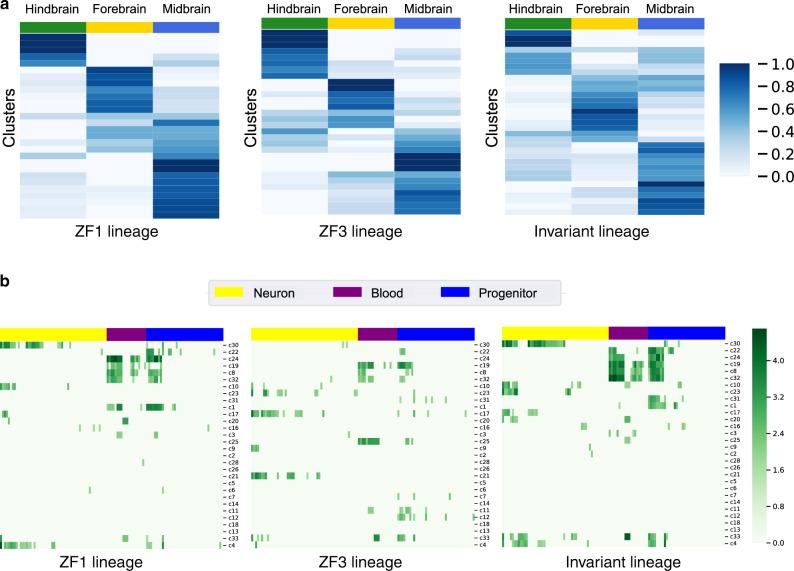
Recent studies combine two novel technologies, single-cell RNA-sequencing and CRISPR-Cas9 barcode editing for elucidating developmental lineages at the whole organism level. While these studies provided several insights, they face several computational challenges. First, lineages are reconstructed based on noisy and often saturated random mutation data. Additionally, due to the randomness of the mutations, lineages from multiple experiments cannot be combined to reconstruct a species-invariant lineage tree. To address these issues we developed a statistical method, LinTIMaT, which reconstructs cell lineages using a maximum-likelihood framework by integrating mutation and expression data. Our analysis shows that expression data helps resolve the ambiguities arising in when lineages are inferred based on mutations alone, while also enabling the integration of different individual lineages for the reconstruction of an invariant lineage tree. LinTIMaT lineages have better cell type coherence, improve the functional significance of gene sets and provide new insights on progenitors and differentiation pathways.
最近的研究结合了两种新的技术,单细胞 RNA 测序和 CRISPR-Cas9 条形码编辑,用于阐明整个生物体水平的发育谱系。虽然这些研究提供了一些见解,但它们面临着几个计算挑战。首先,谱系是基于嘈杂且经常饱和的随机突变数据重建的。此外,由于突变的随机性,来自多个实验的谱系无法组合以重建物种不变的谱系树。为了解决这些问题,我们开发了一种统计方法 LinTIMaT,它使用最大似然框架通过整合突变和表达数据来重建细胞谱系。我们的分析表明,表达数据有助于解决仅基于突变推断谱系时出现的歧义,同时还能够整合不同的个体谱系来重建不变的谱系树。LinTIMaT 谱系具有更好的细胞类型一致性,提高了基因集的功能意义,并提供了关于祖细胞和分化途径的新见解。


 Zotero 插件