Kang Junho, Yu Yeuni, Jeong Seongdo, Lee Hansong, Heo Hye Jin, Park Jeong Jun, Na Hee Sam, Ko Dai Sik, Kim Yun Hak
Interdisciplinary Program of Genomic Data Science, Pusan National University, Yangsan, Republic of Korea.
Departmment of Anatomy, School of Medicine, Pusan National University, Yangsan, Republic of Korea.
Ther Adv Med Oncol. 2020 Jun 8;12:1758835920927838. doi: 10.1177/1758835920927838. eCollection 2020.
High cathepsin D has been associated with poor prognosis in breast cancer; however, the results of many studies are controversial. Here, we assessed the association between high cathepsin D levels and worse breast cancer prognosis by conducting a meta-analysis.
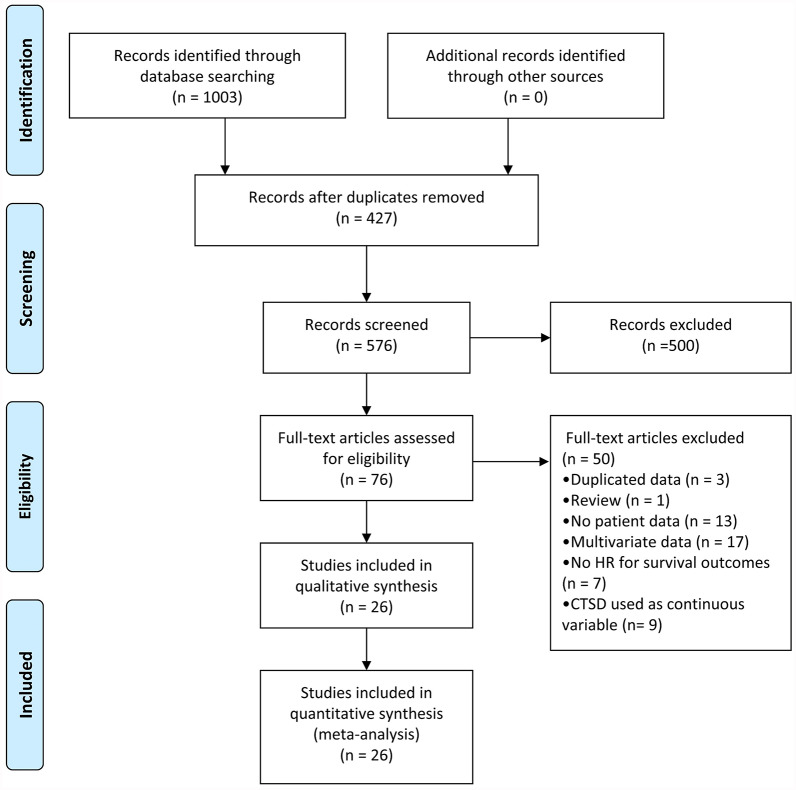
A comprehensive search strategy was used to search relevant literature in PUBMED and EMBASE by September 2018. The meta-analysis was performed in Review Manager 5.3 using hazard ratios (HRs) with 95% confidence intervals (CIs).
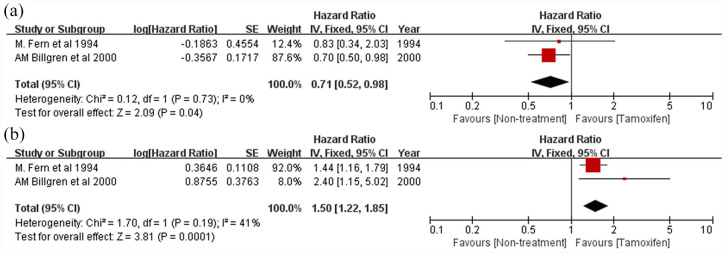
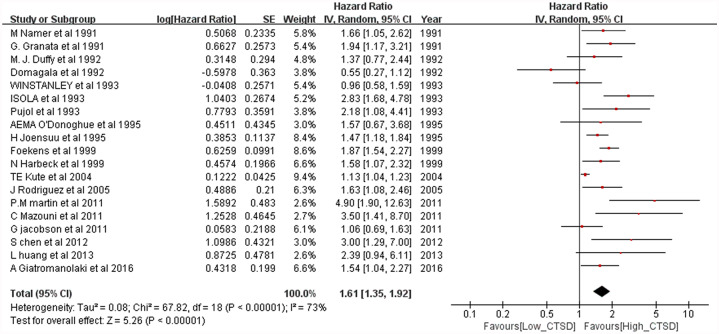
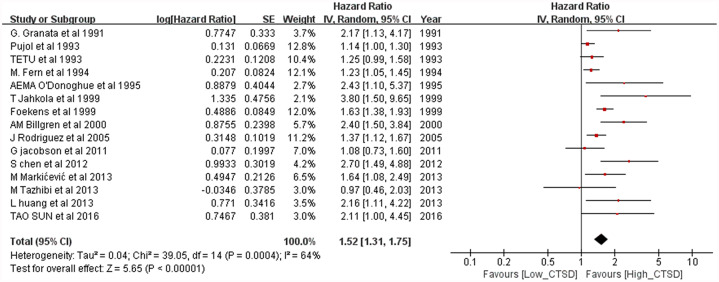
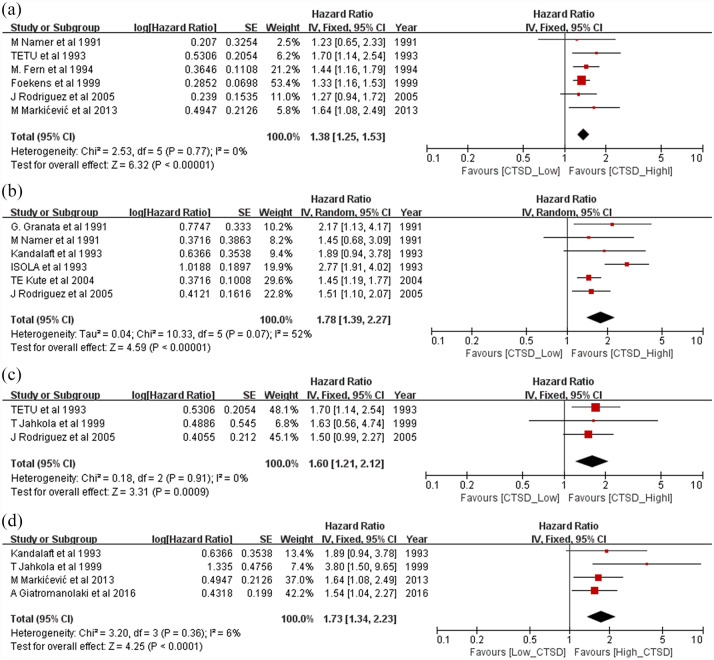
A total of 15,355 breast cancer patients from 26 eligible studies were included in this meta-analysis. Significant associations between elevated high cathepsin D and poor overall survival (OS) (HR = 1.61, 95% CI: 1.35-1.92, < 0.0001) and disease-free survival (DFS) (HR = 1.52, 95% CI: 1.31-2.18, < 0.001) were observed. In the subgroup analysis for DFS, high cathepsin D was significantly associated with poor prognosis in node-positive patients (HR = 1.38, 95% CI: 1.25-1.71, < 0.00001), node-negative patients (HR = 1.78, 95% CI: 1.39-2.27, < 0.0001), early stage patients (HR = 1.73, 95% CI: 1.34-2.23, < 0.0001), and treated with chemotherapy patients (HR = 1.60, 95% CI: 1.21-2.12, < 0.001). Interestingly, patients treated with tamoxifen had a low risk of relapse when their cathepsin D levels were high (HR = 0.71, 95% CI: 0.52-0.98, = 0.04) and a high risk of relapse when their cathepsin D levels were low (HR = 1.50, 95% CI: 1.22-1.85, = 0.0001).
Our meta-analysis suggests that high expression levels of cathepsin D are associated with a poor prognosis in breast cancer. Based on our subgroup analysis, we believe that cathepsin D can act as a marker for poor breast cancer prognosis and also as a therapeutic target for breast cancer.
组织蛋白酶D水平高与乳腺癌预后不良相关;然而,许多研究结果存在争议。在此,我们通过进行一项荟萃分析来评估组织蛋白酶D水平高与乳腺癌预后较差之间的关联。
采用全面的检索策略,在2018年9月前检索PUBMED和EMBASE中的相关文献。使用风险比(HRs)及95%置信区间(CIs)在Review Manager 5.3中进行荟萃分析。
该荟萃分析纳入了来自26项符合条件研究的总共15355例乳腺癌患者。观察到组织蛋白酶D水平升高与总生存期(OS)较差(HR = 1.61,95% CI:1.35 - 1.92,P < 0.0001)及无病生存期(DFS)较差(HR = 1.52,95% CI:1.31 - 2.18,P < 0.001)之间存在显著关联。在DFS的亚组分析中,组织蛋白酶D水平高与淋巴结阳性患者(HR = 1.38,95% CI:1.25 - 1.71,P < 0.00001)、淋巴结阴性患者(HR = 1.78,95% CI:1.39 - 2.27,P < 0.0001)、早期患者(HR = 1.73,95% CI:1.34 - 2.23,P < 0.0001)以及接受化疗患者(HR = 1.60,95% CI:1.21 - 2.12,P < 0.001)的预后较差显著相关。有趣的是,接受他莫昔芬治疗的患者在其组织蛋白酶D水平高时复发风险低(HR = 0.71,95% CI:0.52 - 0.98,P = 0.04),而在其组织蛋白酶D水平低时复发风险高(HR = 1.50,95% CI:1.22 - 1.85,P = 0.0001)。
我们的荟萃分析表明,组织蛋白酶D的高表达水平与乳腺癌预后不良相关。基于我们的亚组分析,我们认为组织蛋白酶D可作为乳腺癌预后不良的标志物,也可作为乳腺癌的治疗靶点。