Ożgo Małgorzata, Urbańska Maria, Hoos Philipp, Imhof Hannes K, Kirschenstein Małgorzata, Mayr Julia, Michl Florian, Tobiasz Rafał, von Wesendonk Marie, Zimmermann Stefan, Geist Juergen
Department of Evolutionary Biology Kazimierz Wielki University Bydgoszcz Poland.
Department of Zoology Poznań University of Life Sciences Poznań Poland.
Ecol Evol. 2020 Apr 12;10(11):4918-4927. doi: 10.1002/ece3.6243. eCollection 2020 Jun.
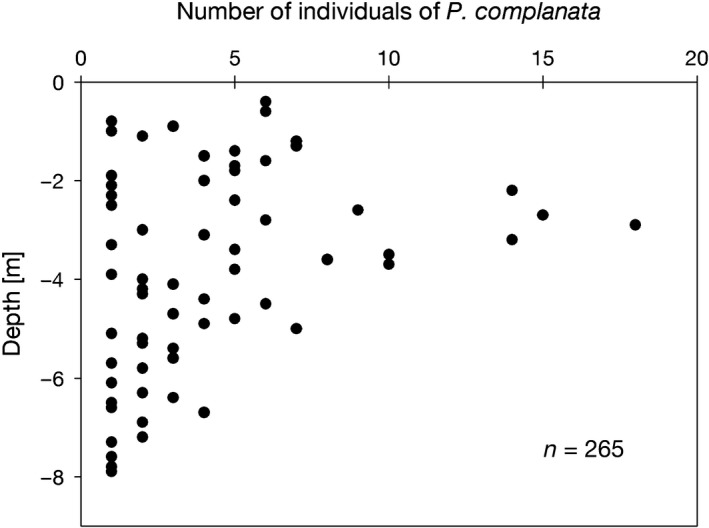
Freshwater mussels are in decline worldwide, with the depressed river mussel being one of the rarest and most endangered species in Europe. Invasive mussels are suspected to be an important factor of decline, but there is little information on their interaction with native species.This study analyzed densities, depth distribution, and individual sizes and weights in one of the largest known populations of in Europe in relation to the co-occurring invasive zebra mussel and other mussel species using a systematic transect analysis. was the dominant unionid species in Lake Siecino reaching densities of up to 26 ind/m, with half of the specimens found at a water depth of 2.0-4.0 m. Densities were highest on sandy substrates in areas of underwater currents. In contrast, 67% of native were found at depths < 1 m, indicating different habitat preference.In the study area, 91% of , 92% of , and all individuals were fouled by . The dreissenid:unionid mass ratio (mean ± ; maximum) was 0.43 ± 0.56; 4.22 and 0.86 ± 1.87; 8.76 in and , respectively. fouled with were impaired in their anchoring capability and had shell deformations potentially affecting shell closing and filtration activity. Fouling intensity was negatively correlated with unionid density, potentially leading to accelerated population declines.The observed adverse effects of invasive zebra mussels on the depressed river mussel and the difficulties in eradicating established populations of invasive mussels suggest that should be considered a serious threat to . Therefore, the further spread of zebra mussels into habitats with native unionids needs to be avoided by all means.
淡水贻贝在全球范围内数量正在减少,凹陷河蚌是欧洲最稀有、最濒危的物种之一。入侵贻贝被认为是数量减少的一个重要因素,但关于它们与本地物种相互作用的信息却很少。本研究通过系统样带分析,在欧洲已知最大的凹陷河蚌种群之一中,分析了其密度、深度分布以及个体大小和重量,同时研究了与之共存的入侵斑马贻贝和其他贻贝物种。凹陷河蚌是锡耶奇诺湖的优势珠蚌科物种,密度高达每平方米26个个体,一半的标本发现于水深2.0至4.0米处。密度在水下有水流区域的沙质底质上最高。相比之下,67%的本地河蚌发现于水深小于1米处,表明其栖息地偏好不同。在研究区域,91%的凹陷河蚌、92%的其他河蚌以及所有的个体都被斑马贻贝附着。斑马贻贝与珠蚌科贻贝的质量比(平均值±标准差;最大值)在凹陷河蚌和其他河蚌中分别为0.43±0.56;4.22和0.86±1.87;8.76。被斑马贻贝附着的凹陷河蚌的固着能力受损,并且贝壳变形,这可能会影响贝壳关闭和过滤活动。附着强度与珠蚌科贻贝密度呈负相关,这可能会导致种群数量加速下降。入侵斑马贻贝对凹陷河蚌观察到的不利影响以及根除已建立的入侵贻贝种群的困难表明,斑马贻贝应被视为对凹陷河蚌的严重威胁。因此,必须不惜一切代价避免斑马贻贝进一步扩散到有本地珠蚌科贻贝的栖息地。