Department of Pharmacy, Oriental College of Pharmacy and Research, Oriental University, Indore, India.
School of Pharmaceutical Sciences, IFTM University, Moradabad, India.
Drug Deliv. 2020 Dec;27(1):888-899. doi: 10.1080/10717544.2020.1775726.
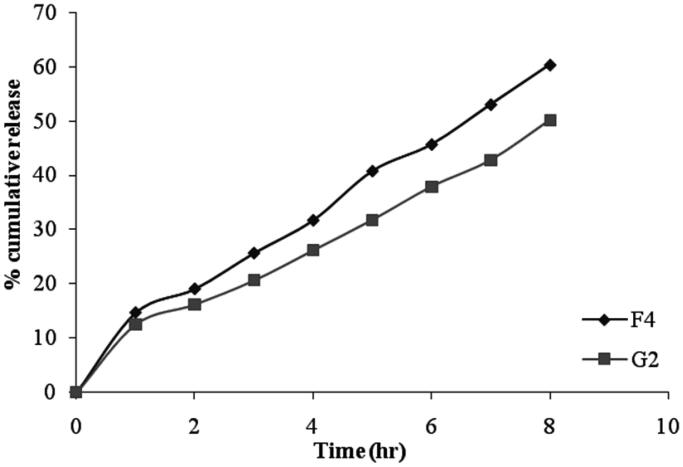
The present study was focused on investigating niosomal gels loaded with cholinergic drug; pilocarpine HCl, for prolonged precorneal residence time and improved bioavailability for glaucoma treatment. Pilocarpine HCl niosomes were prepared using various nonionic surfactants (span 20, span 60 and span 80), in the presence of cholesterol in different molar ratios by ether injection method. The selected formulations were incorporated into carbopol 934 and locust bean gum-based gels. TEM analysis confirmed that niosomes formed were spherical in shape and has a definite internal aqueous space with uniform particle size. Formulation F4 composed of span 60 and cholesterol (1:1) gave the highest entrapment (93.26 ± 1.75%) and slower release results after 8 hours (Q8h = 60.35 ± 1.87%) among other formulations. The drug permeation studies showed that there was a prolonged release of drug from niosomal gels as compared to niosomes itself. Considering the drug release, niosomal gel formulation G2 was the best among the studied formulations. The release data were fitted to an empirical equation, which indicated that the release follows non-Fickian diffusion mechanism. The stability study revealed that incorporation of niosomes in gel increased their stability than the niosome itself. No signs of redness, inflammation, swelling or increased tear production were observed over the study period for tested formulation by Draize's test. The intraocular pressure (IOP) lowering activity of G2 formulation showed relative bioavailability 2.64 times more than bioavailability of marketed Pilopine HS® gel. These results suggest that the niosomal gels containing pilocarpine HCl are promising ocular carriers for glaucoma treatment.
本研究旨在考察载有胆碱能药物盐酸毛果芸香碱的非离子囊泡凝胶,以延长预角膜滞留时间并提高生物利用度用于治疗青光眼。采用乙醚注入法,以不同摩尔比的胆固醇为辅料,用 span20、span60 和 span80 三种非离子表面活性剂制备盐酸毛果芸香碱非离子囊泡。选择的配方被掺入卡波姆 934 和刺梧桐树胶的凝胶中。TEM 分析证实,所形成的非离子囊泡为球形,具有确定的内部水相和均匀的粒径。由 span60 和胆固醇(1:1)组成的配方 F4 给出了最高的包封率(93.26±1.75%),在 8 小时后(Q8h=60.35±1.87%)表现出较慢的释放结果。药物渗透研究表明,与非离子囊泡本身相比,非离子囊泡凝胶中药物的释放时间更长。考虑到药物释放,在所研究的配方中,非离子囊泡凝胶配方 G2 是最好的。释放数据符合经验方程,表明释放遵循非菲克扩散机制。稳定性研究表明,与非离子囊泡本身相比,将非离子囊泡掺入凝胶中可提高其稳定性。通过 Draize 试验,在研究期间,未观察到受试配方出现红肿、炎症、肿胀或泪液分泌增加的迹象。G2 配方的眼压(IOP)降低活性显示出比市售 Pilopine HS®凝胶高 2.64 倍的相对生物利用度。这些结果表明,含有盐酸毛果芸香碱的非离子囊泡凝胶是治疗青光眼的有前途的眼部载体。