Monteiro Waléria P, de Souza Everaldo B, Miranda Leonardo de Sousa, Anjos Luciano J S, Caldeira Cecilio F
Instituto de Geociências, PPG-Ciências Ambientais, Universidade Federal do Pará, Belém 66077-830, PA, Brazil.
Lancaster Environment Centre, Faculty of Science and Technology, Lancaster University, Lancaster LA1 4YQ, UK.
Plants (Basel). 2023 May 25;12(11):2106. doi: 10.3390/plants12112106.
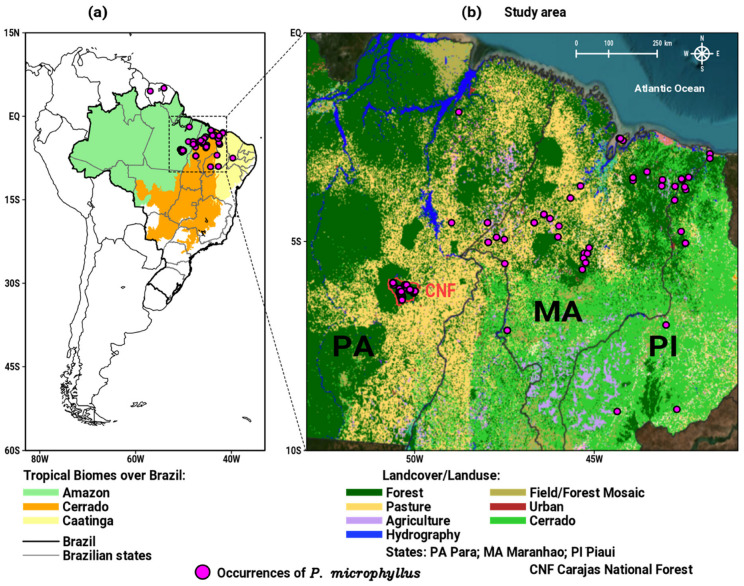
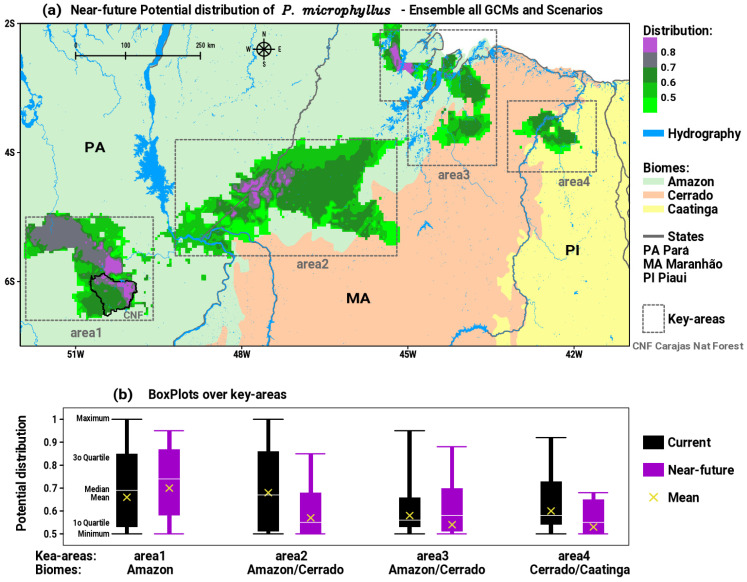
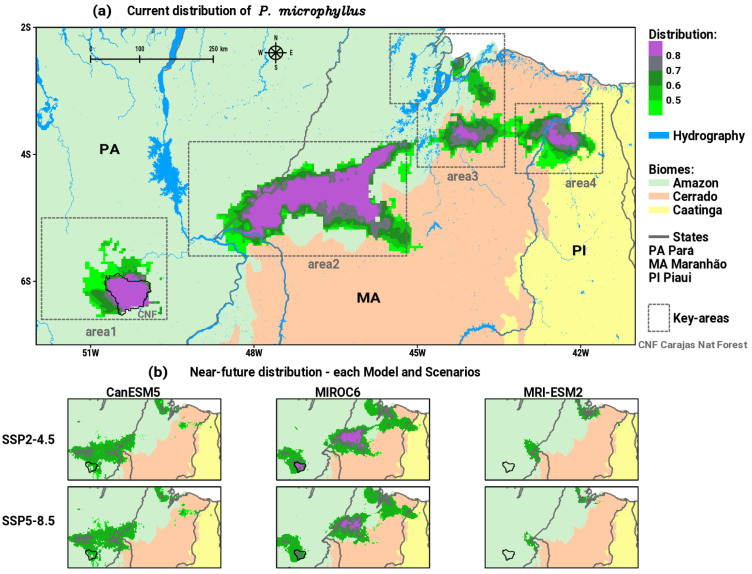
Stapf. ex Wardlew. (Rutaceae) is an endemic and threatened medicinal plant species from tropical Brazil. Popularly known as "jaborandi", it is the unique natural source of pilocarpine, an alkaloid used to medical treat glaucoma and xerostomia. Based on Species Distribution Models (SDMs), we modeled the suitability of geographical distribution considering three Global Circulation Models (GCMs) under two future climate change scenarios (SSP2-4.5 and SSP5-8.5). The quantitative analyses carried out using ten different SDM algorithms revealed that precipitation seasonality (Bio15) and precipitation of the driest month (Bio14) were the most important bioclimatic variables. The results evidenced four main key areas of continuous occurrence of the plant spreading diagonally over tropical Brazilian biomes (Amazon, Cerrado and Caatinga). The near-future (2020 to 2040) ensemble projections considering all GCMs and scenarios have indicated negative impacts for the potential loss or significant reduction in suitable habitats for in the transition region between the Amazon and Cerrado into central and northern Maranhão state, and mainly in the Caatinga biome over the northern Piaui state. On the other hand, positive impacts of the expansion of the plant habitat suitability are projected over forest cover protected areas of the Amazon biome in the southeastern Pará state. Since the jaborandi is of socioeconomic importance for many families in the north/northeast Brazil, it is urgent to implement public policies for conservation and sustainable management, thus mitigating the impacts of global climate change.
斯塔夫(由沃德利定名)(芸香科)是一种原产于巴西热带地区的特有且濒危的药用植物物种。它俗称“毛果芸香”,是毛果芸香碱的唯一天然来源,毛果芸香碱是一种用于治疗青光眼和口干症的生物碱。基于物种分布模型(SDMs),我们在两种未来气候变化情景(SSP2 - 4.5和SSP5 - 8.5)下,考虑三种全球环流模型(GCMs)对地理分布适宜性进行了建模。使用十种不同的SDM算法进行的定量分析表明,降水季节性(生物气候变量15)和最干燥月份的降水量(生物气候变量14)是最重要的生物气候变量。结果表明,该植物持续出现的四个主要关键区域呈对角线分布在巴西热带生物群落(亚马逊、塞拉多和卡廷加)。考虑所有GCMs和情景的近期(2020年至2040年)综合预测表明,在亚马逊和塞拉多之间的过渡区域到马拉尼昂州中部和北部,特别是在皮奥伊州北部的卡廷加生物群落中,适宜栖息地可能丧失或显著减少,这将产生负面影响。另一方面,预计在帕拉州东南部亚马逊生物群落的森林覆盖保护区,该植物栖息地适宜性将扩大,产生积极影响。由于毛果芸香对巴西北部/东北部的许多家庭具有社会经济重要性,因此迫切需要实施保护和可持续管理的公共政策,从而减轻全球气候变化的影响。