• 文献检索
  • 文档翻译
  • 深度研究
  • 学术资讯
  • Suppr Zotero 插件Zotero 插件
  • 邀请有礼
  • 套餐&价格
  • 历史记录
应用&插件
Suppr Zotero 插件Zotero 插件浏览器插件Mac 客户端Windows 客户端微信小程序
定价
高级版会员购买积分包购买API积分包
服务
文献检索文档翻译深度研究API 文档MCP 服务
关于我们
关于 Suppr公司介绍联系我们用户协议隐私条款
关注我们

Suppr 超能文献

核心技术专利:CN118964589B侵权必究
粤ICP备2023148730 号-1Suppr @ 2026

文献检索

告别复杂PubMed语法,用中文像聊天一样搜索,搜遍4000万医学文献。AI智能推荐,让科研检索更轻松。

立即免费搜索

文件翻译

保留排版,准确专业,支持PDF/Word/PPT等文件格式,支持 12+语言互译。

免费翻译文档

深度研究

AI帮你快速写综述,25分钟生成高质量综述,智能提取关键信息,辅助科研写作。

立即免费体验

ReWalk ReStore™ 软机器人外骨骼:外骨骼增强卒中后步态康复的安全性、可靠性和可行性的多中心临床试验。

The ReWalk ReStore™ soft robotic exosuit: a multi-site clinical trial of the safety, reliability, and feasibility of exosuit-augmented post-stroke gait rehabilitation.

机构信息

Department of Physical Therapy & Athletic Training, Boston University, Boston, MA, USA.

Wyss Institute for Biologically Inspired Engineering, Harvard University, Boston, MA, USA.

出版信息

J Neuroeng Rehabil. 2020 Jun 18;17(1):80. doi: 10.1186/s12984-020-00702-5.

DOI:10.1186/s12984-020-00702-5
PMID:32552775
原文链接:https://pmc.ncbi.nlm.nih.gov/articles/PMC7301475/
Abstract

BACKGROUND

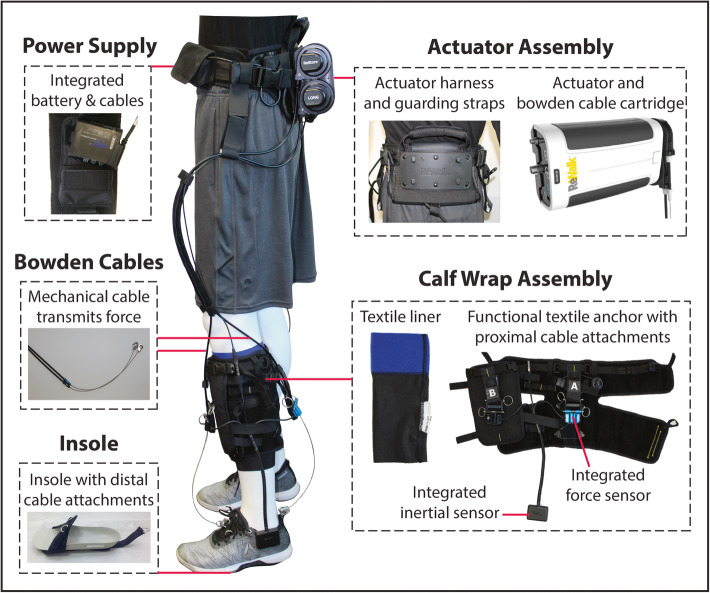
Atypical walking in the months and years after stroke constrain community reintegration and reduce mobility, health, and quality of life. The ReWalk ReStore™ is a soft robotic exosuit designed to assist the propulsion and ground clearance subtasks of post-stroke walking by actively assisting paretic ankle plantarflexion and dorsiflexion. Previous proof-of-concept evaluations of the technology demonstrated improved gait mechanics and energetics and faster and farther walking in users with post-stroke hemiparesis. We sought to determine the safety, reliability, and feasibility of using the ReStore™ during post-stroke rehabilitation.

METHODS

A multi-site clinical trial (NCT03499210) was conducted in preparation for an application to the United States Food and Drug Administration (FDA). The study included 44 users with post-stroke hemiparesis who completed up to 5 days of training with the ReStore™ on the treadmill and over ground. In addition to primary and secondary endpoints of safety and device reliability across all training activities, an exploratory evaluation of the effect of multiple exposures to using the device on users' maximum walking speeds with and without the device was conducted prior to and following the five training visits.

RESULTS

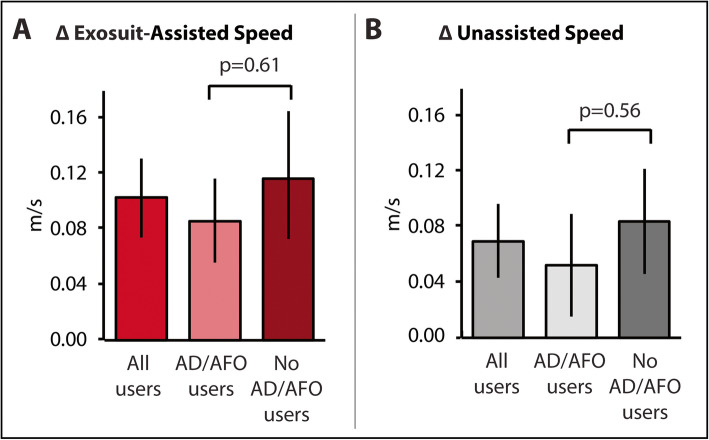
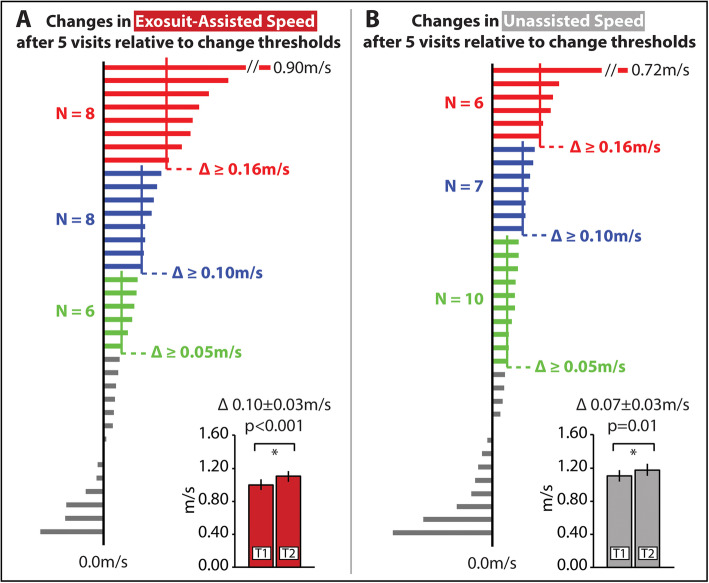
All 44 study participants completed safety and reliability evaluations. Thirty-six study participants completed all five training days. No device-related falls or serious adverse events were reported. A low rate of device malfunctions was reported by clinician-operators. Regardless of their reliance on ancillary assistive devices, after only 5 days of walking practice with the device, study participants increased both their device-assisted (Δ: 0.10 ± 0.03 m/s) and unassisted (Δ: 0.07 ± 0.03 m/s) maximum walking speeds (P's < 0.05).

CONCLUSIONS

When used under the direction of a licensed physical therapist, the ReStore™ soft exosuit is safe and reliable for use during post-stroke gait rehabilitation to provide targeted assistance of both paretic ankle plantarflexion and dorsiflexion during treadmill and overground walking.

TRIAL REGISTRATION

NCT03499210. Prospectively registered on March 28, 2018.

摘要

背景

中风后数月和数年的异常行走限制了社区融入,降低了移动能力、健康水平和生活质量。ReWalk ReStore™ 是一种软机器人外骨骼,旨在通过主动辅助瘫痪足踝的背屈和跖屈,帮助患者完成中风后行走的推进和地面间隙两个子任务。该技术的先前概念验证评估表明,在偏瘫患者中,使用该技术可改善步态力学和能量学,并提高行走速度和距离。我们旨在确定在中风后康复期间使用 ReStore™ 的安全性、可靠性和可行性。

方法

一项多中心临床试验(NCT03499210)正在进行中,以准备向美国食品和药物管理局(FDA)申请。该研究纳入了 44 名中风偏瘫患者,他们在跑步机和地面上完成了最多 5 天的 ReStore™ 训练。除了对所有训练活动的安全性和设备可靠性进行主要和次要终点评估外,在 5 次训练访问前后,还对使用设备对患者在使用和不使用设备时的最大行走速度的多次暴露的影响进行了探索性评估。

结果

所有 44 名研究参与者均完成了安全性和可靠性评估。36 名研究参与者完成了所有 5 天的训练。没有报告与设备相关的跌倒或严重不良事件。临床医生操作员报告设备故障的发生率较低。无论他们是否依赖辅助辅助设备,在仅使用该设备进行 5 天的步行练习后,研究参与者的设备辅助(Δ:0.10±0.03 m/s)和非辅助(Δ:0.07±0.03 m/s)最大行走速度均有所提高(P<0.05)。

结论

在有执照的物理治疗师的指导下,ReStore™ 软外骨骼在中风后步态康复期间使用是安全可靠的,可以在跑步机和地面行走时为瘫痪足踝的背屈和跖屈提供针对性的辅助。

试验注册

NCT03499210。于 2018 年 3 月 28 日前瞻性注册。
https://cdn.ncbi.nlm.nih.gov/pmc/blobs/c7dc/7301475/d6d4dd79bb94/12984_2020_702_Fig4_HTML.jpg
https://cdn.ncbi.nlm.nih.gov/pmc/blobs/c7dc/7301475/09746b28fc63/12984_2020_702_Fig1_HTML.jpg
https://cdn.ncbi.nlm.nih.gov/pmc/blobs/c7dc/7301475/129bc83deb30/12984_2020_702_Fig2_HTML.jpg
https://cdn.ncbi.nlm.nih.gov/pmc/blobs/c7dc/7301475/06bd51518d3e/12984_2020_702_Fig3_HTML.jpg
https://cdn.ncbi.nlm.nih.gov/pmc/blobs/c7dc/7301475/d6d4dd79bb94/12984_2020_702_Fig4_HTML.jpg
https://cdn.ncbi.nlm.nih.gov/pmc/blobs/c7dc/7301475/09746b28fc63/12984_2020_702_Fig1_HTML.jpg
https://cdn.ncbi.nlm.nih.gov/pmc/blobs/c7dc/7301475/129bc83deb30/12984_2020_702_Fig2_HTML.jpg
https://cdn.ncbi.nlm.nih.gov/pmc/blobs/c7dc/7301475/06bd51518d3e/12984_2020_702_Fig3_HTML.jpg
https://cdn.ncbi.nlm.nih.gov/pmc/blobs/c7dc/7301475/d6d4dd79bb94/12984_2020_702_Fig4_HTML.jpg

相似文献

1
The ReWalk ReStore™ soft robotic exosuit: a multi-site clinical trial of the safety, reliability, and feasibility of exosuit-augmented post-stroke gait rehabilitation.ReWalk ReStore™ 软机器人外骨骼:外骨骼增强卒中后步态康复的安全性、可靠性和可行性的多中心临床试验。
J Neuroeng Rehabil. 2020 Jun 18;17(1):80. doi: 10.1186/s12984-020-00702-5.
2
Implementation of a unilateral hip flexion exosuit to aid paretic limb advancement during inpatient gait retraining for individuals post-stroke: a feasibility study.单侧髋关节屈伸助力外骨骼在住院步态再训练中辅助脑卒中后患者下肢运动:一项可行性研究。
J Neuroeng Rehabil. 2024 Jul 18;21(1):121. doi: 10.1186/s12984-024-01410-0.
3
Biomechanical mechanisms underlying exosuit-induced improvements in walking economy after stroke.中风后外骨骼套装改善步行经济性的生物力学机制。
J Exp Biol. 2018 Mar 7;221(Pt 5):jeb168815. doi: 10.1242/jeb.168815.
4
Task-specific ankle robotics gait training after stroke: a randomized pilot study.中风后特定任务的踝关节机器人步态训练:一项随机试点研究。
J Neuroeng Rehabil. 2016 Jun 2;13(1):51. doi: 10.1186/s12984-016-0158-1.
5
Human-centered design of a novel soft exosuit for post-stroke gait rehabilitation.一种用于中风后步态康复的新型柔软外骨骼套装的以人为本设计。
J Neuroeng Rehabil. 2024 Apr 24;21(1):62. doi: 10.1186/s12984-024-01356-3.
6
Exoskeleton for post-stroke recovery of ambulation (ExStRA): study protocol for a mixed-methods study investigating the efficacy and acceptance of an exoskeleton-based physical therapy program during stroke inpatient rehabilitation.用于卒中后步行康复的外骨骼(ExStRA):一项混合方法研究的研究方案,旨在调查基于外骨骼的物理治疗方案在卒中住院康复期间的疗效和接受度。
BMC Neurol. 2020 Jan 28;20(1):35. doi: 10.1186/s12883-020-1617-7.
7
O 089 - A soft robotic exosuit assisting the paretic ankle in patients post-stroke: Effect on muscle activation during overground walking.O 089 - 一种用于辅助脑卒中后偏瘫患者踝关节的软体机器人外骨骼:对地面行走过程中肌肉激活的影响。
Gait Posture. 2022 Jun;95:217-218. doi: 10.1016/j.gaitpost.2018.06.124. Epub 2018 Jun 26.
8
Reducing Circumduction and Hip Hiking During Hemiparetic Walking Through Targeted Assistance of the Paretic Limb Using a Soft Robotic Exosuit.通过使用软机器人外骨骼对偏瘫肢体进行有针对性的辅助来减少偏瘫步行过程中的环转和髋关节上提。
Am J Phys Med Rehabil. 2017 Oct;96(10 Suppl 1):S157-S164. doi: 10.1097/PHM.0000000000000800.
9
The H2 robotic exoskeleton for gait rehabilitation after stroke: early findings from a clinical study.用于中风后步态康复的H2机器人外骨骼:一项临床研究的早期结果
J Neuroeng Rehabil. 2015 Jun 17;12:54. doi: 10.1186/s12984-015-0048-y.
10
Ankle training with a robotic device improves hemiparetic gait after a stroke.使用机器人设备进行踝关节训练可改善脑卒中后的偏瘫步态。
Neurorehabil Neural Repair. 2011 May;25(4):369-77. doi: 10.1177/1545968310388291. Epub 2010 Nov 29.

引用本文的文献

1
A Lightweight Powered Hip Exoskeleton With Parallel Actuation for Frontal and Sagittal Plane Assistance.一种用于额状面和矢状面辅助的具有并联驱动的轻型动力髋关节外骨骼。
IEEE Trans Robot. 2025 Feb;41:1-17. doi: 10.1109/tro.2025.3539172.
2
Comparison of Five Rehabilitation Interventions for Acute Ischemic Stroke: A Randomized Trial.急性缺血性卒中五种康复干预措施的比较:一项随机试验
J Clin Med. 2025 Feb 28;14(5):1648. doi: 10.3390/jcm14051648.
3
Elastic textile-based wearable modulation of musculoskeletal load: A comprehensive review of passive exosuits and resistance clothing.

本文引用的文献

1
Walking faster and farther with a soft robotic exosuit: Implications for post-stroke gait assistance and rehabilitation.借助柔软的机器人外骨骼套装走得更快更远:对中风后步态辅助与康复的意义。
IEEE Open J Eng Med Biol. 2020;1:108-115. doi: 10.1109/ojemb.2020.2984429. Epub 2020 Apr 2.
2
Offline assistance optimization of a soft exosuit for augmenting ankle power of stroke survivors during walking.用于增强中风幸存者行走时踝关节力量的软外骨骼离线辅助优化
IEEE Robot Autom Lett. 2020;5(2):828-835. doi: 10.1109/lra.2020.2965072. Epub 2020 Jan 9.
3
Merged plantarflexor muscle activity is predictive of poor walking performance in post-stroke hemiparetic subjects.
基于弹性纺织品的肌肉骨骼负荷可穿戴调节:被动外骨骼套装和阻力服装的综合综述。
Wearable Technol. 2025 Feb 25;6:e11. doi: 10.1017/wtc.2025.2. eCollection 2025.
4
New protocol for early robot-assisted gait training after spinal surgery.脊柱手术后早期机器人辅助步态训练的新方案。
Front Med (Lausanne). 2024 Oct 23;11:1450883. doi: 10.3389/fmed.2024.1450883. eCollection 2024.
5
Muscular, temporal, and spatial responses to shoulder exosuit assistance during functional tasks.肩部外骨骼辅助功能性任务时的肌肉、时间和空间响应。
J Neurophysiol. 2024 Nov 1;132(5):1507-1519. doi: 10.1152/jn.00080.2024. Epub 2024 Oct 16.
6
Effect of a soft exosuit on daily life gait performance in people with incomplete spinal cord injury: study protocol for a randomized controlled trial.软性外骨骼对不完全性脊髓损伤患者日常生活步态表现的影响:一项随机对照试验的研究方案。
Trials. 2024 Sep 6;25(1):592. doi: 10.1186/s13063-024-08412-2.
7
A Propulsion Neuroprosthesis Improves Overground Walking in Community-Dwelling Individuals After Stroke.一种推进式神经假体可改善中风后社区居住个体的地面行走能力。
IEEE Open J Eng Med Biol. 2024 Jul 4;5:563-572. doi: 10.1109/OJEMB.2024.3416028. eCollection 2024.
8
Implementation of a unilateral hip flexion exosuit to aid paretic limb advancement during inpatient gait retraining for individuals post-stroke: a feasibility study.单侧髋关节屈伸助力外骨骼在住院步态再训练中辅助脑卒中后患者下肢运动:一项可行性研究。
J Neuroeng Rehabil. 2024 Jul 18;21(1):121. doi: 10.1186/s12984-024-01410-0.
9
DE-AFO: A Robotic Ankle Foot Orthosis for Children with Cerebral Palsy Powered by Dielectric Elastomer Artificial Muscle.DE-AFO:一种由介电弹性体人工肌肉驱动的用于脑瘫儿童的机器人踝足矫形器。
Sensors (Basel). 2024 Jun 11;24(12):3787. doi: 10.3390/s24123787.
10
Efficacy of a Soft Robotic Exoskeleton to Improve Lower Limb Motor Function in Children with Spastic Cerebral Palsy: A Single-Blinded Randomized Controlled Trial.软质机器人外骨骼改善痉挛型脑瘫患儿下肢运动功能的疗效:一项单盲随机对照试验
Brain Sci. 2024 Apr 25;14(5):425. doi: 10.3390/brainsci14050425.
合并的跖屈肌活动可预测中风后偏瘫患者的步行能力不佳。
J Biomech. 2019 Jan 3;82:361-367. doi: 10.1016/j.jbiomech.2018.11.011. Epub 2018 Nov 15.
4
Paretic propulsion as a measure of walking performance and functional motor recovery post-stroke: A review.偏瘫推进作为中风后步行能力和功能性运动恢复的一项指标:综述
Gait Posture. 2019 Feb;68:6-14. doi: 10.1016/j.gaitpost.2018.10.027. Epub 2018 Oct 25.
5
Shaping neuroplasticity by using powered exoskeletons in patients with stroke: a randomized clinical trial.使用动力外骨骼重塑脑卒中患者的神经可塑性:一项随机临床试验。
J Neuroeng Rehabil. 2018 Apr 25;15(1):35. doi: 10.1186/s12984-018-0377-8.
6
Biomechanical mechanisms underlying exosuit-induced improvements in walking economy after stroke.中风后外骨骼套装改善步行经济性的生物力学机制。
J Exp Biol. 2018 Mar 7;221(Pt 5):jeb168815. doi: 10.1242/jeb.168815.
7
Reducing Circumduction and Hip Hiking During Hemiparetic Walking Through Targeted Assistance of the Paretic Limb Using a Soft Robotic Exosuit.通过使用软机器人外骨骼对偏瘫肢体进行有针对性的辅助来减少偏瘫步行过程中的环转和髋关节上提。
Am J Phys Med Rehabil. 2017 Oct;96(10 Suppl 1):S157-S164. doi: 10.1097/PHM.0000000000000800.
8
A soft robotic exosuit improves walking in patients after stroke.软性机器人外骨骼可改善中风后患者的行走能力。
Sci Transl Med. 2017 Jul 26;9(400). doi: 10.1126/scitranslmed.aai9084.
9
Reducing The Cost of Transport and Increasing Walking Distance After Stroke: A Randomized Controlled Trial on Fast Locomotor Training Combined With Functional Electrical Stimulation.降低中风后的运输成本并增加步行距离:一项关于快速运动训练结合功能性电刺激的随机对照试验。
Neurorehabil Neural Repair. 2016 Aug;30(7):661-70. doi: 10.1177/1545968315619696. Epub 2015 Nov 30.
10
Revisiting the mechanics and energetics of walking in individuals with chronic hemiparesis following stroke: from individual limbs to lower limb joints.重新审视中风后慢性偏瘫患者的行走力学与能量学:从单个肢体到下肢关节
J Neuroeng Rehabil. 2015 Feb 27;12:24. doi: 10.1186/s12984-015-0012-x.