National Institute for Antibiotic Resistance and Infection Control, Tel Aviv Sourasky Medical Center, Tel Aviv, Israel.
University of Adelaide, Adelaide, Australia.
Euro Surveill. 2020 Jun;25(23). doi: 10.2807/1560-7917.ES.2020.25.23.1900387.
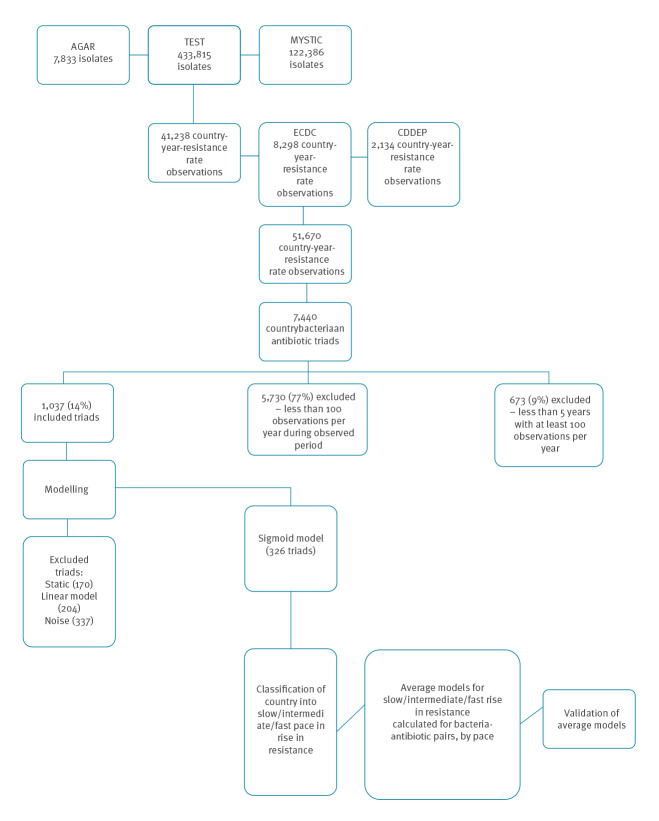
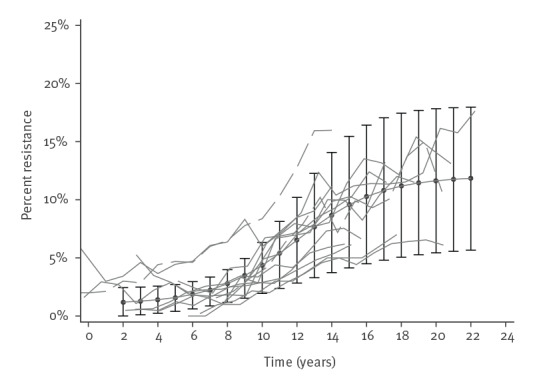
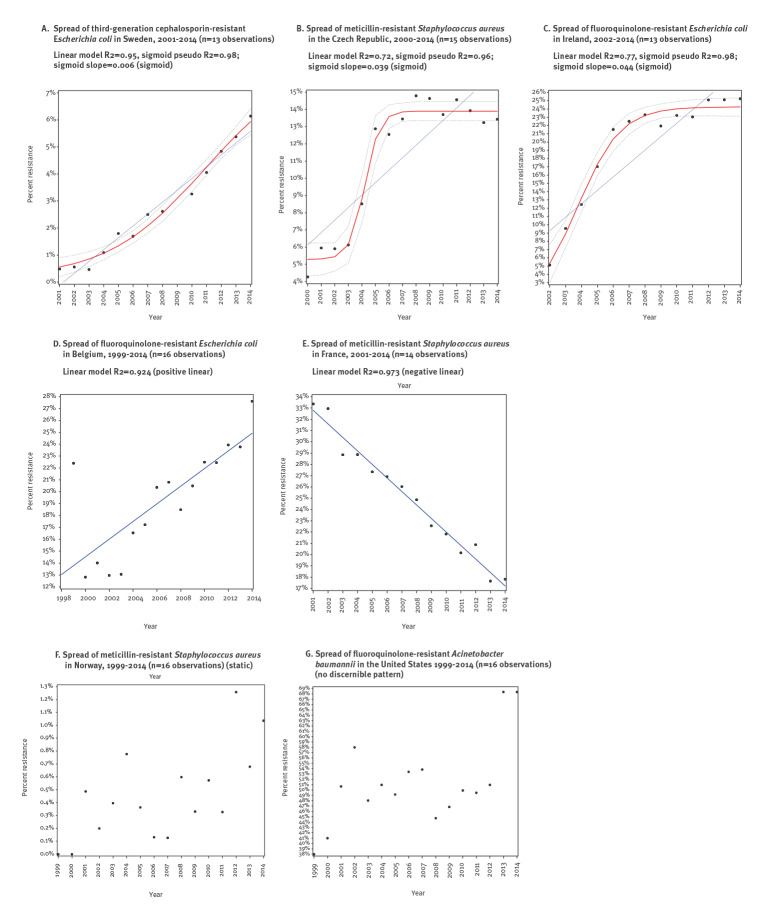
BackgroundThe spread of antimicrobial resistance (AMR) is of worldwide concern. Public health policymakers and pharmaceutical companies pursuing antibiotic development require accurate predictions about the future spread of AMR.AimWe aimed to identify and model temporal and geographical patterns of AMR spread and to predict future trends based on a slow, intermediate or rapid rise in resistance.MethodsWe obtained data from five antibiotic resistance surveillance projects spanning the years 1997 to 2015. We aggregated the isolate-level or country-level data by country and year to produce country-bacterium-antibiotic class triads. We fitted both linear and sigmoid models to these triads and chose the one with the better fit. For triads that conformed to a sigmoid model, we classified AMR progression into one of three characterising paces: slow, intermediate or fast, based on the sigmoid slope. Within each pace category, average sigmoid models were calculated and validated.ResultsWe constructed a database with 51,670 country-year-bacterium-antibiotic observations, grouped into 7,440 country-bacterium-antibiotic triads. A total of 1,037 triads (14%) met the inclusion criteria. Of these, 326 (31.4%) followed a sigmoid (logistic) pattern over time. Among 107 triads for which both sigmoid and linear models could be fit, the sigmoid model was a better fit in 84%. The sigmoid model deviated from observed data by a median of 6.5%; the degree of deviation was related to the pace of spread.ConclusionWe present a novel method of describing and predicting the spread of antibiotic-resistant organisms.
背景
抗菌药物耐药性(AMR)的传播引起了全球关注。公共卫生政策制定者和从事抗生素开发的制药公司都需要对 AMR 的未来传播进行准确预测。
目的
我们旨在识别和建模 AMR 传播的时间和地理模式,并根据耐药性的缓慢、中等或快速上升来预测未来趋势。
方法
我们从五个抗生素耐药性监测项目中获取了 1997 年至 2015 年的数据。我们根据国家和年份将分离株水平或国家水平的数据汇总,生成国家-细菌-抗生素类别三联体。我们对这些三联体拟合了线性和 S 型模型,并选择了拟合效果更好的模型。对于符合 S 型模型的三联体,我们根据 S 型斜率将 AMR 进展分为缓慢、中等或快速三种特征性速度之一。在每个速度类别中,计算并验证平均 S 型模型。
结果
我们构建了一个包含 51670 个国家-年份-细菌-抗生素观察值的数据库,分为 7440 个国家-细菌-抗生素三联体。共有 1037 个三联体(14%)符合纳入标准。其中,326 个(31.4%)随着时间的推移呈现 S 型(逻辑)模式。在可以拟合 S 型和线性模型的 107 个三联体中,S 型模型在 84%的情况下拟合效果更好。S 型模型与观察数据的偏差中位数为 6.5%;偏差程度与传播速度有关。
结论
我们提出了一种描述和预测抗生素耐药性生物传播的新方法。