Vihta Karina-Doris, Pritchard Emma, Pouwels Koen B, Hopkins Susan, Guy Rebecca L, Henderson Katherine, Chudasama Dimple, Hope Russell, Muller-Pebody Berit, Walker Ann Sarah, Clifton David, Eyre David W
Modernising Medical Microbiology, Experimental Medicine, Nuffield Department of Medicine, Level 7 Research Offices, John Radcliffe Hospital, Headley Way, University of Oxford, Oxford, UK.
The National Institute for Health Research Health Protection Research Unit in Healthcare Associated Infections and Antimicrobial Resistance, University of Oxford, Oxford, UK.
Commun Med (Lond). 2024 Oct 10;4(1):197. doi: 10.1038/s43856-024-00606-8.
Predicting antimicrobial resistance (AMR), a top global health threat, nationwide at an aggregate hospital level could help target interventions. Using machine learning, we exploit historical AMR and antimicrobial usage to predict future AMR.
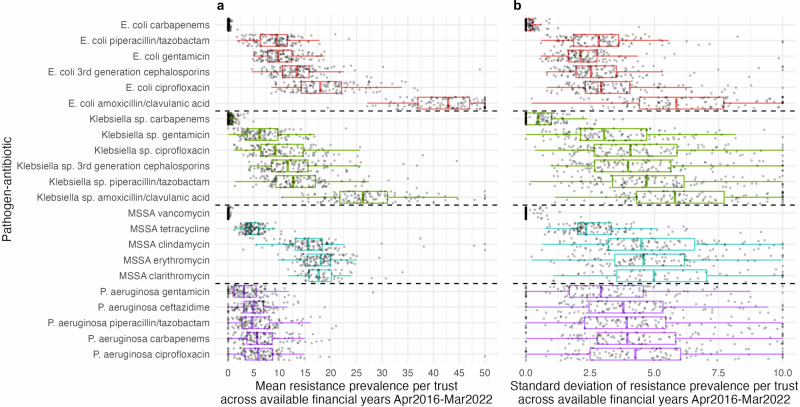
Antimicrobial use and AMR prevalence in bloodstream infections in hospitals in England were obtained per hospital group (Trust) and financial year (FY, April-March) for 22 pathogen-antibiotic combinations (FY2016-2017 to FY2021-2022). Extreme Gradient Boosting (XGBoost) model predictions were compared to the previous value taken forwards, the difference between the previous two years taken forwards and linear trend forecasting (LTF). XGBoost feature importances were calculated to aid interpretability.
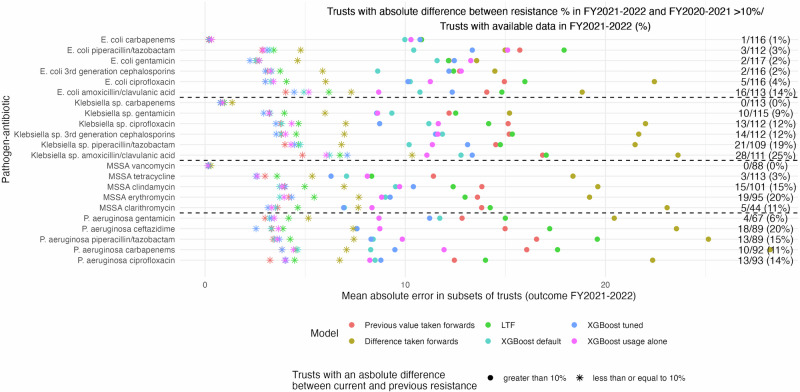
Here we show that XGBoost models achieve the best predictive performance. Relatively limited year-to-year variability in AMR prevalence within Trust-pathogen-antibiotic combinations means previous value taken forwards also achieves a low mean absolute error (MAE), similar to or slightly higher than XGBoost. Using the difference between the previous two years taken forward or LTF performs consistently worse. XGBoost considerably outperforms all other methods in Trusts with a larger change in AMR prevalence from FY2020-2021 (last training year) to FY2021-2022 (held-out test set). Feature importance values indicate that besides historical resistance to the same pathogen-antibiotic combination as the outcome, complex relationships between resistance in different pathogens to the same antibiotic/antibiotic class and usage are exploited for predictions. These are generally among the top ten features ranked according to their mean absolute SHAP values.
Year-to-year resistance has generally changed little within Trust-pathogen-antibiotic combinations. In those with larger changes, XGBoost models can improve predictions, enabling informed decisions, efficient resource allocation, and targeted interventions.
预测抗菌药物耐药性(AMR)是全球首要的健康威胁,在全国范围内的综合医院层面进行预测有助于确定干预措施的目标。我们利用机器学习,通过历史AMR数据和抗菌药物使用情况来预测未来的AMR。
获取了英格兰各医院集团(信托机构)和财政年度(财年,4月至次年3月)中22种病原体-抗生素组合在血流感染中的抗菌药物使用情况和AMR流行率(2016-2017财年至2021-2022财年)。将极端梯度提升(XGBoost)模型的预测结果与向前采用的前一个值、向前采用的前两年的差值以及线性趋势预测(LTF)进行比较。计算XGBoost的特征重要性以辅助解释。
我们在此表明,XGBoost模型具有最佳的预测性能。在信托机构-病原体-抗生素组合中,AMR流行率的逐年变化相对有限,这意味着向前采用的前一个值也能实现较低的平均绝对误差(MAE),与XGBoost相似或略高。使用向前采用的前两年的差值或LTF的表现始终较差。在AMR流行率从2020-2021财年(最后一个训练年)到2021-2022财年(验证测试集)变化较大的信托机构中,XGBoost明显优于所有其他方法。特征重要性值表明,除了与结果中相同病原体-抗生素组合的历史耐药性外,不同病原体对同一抗生素/抗生素类别的耐药性与使用情况之间的复杂关系也被用于预测。根据其平均绝对SHAP值排名,这些通常在前十大特征之中。
在信托机构-病原体-抗生素组合中,逐年的耐药性变化通常较小。在变化较大的组合中,XGBoost模型可以改善预测,从而做出明智的决策、进行有效的资源分配并实施有针对性的干预措施。