Eltaher Hoda M, Abukunna Fatima E, Ruiz-Cantu Laura, Stone Zack, Yang Jing, Dixon James E
Regenerative Medicine & Cellular Therapies Division, School of Pharmacy, The University of Nottingham Biodiscovery Institute (BDI), University of Nottingham, Nottingham, NG7 2RD, UK; Department of Pharmaceutics, Faculty of Pharmacy, Alexandria University, 21521, Egypt.
Regenerative Medicine & Cellular Therapies Division, School of Pharmacy, The University of Nottingham Biodiscovery Institute (BDI), University of Nottingham, Nottingham, NG7 2RD, UK.
Acta Biomater. 2020 Sep 1;113:339-349. doi: 10.1016/j.actbio.2020.06.012. Epub 2020 Jun 14.
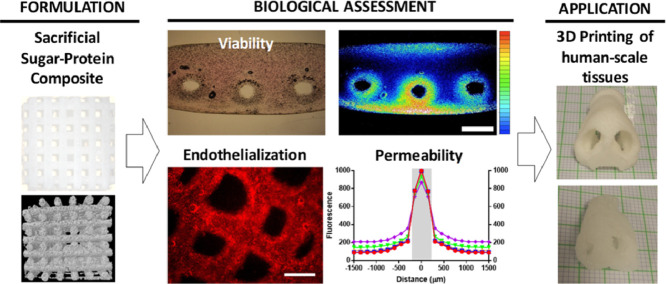
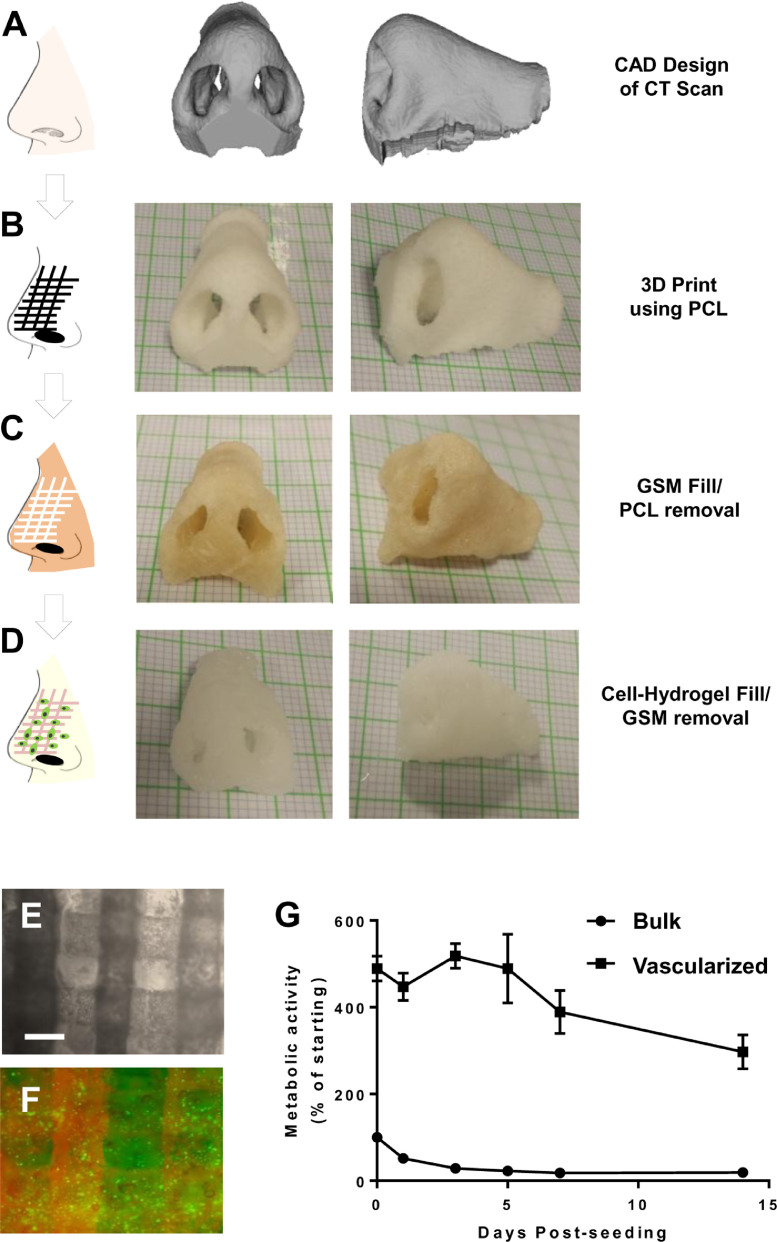
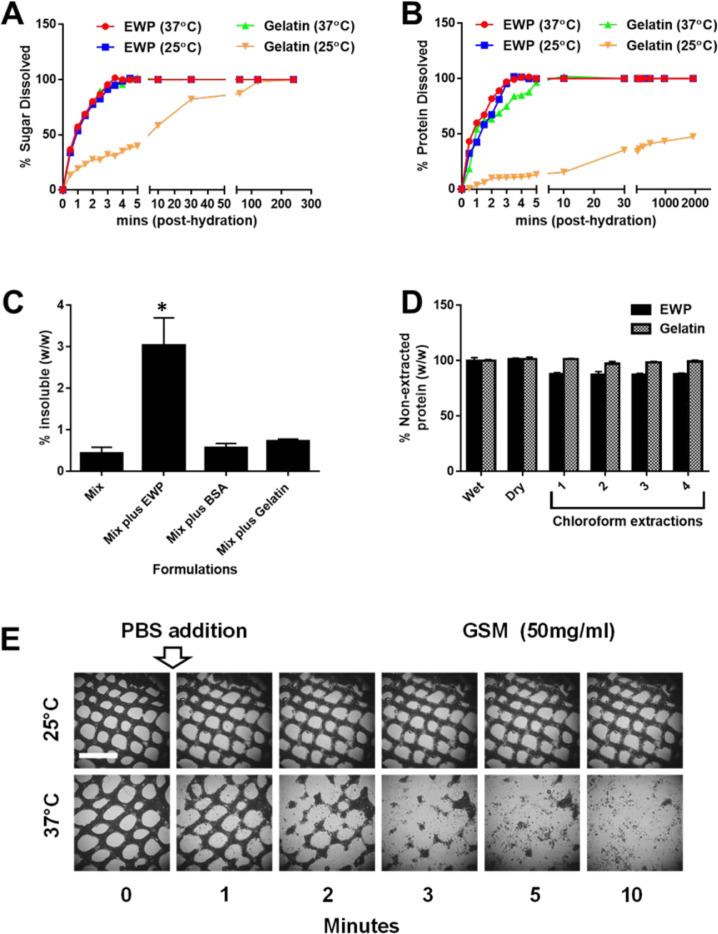
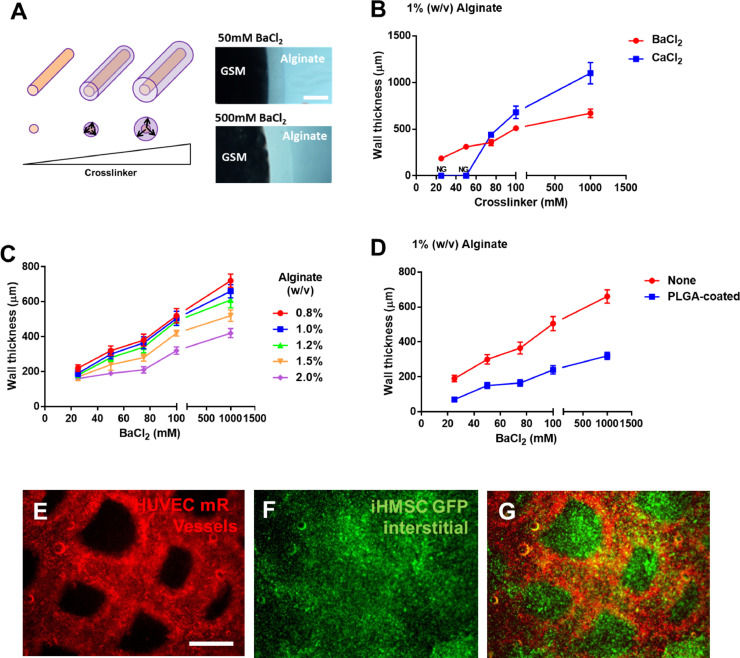
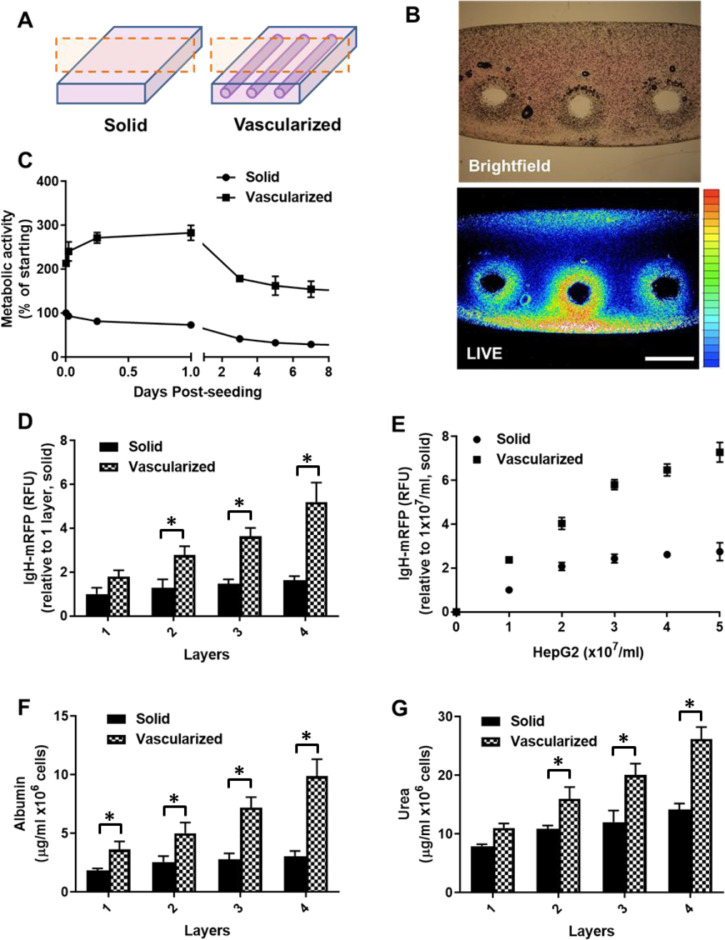
Combating necrosis, by supplying nutrients and removing waste, presents the major challenge for engineering large three-dimensional (3D) tissues. Previous elegant work used 3D printing with carbohydrate glass as a cytocompatible sacrificial template to create complex engineered tissues with vascular networks (Miller et al. 2012, Nature Materials). The fragile nature of this material compounded with the technical complexity needed to create high-resolution structures led us to create a flexible sugar-protein composite, termed Gelatin-sucrose matrix (GSM), to achieve a more robust and applicable material. Here we developed a low-range (25-37˚C) temperature sensitive formulation that can be moulded with micron-resolution features or cast during 3D printing to produce complex flexible filament networks forming sacrificial vessels. Using the temperature-sensitivity, we could control filament degeneration meaning GSM can be used with a variety of matrices and crosslinking strategies. Furthermore by incorporation of biocompatible crosslinkers into GSM directly, we could create thin endothelialized vessel walls and generate patterned tissues containing multiple matrices and cell-types. We also demonstrated that perfused vascular channels sustain metabolic function of a variety of cell-types including primary human cells. Importantly, we were able to construct vascularized human noses which otherwise would have been necrotic. Our material can now be exploited to create human-scale tissues for regenerative medicine applications. STATEMENT OF SIGNIFICANCE: Authentic and engineered tissues have demands for mass transport, exchanging nutrients and oxygen, and therefore require vascularization to retain viability and inhibit necrosis. Basic vascular networks must be included within engineered tissues intrinsically. Yet, this has been unachievable in physiologically-sized constructs with tissue-like cell densities until recently. Sacrificial moulding is an alternative in which networks of rigid lattices of filaments are created to prevent subsequent matrix ingress. Our study describes a biocompatible sacrificial sugar-protein formulation; GSM, made from mixtures of inexpensive and readily available bio-grade materials. GSM can be cast/moulded or bioprinted as sacrificial filaments that can rapidly dissolve in an aqueous environment temperature-sensitively. GSM material can be used to engineer viable and vascularized human-scale tissues for regenerative medicine applications.
通过供应营养物质和清除废物来对抗坏死,是构建大型三维(3D)组织面临的主要挑战。此前的出色工作利用以碳水化合物玻璃作为细胞相容性牺牲模板的3D打印技术,来创建具有血管网络的复杂工程组织(Miller等人,2012年,《自然材料》)。这种材料的脆弱性,再加上创建高分辨率结构所需的技术复杂性,促使我们创建一种灵活的糖蛋白复合材料,称为明胶 - 蔗糖基质(GSM),以获得一种更坚固且适用的材料。在此,我们开发了一种低温范围(25 - 37˚C)的温度敏感配方,该配方可以模塑出微米级分辨率的特征,或者在3D打印过程中浇铸,以生产形成牺牲血管的复杂柔性细丝网络。利用温度敏感性,我们可以控制细丝的降解,这意味着GSM可以与多种基质和交联策略一起使用。此外,通过直接将生物相容性交联剂掺入GSM中,我们可以创建薄的内皮化血管壁,并生成包含多种基质和细胞类型的图案化组织。我们还证明,灌注的血管通道能够维持包括原代人类细胞在内的多种细胞类型的代谢功能。重要的是,我们能够构建出原本会坏死的血管化人类鼻子。现在,我们的材料可用于创建用于再生医学应用的人体规模组织。意义声明:真实组织和工程组织都需要进行物质运输,交换营养物质和氧气,因此需要血管化以保持活力并抑制坏死。基本的血管网络必须内在地包含在工程组织中。然而,直到最近,在具有组织样细胞密度的生理尺寸构建物中,这一直是无法实现的。牺牲性模塑是一种替代方法,其中创建细丝的刚性晶格网络以防止随后的基质侵入。我们的研究描述了一种生物相容性牺牲糖蛋白配方;GSM,由廉价且易于获得的生物级材料混合物制成。GSM可以浇铸/模塑或生物打印成牺牲细丝,这些细丝可以在水性环境中对温度敏感地快速溶解。GSM材料可用于为再生医学应用构建有活力且血管化的人体规模组织。