Wolfson Diabetes and Endocrinology Clinic, Cambridge University Hospital NHS Foundation Trust, Cambridge, UK.
Department of Medical Genetics, Cambridge University, Cambridge, UK.
Eur J Endocrinol. 2020 Aug;183(2):G79-G88. doi: 10.1530/EJE-20-0424.
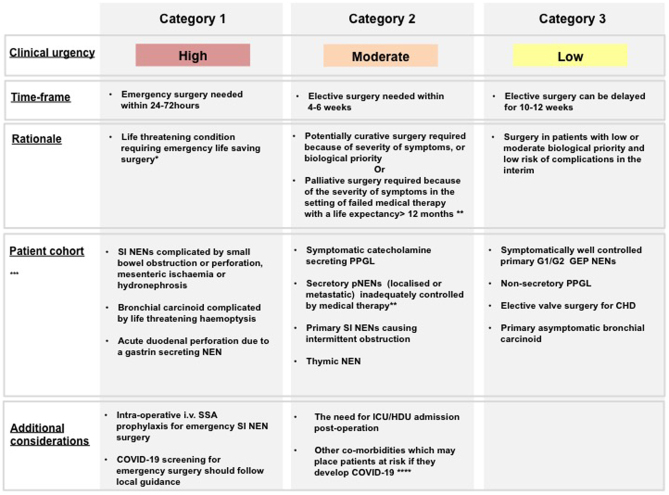
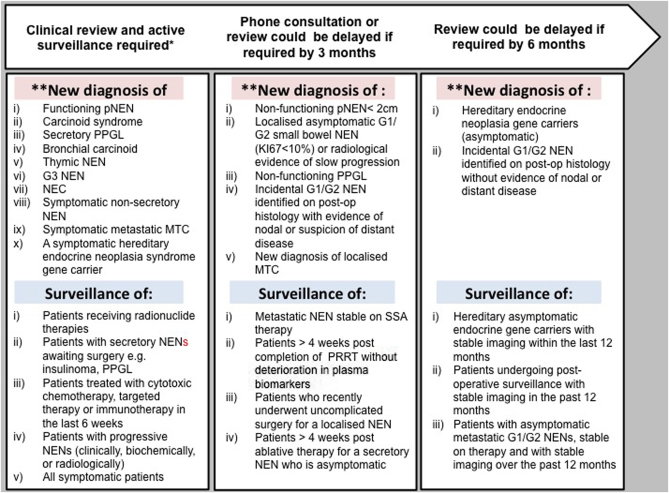
In viral pandemics, most specifically Covid-19, many patients with neuroendocrine neoplasms (NENs), including phaeochromocytomas, paragangliomas and medullary thyroid carcinoma, may develop Covid-19 in a mild or severe form, or be concerned about the influence of viral infection relative to their anti-tumoral therapy. In general, newly presenting patients should be assessed, and patients recently receiving chemotherapy, targeted therapy or radionuclide therapy, or showing tumour growth, should be closely followed. For previously diagnosed patients, who have indolent disease, some delay in routine follow-up or treatment may not be problematic. However, patients developing acute secretory syndromes due to functional neuroendocrine neoplasms (such as of the pancreas, intestine or lung), phaeochromocytomas and paragangliomas, will require prompt treatment. Patients with life-threatening Covid-19-related symptoms should be urgently treated and long-term anti-tumoral treatments may be temporarily delayed. In patients with especially aggressive NENs, a careful judgement should be made regarding the severity of any Covid-19 illness, tumour grade, and the immunosuppressant effects of any planned chemotherapy, immunotherapy (e.g. interferon-alpha), targeted therapy or related treatment. In other cases, especially patients with completely resected NENs, or who are under surveillance for a genetic disorder, a telephone or delayed consultation may be in order, balancing the risk of a delay against that of the possible development of Covid-19.
在病毒性大流行中,特别是在 COVID-19 中,许多神经内分泌肿瘤(NENs)患者,包括嗜铬细胞瘤、副神经节瘤和甲状腺髓样癌,可能会以轻度或重度形式感染 COVID-19,或者担心病毒感染相对于他们的抗肿瘤治疗的影响。一般来说,新出现的患者应进行评估,而最近接受化疗、靶向治疗或放射性核素治疗的患者,或表现出肿瘤生长的患者,应密切随访。对于以前诊断出的疾病惰性的患者,常规随访或治疗的一些延迟可能不会有问题。但是,由于功能性神经内分泌肿瘤(如胰腺、肠道或肺部)、嗜铬细胞瘤和副神经节瘤而出现急性分泌综合征的患者,需要及时治疗。有危及生命的 COVID-19 相关症状的患者应紧急治疗,长期抗肿瘤治疗可能会暂时推迟。对于具有侵袭性神经内分泌肿瘤的患者,应仔细判断 COVID-19 疾病的严重程度、肿瘤分级以及任何计划化疗、免疫疗法(如干扰素-α)、靶向治疗或相关治疗的免疫抑制作用。在其他情况下,特别是对于完全切除的 NENs 患者,或正在接受遗传疾病监测的患者,电话或延迟咨询可能是合适的,需要权衡延迟的风险与可能发展 COVID-19 的风险。