Department of Psychology, Virginia Commonwealth University, Richmond, VA, USA.
Department of Health Behavior and Policy, Virginia Commonwealth University, Richmond, VA, USA.
Transl Psychiatry. 2020 Jun 18;10(1):196. doi: 10.1038/s41398-020-00865-8.
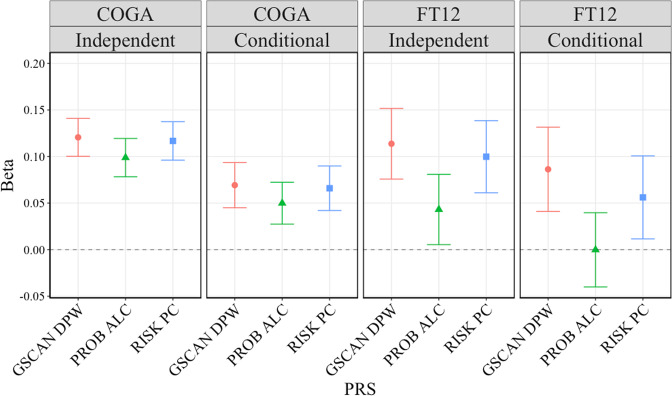
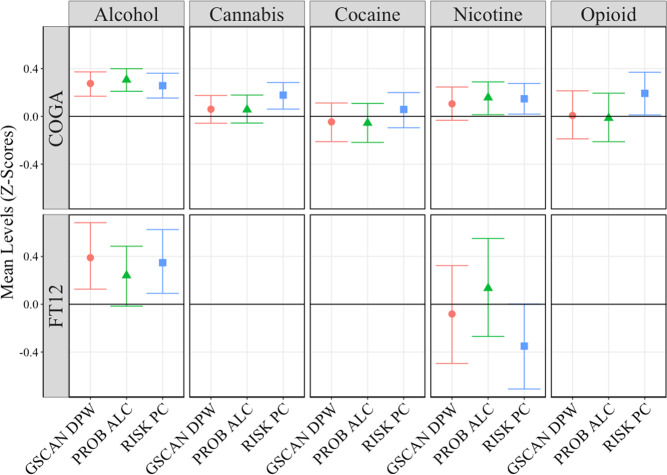
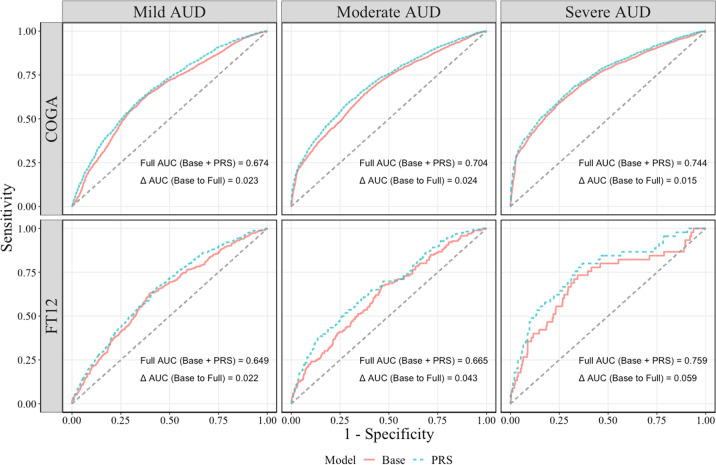
Genome-wide, polygenic risk scores (PRS) have emerged as a useful way to characterize genetic liability. There is growing evidence that PRS may prove useful for early identification of those at increased risk for certain diseases. The current potential of PRS for alcohol use disorders (AUD) remains an open question. Using data from both a population-based sample [the FinnTwin12 (FT12) study] and a high-risk sample [the Collaborative Study on the Genetics of Alcoholism (COGA)], we examined the association between PRSs derived from genome-wide association studies (GWASs) of (1) alcohol dependence/alcohol problems, (2) alcohol consumption, and (3) risky behaviors with AUD and other substance use disorder (SUD) criteria. These PRSs explain ~2.5-3.5% of the variance in AUD (across FT12 and COGA) when all PRSs are included in the same model. Calculations of area under the curve (AUC) show PRS provide only a slight improvement over a model with age, sex, and ancestral principal components as covariates. While individuals in the top 20, 10, and 5% of the PRS distribution had greater odds of having an AUD compared to the lower end of the continuum in both COGA and FT12, the point estimates at each threshold were statistically indistinguishable. Those in the top 5% reported greater levels of licit (alcohol and nicotine) and illicit (cannabis and opioid) SUD criteria. PRSs are associated with risk for SUD in independent samples. However, usefulness for identifying those at increased risk in their current form is modest, at best. Improvement in predictive ability will likely be dependent on increasing the size of well-phenotyped discovery samples.
全基因组多基因风险评分 (PRS) 已成为一种描述遗传易感性的有用方法。越来越多的证据表明,PRS 可能有助于早期识别某些疾病风险增加的人群。目前,PRS 对酒精使用障碍 (AUD) 的潜在作用仍是一个悬而未决的问题。本研究利用基于人群的样本[芬特温 12 研究 (FT12)]和高风险样本[酒精遗传合作研究 (COGA)]的数据,检验了源自全基因组关联研究 (GWAS) 的三种 PRS 与 AUD 及其他物质使用障碍 (SUD) 标准之间的关联:(1) 酒精依赖/酒精问题;(2) 饮酒;(3) 危险行为。当所有 PRS 都包含在同一个模型中时,这些 PRS 解释了 AUD 的约 2.5-3.5%的方差(FT12 和 COGA 均适用)。曲线下面积 (AUC) 的计算表明,PRS 仅在一个包含年龄、性别和祖先主成分作为协变量的模型上略有改善。与 COGA 和 FT12 中连续体的低端相比,PRS 分布前 20%、10%和 5%的个体出现 AUD 的几率更高,但每个阈值的点估计值在统计学上无显著差异。处于 PRS 分布前 5%的个体报告称,他们有更高的合法(酒精和尼古丁)和非法(大麻和阿片类药物)SUD 标准。PRS 与独立样本中的 SUD 风险相关。然而,就目前形式而言,其识别高风险人群的用途适度,最多只能说是适度的。预测能力的提高可能取决于增加具有良好表型的发现样本的规模。