Korea Zoonosis Research Institute, Jeonbuk National University, Iksan, Jeonbuk 54531, Korea.
Department of Bioactive Material Sciences, Jeonbuk National University, Jeonju, Jeonbuk 54896, Korea.
Cells. 2020 Jun 17;9(6):1480. doi: 10.3390/cells9061480.
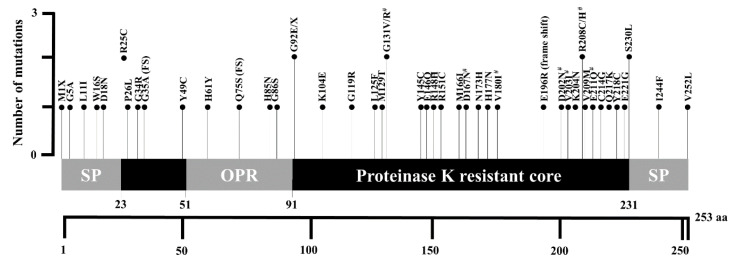
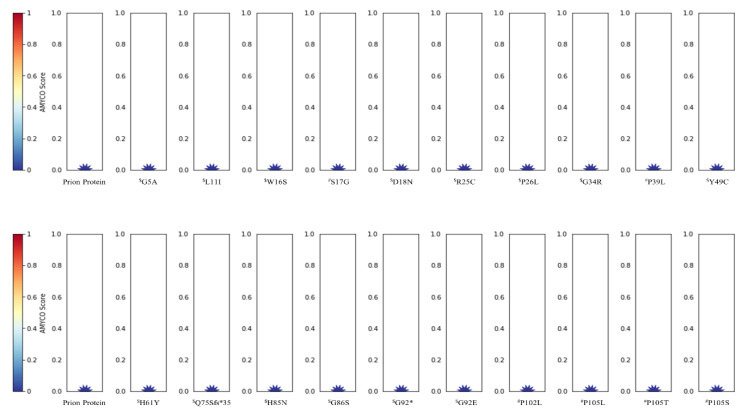
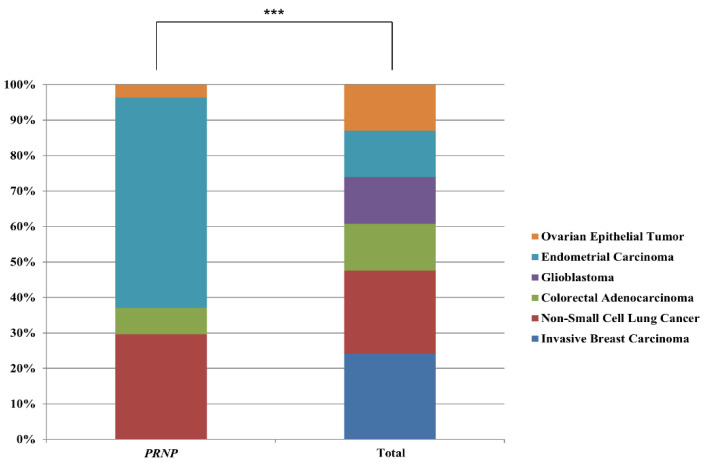
Prion diseases are caused by misfolded prion protein (PrP) and are accompanied by spongiform vacuolation of brain lesions. Approximately three centuries have passed since prion diseases were first discovered around the world; however, the exact role of certain factors affecting the causative agent of prion diseases is still debatable. In recent studies, somatic mutations were assumed to be cause of several diseases. Thus, we postulated that genetically unstable cancer tissue may cause somatic mutations in the prion protein gene (), which could trigger the onset of prion diseases. To identify somatic mutations in the gene in cancer tissues, we analyzed somatic mutations in the gene in cancer patients using the Cancer Genome Atlas (TCGA) database. In addition, to evaluate whether the somatic mutations in the gene in cancer patients had a damaging effect, we performed analysis using PolyPhen-2, PANTHER, PROVEAN, and AMYCO. We identified a total of 48 somatic mutations in the gene, including 8 somatic mutations that are known pathogenic mutations of prion diseases. We identified significantly different distributions among the types of cancer, the mutation counts, and the ages of diagnosis between the total cancer patient population and cancer patients carrying somatic mutations in the gene. Strikingly, although invasive breast carcinoma and glioblastoma accounted for a high percentage of the total cancer patient population (9.9% and 5.4%, respectively), somatic mutations in the gene have not been identified in these two cancer types. We suggested the possibility that somatic mutations of the gene in glioblastoma can be masked by a diagnosis of prion disease. In addition, we found four aggregation-prone somatic mutations, these being L125F, E146Q, R151C, and K204N. To the best of our knowledge, this is the first specific analysis of the somatic mutations in the gene in cancer patients.
朊病毒病是由错误折叠的朊病毒蛋白(PrP)引起的,伴有脑病变的海绵状空泡化。自朊病毒病在全球首次发现以来,大约已经过去了三个世纪;然而,某些影响朊病毒病病原体的因素的确切作用仍存在争议。在最近的研究中,体细胞突变被认为是几种疾病的原因。因此,我们假设遗传不稳定的癌症组织可能会导致朊病毒蛋白基因()中的体细胞突变,从而引发朊病毒病的发生。为了在癌症组织中鉴定基因中的体细胞突变,我们使用癌症基因组图谱(TCGA)数据库分析了癌症患者基因中的体细胞突变。此外,为了评估癌症患者基因中的体细胞突变是否具有破坏性影响,我们使用 PolyPhen-2、PANTHER、PROVEAN 和 AMYCO 进行了分析。我们总共鉴定了基因中的 48 个体细胞突变,其中包括 8 个已知是朊病毒病的致病性突变的体细胞突变。我们发现,在癌症类型、突变数量和诊断年龄方面,总癌症患者人群和携带基因体细胞突变的癌症患者之间存在显著差异。值得注意的是,尽管浸润性乳腺癌和胶质母细胞瘤在总癌症患者人群中占比很高(分别为 9.9%和 5.4%),但尚未在这两种癌症类型中发现基因的体细胞突变。我们提出了这样一种可能性,即基因中的体细胞突变可能被朊病毒病的诊断所掩盖。此外,我们发现了四个易于聚集的体细胞突变,即 L125F、E146Q、R151C 和 K204N。据我们所知,这是首次对癌症患者基因中的体细胞突变进行专门分析。