Department of Medicine, Division of General Internal Medicine and Clinical Innovation, NYU Robert I. Grossman School of Medicine, 462 1st Avenue, New York, NY, 10016, USA.
Institute for Innovations in Medical Education, Division of Education Quality, 550 First Avenue, Medical Science Building, Suite G107, New York, NY, 10016, USA.
BMC Med Educ. 2020 Jun 19;20(1):199. doi: 10.1186/s12909-020-02113-5.
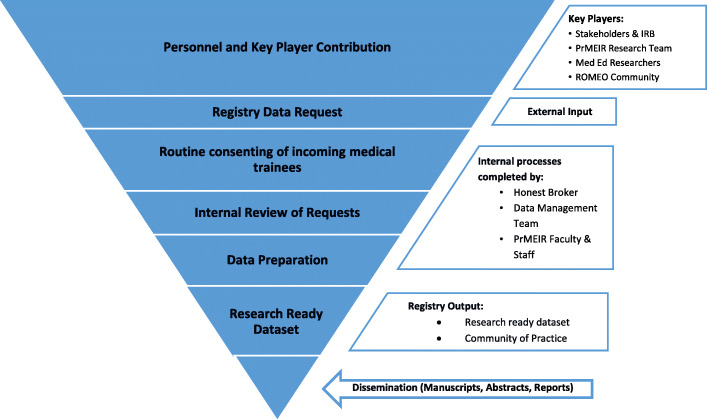
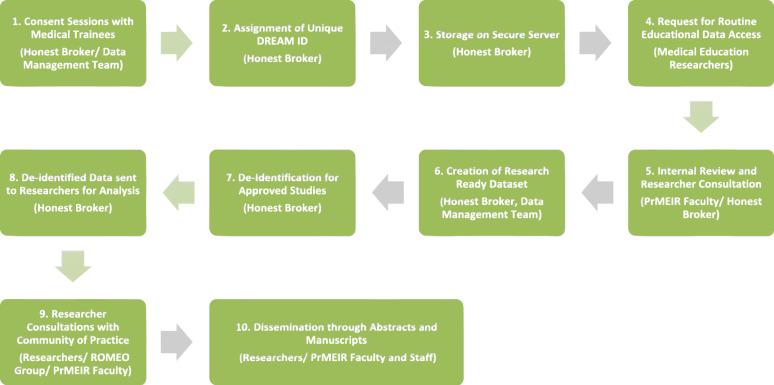
Medical Education research suffers from several methodological limitations including too many single institution, small sample-sized studies, limited access to quality data, and insufficient institutional support. Increasing calls for medical education outcome data and quality improvement research have highlighted a critical need for uniformly clean and easily accessible data. Research registries may fill this gap. In 2006, the Research on Medical Education Outcomes (ROMEO) unit of the Program for Medical Innovations and Research (PrMEIR) at New York University's (NYU) Robert I. Grossman School of Medicine established the Database for Research on Academic Medicine (DREAM). DREAM is a database of routinely collected, de-identified undergraduate (UME, medical school leading up to the Medical Doctor degree) and graduate medical education (GME, residency also known as post graduate education leading to eligibility for specialty board certification) outcomes data available, through application, to researchers. Learners are added to our database through annual consent sessions conducted at the start of educational training. Based on experience, we describe our methods in creating and maintaining DREAM to serve as a guide for institutions looking to build a new or scale up their medical education registry.
At present, our UME and GME registries have consent rates of 90% (n = 1438/1598) and 76% (n = 1988/2627), respectively, with a combined rate of 81% (n = 3426/4225). 7% (n = 250/3426) of these learners completed both medical school and residency at our institution. DREAM has yielded a total of 61 individual studies conducted by medical education researchers and a total of 45 academic journal publications.
We have built a community of practice through the building of DREAM and hope, by persisting in this work the full potential of this tool and the community will be realized. While researchers with access to the registry have focused primarily on curricular/ program evaluation, learner competency assessment, and measure validation, we hope to expand the output of the registry to include patient outcomes by linking learner educational and clinical performance across the UME-GME continuum and into independent practice. Future publications will reflect our efforts in reaching this goal and will highlight the long-term impact of our collaborative work.
医学教育研究存在一些方法学限制,包括过多的单机构、小样本量研究、获取高质量数据的机会有限以及机构支持不足。对医学教育成果数据和质量改进研究的日益呼吁凸显了对统一、干净和易于访问的数据的迫切需求。研究注册处可能会填补这一空白。2006 年,纽约大学罗伯特·I·格罗斯曼医学院医学创新与研究计划(PrMEIR)的医学教育成果研究(ROMEO)部门成立了学术医学研究数据库(DREAM)。DREAM 是一个数据库,其中包含通过申请可获得的常规收集的、去识别的本科(UME,医学博士学位之前的医学院)和研究生医学教育(GME,也称为 residency,是获得专业委员会认证资格的毕业后教育)成果数据。学习者通过在教育培训开始时举行的年度同意会议加入我们的数据库。根据经验,我们描述了创建和维护 DREAM 的方法,以作为希望建立新的或扩大其医学教育注册处的机构的指南。
目前,我们的 UME 和 GME 注册处的同意率分别为 90%(n=1438/1598)和 76%(n=1988/2627),合并率为 81%(n=3426/4225)。7%(n=250/3426)的学习者在我们的机构完成了医学学业和住院医师培训。DREAM 共产生了 61 项由医学教育研究人员进行的独立研究和 45 项学术期刊出版物。
我们通过建立 DREAM 建立了一个实践共同体,希望通过坚持这项工作,充分发挥该工具和共同体的潜力。虽然有访问权限的研究人员主要关注课程/项目评估、学习者能力评估和度量验证,但我们希望通过在 UME-GME 连续体和独立实践中链接学习者的教育和临床表现来扩大注册表的产出,包括患者结果。未来的出版物将反映我们实现这一目标的努力,并强调我们协作工作的长期影响。