Department of Environmental Sciences, Zoology, University of Basel, Vesalgasse 1, 4051, Basel, Switzerland.
Université Toulouse 3 Paul Sabatier, CNRS, UMR5174, EDB (Laboratoire Évolution & Diversité Biologique), Toulouse, France.
Heredity (Edinb). 2020 Oct;125(4):173-183. doi: 10.1038/s41437-020-0332-x. Epub 2020 Jun 19.
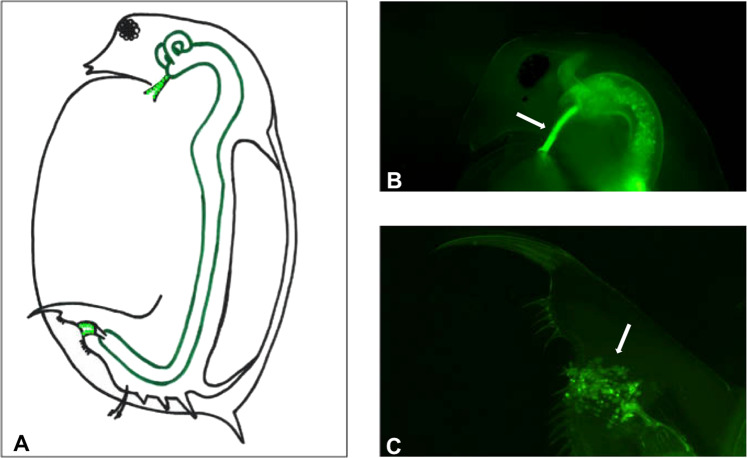
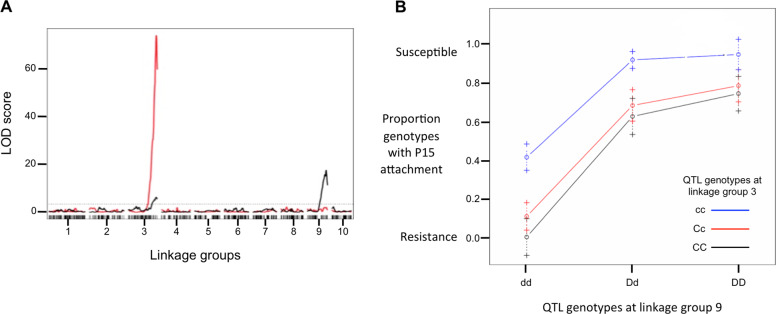
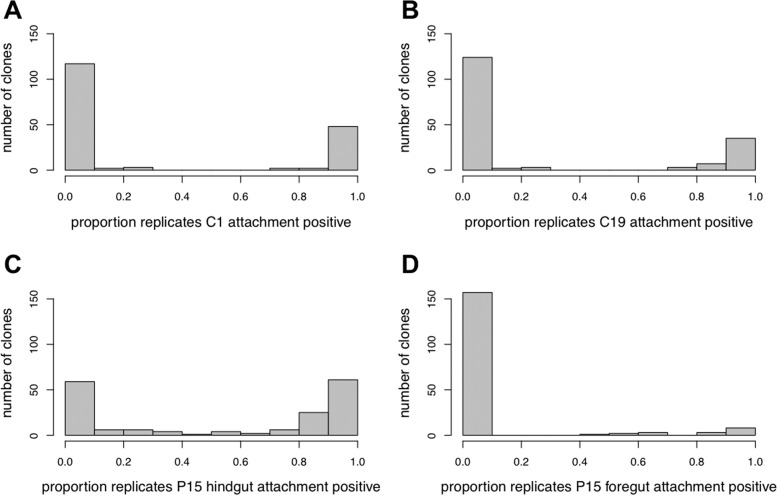
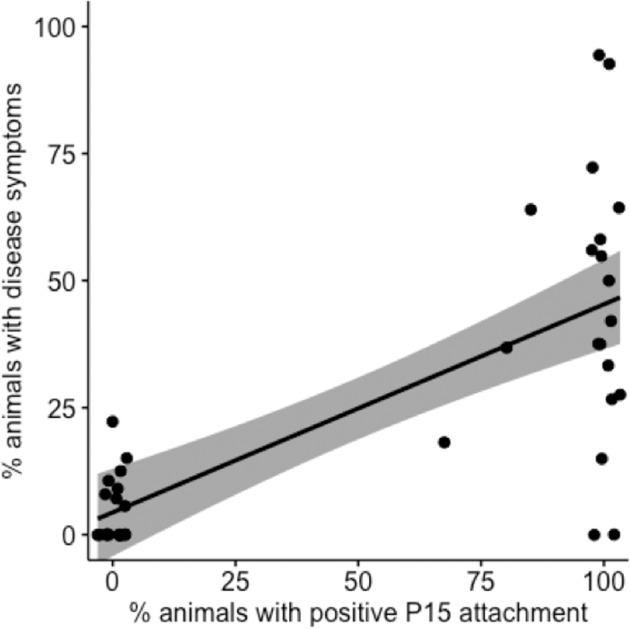
To understand the mechanisms of antagonistic coevolution, it is crucial to identify the genetics of parasite resistance. In the Daphnia magna-Pasteuria ramosa host-parasite system, the most important step of the infection process is the one in which P. ramosa spores attach to the host's foregut. A matching-allele model (MAM) describes the host-parasite genetic interactions underlying attachment success. Here we describe a new P. ramosa genotype, P15, which, unlike previously studied genotypes, attaches to the host's hindgut, not to its foregut. Host resistance to P15 attachment shows great diversity across natural populations. In contrast to P. ramosa genotypes that use foregut attachment, P15 shows some quantitative variation in attachment success and does not always lead to successful infections, suggesting that hindgut attachment represents a less-efficient infection mechanism than foregut attachment. Using a Quantitative Trait Locus (QTL) approach, we detect two significant QTLs in the host genome: one that co-localizes with the previously described D. magna PR locus of resistance to foregut attachment, and a second, major QTL located in an unlinked genomic region. We find no evidence of epistasis. Fine mapping reveals a genomic region, the D locus, of ~13 kb. The discovery of a second P. ramosa attachment site and of a novel host-resistance locus increases the complexity of this system, with implications for both for the coevolutionary dynamics (e.g., Red Queen and the role of recombination), and for the evolution and epidemiology of the infection process.
为了理解拮抗共进化的机制,识别寄生虫抗性的遗传学基础至关重要。在大型溞-粘孢子虫宿主-寄生虫系统中,感染过程中最重要的步骤是粘孢子虫孢子附着在宿主的前肠上。匹配等位基因模型(MAM)描述了附着成功背后的宿主-寄生虫遗传相互作用。在这里,我们描述了一种新的粘孢子虫基因型 P15,与以前研究的基因型不同,它附着在宿主的后肠上,而不是前肠上。宿主对 P15 附着的抗性在自然种群中表现出很大的多样性。与使用前肠附着的粘孢子虫基因型不同,P15 的附着成功率存在一定的数量变化,并不总是导致成功感染,这表明后肠附着代表一种效率低于前肠附着的感染机制。使用数量性状位点(QTL)方法,我们在宿主基因组中检测到两个显著的 QTL:一个与先前描述的大型溞对前肠附着抗性的 PR 基因座共定位,另一个位于不相关的基因组区域的主要 QTL。我们没有发现上位性的证据。精细定位揭示了一个约 13kb 的基因组区域,即 D 基因座。第二个粘孢子虫附着位点和新的宿主抗性基因座的发现增加了这个系统的复杂性,对共进化动态(例如,红皇后和重组的作用)以及感染过程的进化和流行病学都有影响。