National Institute of Plant Genome Research, Aruna Asaf Ali Marg, New Delhi, 110067, India.
Department of Plant Sciences, School of Life Sciences, University of Hyderabad, Hyderabad, Telangana, 500046, India.
Plant Cell Rep. 2020 Sep;39(9):1109-1114. doi: 10.1007/s00299-020-02560-w. Epub 2020 Jun 19.
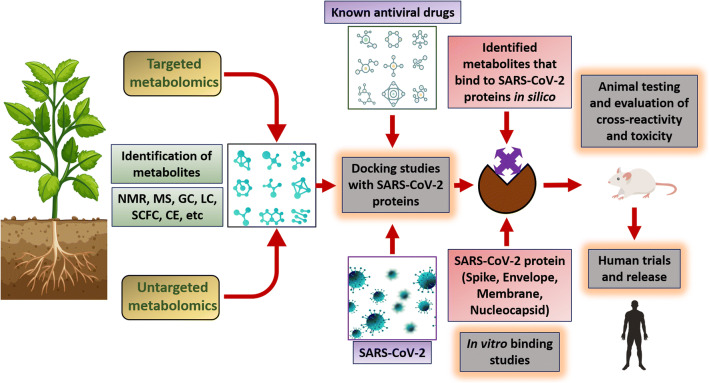
The exponential spread of Severe acute respiratory syndrome coronavirus 2 (SARS-CoV-2) emphasizes the immediate need for effective antiviral drugs and vaccines that could control and prevent the spread of this pandemic. Several new and repurposed drugs are being tested for their effectiveness in the treatment regime, and the development of vaccines is underway. The availability of genome sequence information of the virus and the identification of potential targets to neutralize and eradicate the infection have enabled the search for novel as well as existing molecules to perform the desired function. However, the application of plants in the development of potential biomolecules, such as antibiotics and vaccines, is limited. Traditional medicines involving plant-based formulations have proven successful in boosting immunity and providing tolerance to virus infections. Still, in-depth studies are not available to explore the bioactive compounds of plant origin and their mechanism of action. Given this, the current opinion article conveys our thoughts and perspectives on the promising usage of plant-based biomolecules in circumventing SARS-CoV-2, and how these molecules can work synergistically with other potential drugs for treating SARS-CoV-2.
严重急性呼吸综合征冠状病毒 2 (SARS-CoV-2) 的指数级传播强调了立即需要有效的抗病毒药物和疫苗,以控制和预防这一大流行病的传播。正在测试几种新的和重新利用的药物在治疗方案中的有效性,并且正在开发疫苗。病毒基因组序列信息的可用性以及中和和消除感染的潜在靶标的识别,使得能够寻找新的和现有的分子来执行所需的功能。然而,植物在开发潜在生物分子(如抗生素和疫苗)方面的应用受到限制。涉及植物配方的传统药物已被证明在增强免疫力和对病毒感染的耐受性方面是成功的。尽管如此,仍缺乏深入的研究来探索植物来源的生物活性化合物及其作用机制。有鉴于此,本文传达了我们对植物来源的生物分子在规避 SARS-CoV-2 方面的有希望的用途的看法和观点,以及这些分子如何与其他治疗 SARS-CoV-2 的潜在药物协同作用。