Health Services, Policy, and Practice, Brown University School of Public Health, Providence, RI, USA.
Health Systems and Policy, Swiss Tropical and Public Health Institute, Basel, Switzerland.
J Int AIDS Soc. 2020 Jun;23 Suppl 1(Suppl 1):e25496. doi: 10.1002/jia2.25496.
Like many countries in sub-Saharan Africa, Kenya is experiencing a rapid rise in the burden of non-communicable diseases (NCDs): NCDs now contribute to over 50% of inpatient admissions and 40% of hospital deaths in the country. The Academic Model Providing Access to Healthcare (AMPATH) Chronic Disease Management (CDM) programme builds on lessons and capacity of HIV care to deliver chronic NCD care layered into both HIV and primary care platforms to over 24,000 patients across 69 health facilities in western Kenya. We conducted a cost and budget impact analysis of scaling up the AMPATH CDM programme in western Kenya using the International Society for Pharmacoeconomics and Outcomes Research guidelines.
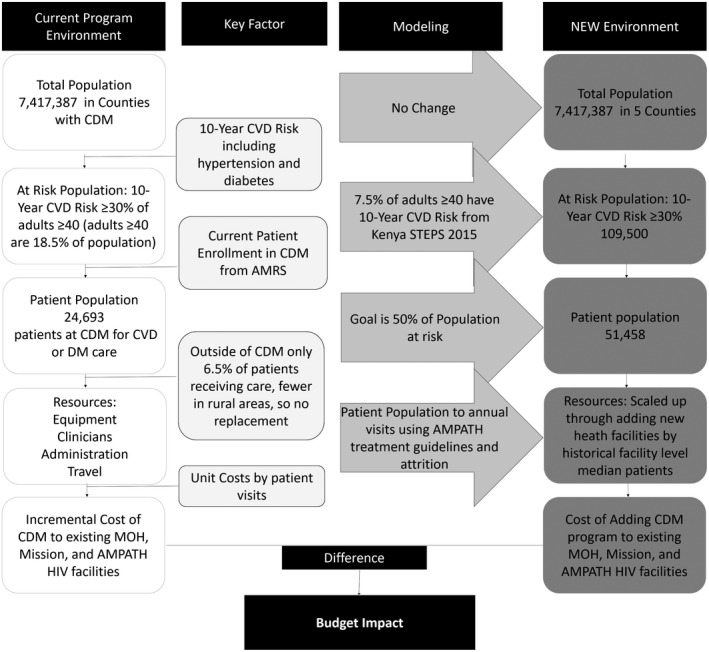
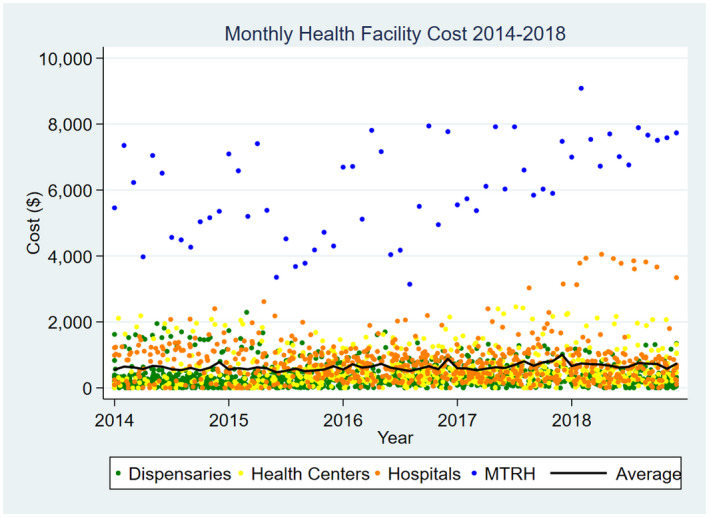
Costs of the CDM programme for the health system were measured retrospectively for 69 AMPATH clinics from 2014 to 2018 using programmatic records and clinic schedules to assign per clinic monthly costs. We quantified the additional costs to provide NCD care above those associated with existing HIV or acute care services, including clinician, staff, training, travel and equipment costs, but do not include drugs or consumables as they would be paid by the patient. We projected the budget impact of increasing CDM coverage to 50% of the eligible population from 2021 to 2025, and compared it with the county budgets from 2019.
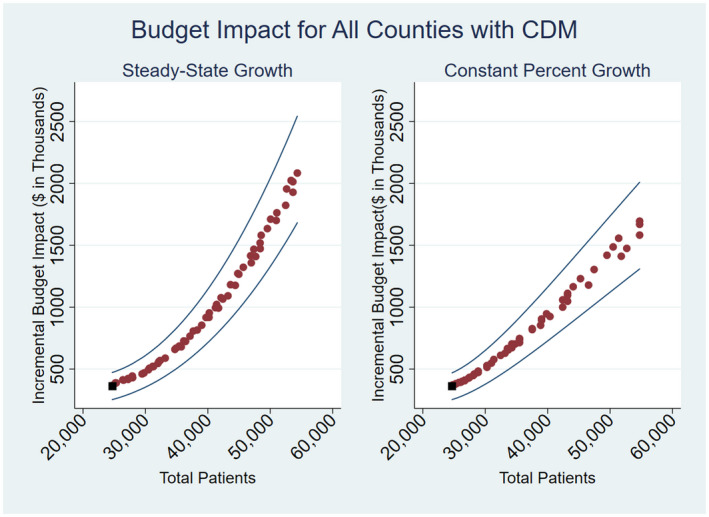
The per visit cost of providing CDM care was $10.42 (SD $2.26), with costs at facilities added to HIV clinics $1.00 (95% CI: -$2:11 to $0.11) lower than at primary care facilities. The budget impact of adding 26,765 patients from 2021 to 2025 to the CDM programme was 3,088,928 under constant percent growth, and 3,451,732 under steady-state enrolment. Scaling up under the constant percent growth scenario resulted in 12% cost savings in the budget impact. The county programmatic CDM cost in 2025 was <1% of the county healthcare budgets from 2019.
The budget impact of scaling up AMPATH's CDM programme will be driven by annual growth scenarios, and facility/provider mix. By leveraging task shifting, referral systems and partnering with public and non-profit clinics without NCD services, AMPATH's CDM programme can provide critical NCD care to new, rural populations with minimal financial impact.
与撒哈拉以南非洲的许多国家一样,肯尼亚正面临着非传染性疾病(NCDs)负担迅速增加的挑战:NCDs 现在导致该国超过 50%的住院病人和 40%的医院死亡。学术模型提供医疗保健(AMPATH)慢性病管理(CDM)计划借鉴了艾滋病毒护理的经验和能力,将慢性 NCD 护理分层到艾滋病毒和初级保健平台中,为肯尼亚西部的 69 个卫生机构的 24000 多名患者提供服务。我们根据国际药物经济学和结果研究协会的指南,对肯尼亚西部 AMPATH CDM 计划的成本和预算影响进行了分析。
使用方案记录和诊所时间表,从 2014 年至 2018 年,对 69 个 AMPATH 诊所的 CDM 计划的卫生系统成本进行了回顾性测量,以分配每个诊所的每月成本。我们量化了提供 NCD 护理的额外成本,这些成本高于与现有艾滋病毒或急性护理服务相关的成本,包括临床医生、工作人员、培训、差旅和设备成本,但不包括药品或耗材,因为这些费用将由患者支付。我们预测了从 2021 年到 2025 年,将 CDM 覆盖范围扩大到符合条件人群的 50%的预算影响,并将其与 2019 年的县预算进行了比较。
提供 CDM 护理的每次就诊费用为 10.42 美元(SD 2.26),在 HIV 诊所增加的设施费用比在初级保健设施增加的费用低 1.00 美元(95%CI:-2 美元至 0.11 美元)。从 2021 年到 2025 年,将 26765 名患者纳入 CDM 计划,在恒定百分比增长的情况下,预算影响为 3088928 美元,在稳定状态下为 3451732 美元。在恒定百分比增长情景下扩大规模将使预算影响降低 12%的成本。2025 年县方案性 CDM 成本占 2019 年县医疗保健预算的<1%。
扩大 AMPATH CDM 计划的预算影响将取决于年度增长情景和设施/提供者的组合。通过利用任务转移、转诊系统以及与没有 NCD 服务的公共和非营利诊所合作,AMPATH 的 CDM 计划可以为新的农村人群提供重要的 NCD 护理,而对财务影响最小。