Robert Michael A, Stewart-Ibarra Anna M, Estallo Elizabet L
Department of Mathematics, Physics, and Statistics, University of the Sciences, Philadelphia, PA, 19104, United States.
Inter-American Institute for Global Change Research (IAI), Montevideo, Department of Montevideo, Uruguay.
Curr Opin Virol. 2020 Feb;40:41-47. doi: 10.1016/j.coviro.2020.05.001. Epub 2020 Jun 20.
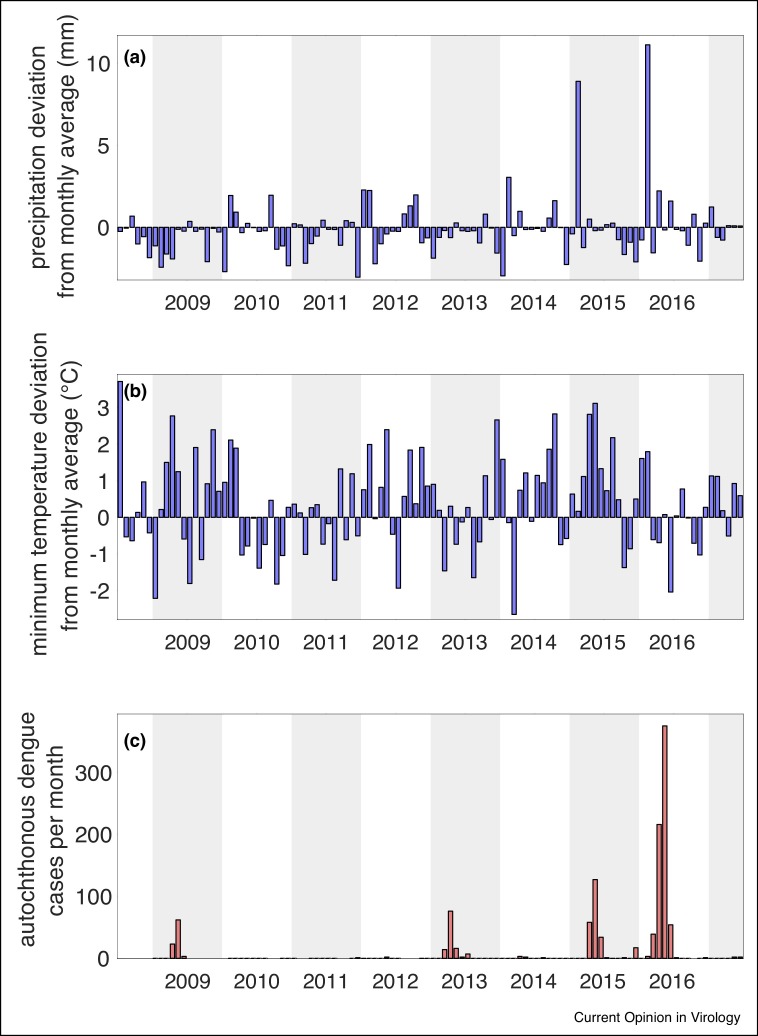
Climate change is leading to increases in global temperatures and erratic precipitation patterns, both of which are contributing to the expansion of mosquito-borne arboviruses and the populations of the mosquitos that vector them. Herein, we review recent evidence of emergence and expansion of arboviruses transmitted by Aedes mosquitos that has been driven in part by environmental changes. We present as a case study of recent work from Córdoba, Argentina, where dengue has been actively emerging in the past decade. We review recent empirical and modeling studies that aim to understand the impact of climate on future expansion of arboviruses, and we highlight gaps in empirical studies linking climate to arbovirus transmission at regional levels.
气候变化正导致全球气温上升和降水模式不稳定,这两者都促使蚊媒虫媒病毒的传播范围扩大以及传播这些病毒的蚊子种群增加。在此,我们回顾了近期部分由环境变化驱动的、伊蚊传播的虫媒病毒出现和扩散的证据。我们以阿根廷科尔多瓦近期的工作为例进行研究,在过去十年里,登革热疫情在当地频繁出现。我们回顾了近期旨在了解气候对虫媒病毒未来传播影响的实证研究和模型研究,并强调了在区域层面将气候与虫媒病毒传播联系起来的实证研究中的差距。